
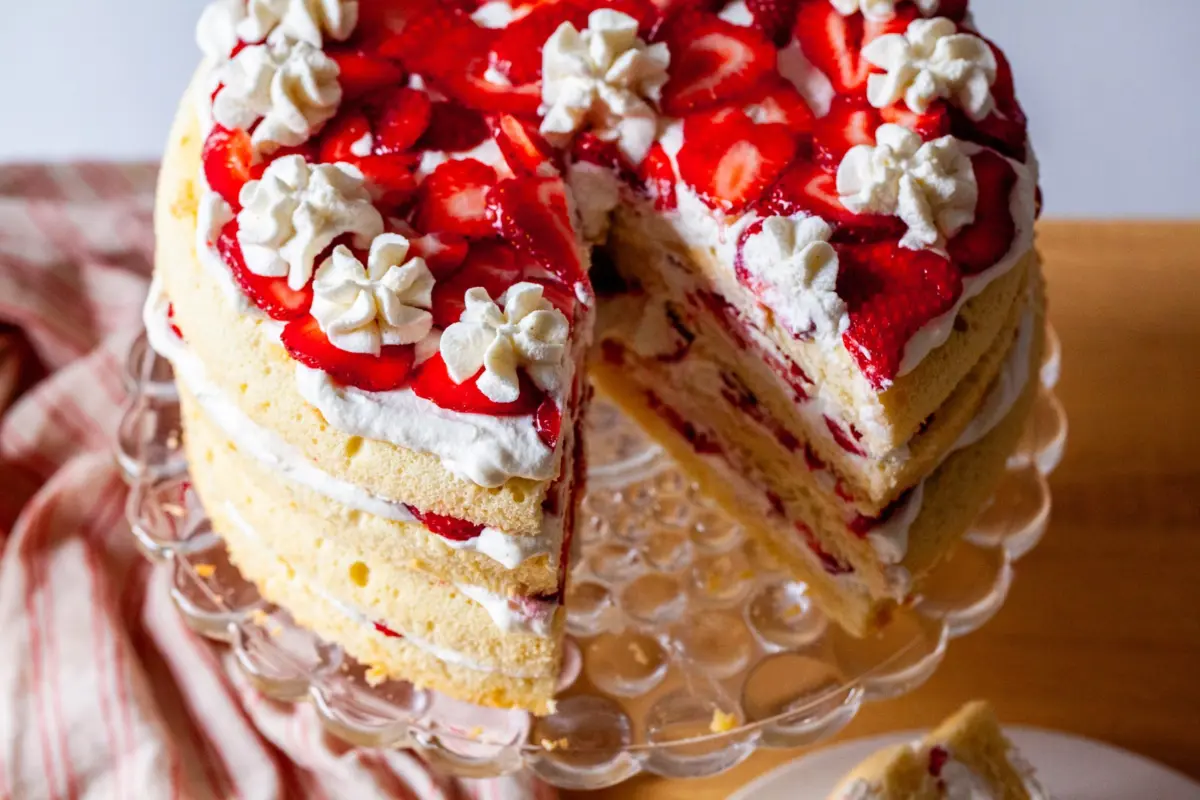
Nearly two decades after first introducing a towering, featherweight strawberry chiffon shortcake to the food-writing world, celebrated recipe developer and culinary author Deb has returned to the classic dessert. Originally baked in 2007 for a friend’s rooftop birthday barbecue during the infancy of her website, the original recipe has undergone a comprehensive, real-life modernization. The result is a streamlined, resilient, and crowd-pleasing iteration of the summer staple that promises all the ethereal qualities of a traditional chiffon cake without the excessive kitchen friction that often deters home bakers.
Back in 2007, the chiffon cake presented a paradox for home kitchens. While undeniably impressive in its structural height and featherlight crumb, the baking process was famously fussy. Preparing a traditional chiffon cake involved meticulous sifting, specialized ingredients such as cake flour instead of all-purpose flour and superfine sugar instead of regular granulated, an awkward ratio of egg yolks to egg whites, cream of tartar, and a minimum of three separate mixing bowls just for the cake layers. Furthermore, bakers had to contend with the notoriously temperamental nature of chiffon cakes, which possess an inherent tendency to dip in the center as they cool.

Despite these hurdles, the original dessert was an instant hit at that rooftop gathering, proving that guests are rarely unhappy to encounter layers of whipped cream and fresh strawberries sandwiched between delicate cake tiers, regardless of how inexpertly assembled. Over the years, however, the recipe sat in a metaphorical queue awaiting a refresh. The goal for the updated version was clear: eliminate as much of the structural rigidity and unnecessary fuss as possible to create a chiffon cake suited for modern, real-life baking, while retaining the magical texture that defines the style.
Along the way, the culinary perspective shifted profoundly. Embracing what can only be described as a "Chiffon Cake Era," the appeal of the cake finally clicked on a deeper level. Beyond being light as air and glorious as a seasonal summer dessert, the modern iteration boasts remarkable keeping qualities, maintaining a texture on day six that is just as fresh and appealing as the day it was baked.

The true test of the perfected recipe came during a recent birthday celebration. The author blew out the candles on a supersized, four-layer version of the cake before stepping away momentarily to walk an elderly family member out to her car. Upon returning just minutes later, she discovered that the large cake had been nearly decimated, with only a single solitary piece remaining on the tables and surrounding plates left entirely untouched. Panic briefly set in with questions about whether guests were still cutting slices or if anyone had saved a piece.
As it turned out, the cake had been devoured frantically straight from the serving platters the absolute moment they were set down, completely bypassing the traditional notions of patience and plates. Attendees were effusive in their praise, describing the dessert as a weightless, melt-in-your-mouth experience that warranted doubling the volume for future gatherings simply because guests were heartbroken at missing out on thirds.

Perfecting the Process
The updated recipe introduces several crucial modernizations designed to simplify execution while maximizing structural integrity and flavor. The baking process begins by heating the oven to 325 degrees Fahrenheit (165 degrees Celsius) and preparing two nine-inch round cake pans. Rather than coating the entire interior, bakers are instructed to lightly grease only the bottom of the pans and line them with a fitted circle of parchment paper, using the oil merely to hold the paper in place. The sides of the pans must remain ungreased to allow the batter to grip the metal as it rises. Additionally, two cooling racks are lightly coated with nonstick spray in preparation for the cooling phase.
The batter construction relies on a dual-bowl method designed to incorporate maximum air without unnecessary complications. In the first large bowl, egg yolks are whisked together with lemon zest and one cup of granulated sugar. Although the mixture appears remarkably stiff and dry initially, sustained whisking for about one minute transforms the batter, loosening it into a pale yellow, thick consistency reminiscent of frosting. Vegetable oil, water, and vanilla extract are then whisked in, followed by the dry ingredients added in stages—half the flour, salt, and baking powder, followed by the remaining flour—yielding a very thick base.

In a separate large bowl, an electric mixer is employed to beat egg whites until they form thick peaks. The remaining quarter-cup of sugar is added gradually during the whipping process, followed by a splash of lemon juice to stabilize the whites until they hold firm yet slightly drooping peaks.
Incorporating the whipped whites requires a delicate touch. A quarter of the egg whites is whisked directly into the heavy yolk mixture to loosen the dense batter, after which the remaining whites are gently folded in across two additions to prevent deflation. The batter is then divided evenly between the prepared pans and baked for 20 to 25 minutes, or until a toothpick inserted into the center emerges clean.

Cooling and Assembly
To combat the traditional chiffon cake defect of center-dipping and shrinkage, the updated recipe employs two clever physical interventions immediately upon removal from the oven. As soon as each layer is extracted from the heat, the pan is dropped a few inches onto the kitchen counter—a technique that dramatically reduces post-bake shrinkage. The pans are then inverted immediately, resting upside down on the pre-greased cooling racks until the cakes are completely cool.
While the layers cool, the cream component is prepared using an electric mixer to whip heavy cream, powdered sugar, and vanilla until soft peaks form. Sour cream or crème fraîche is then incorporated, beating until the mixture thickens sufficiently to hold its shape while remaining luxuriously creamy rather than grainy.

Once the cake layers are completely cool, the pans are carefully flipped back over. Although the tops of the cakes will have adhered slightly to the greased racks, the sticking is minimized compared to an ungreased surface. A knife is run around the perimeter of each layer to release it from the pan sides, after which the layers are turned out onto a rack. Using a long, serrated knife, each of the two baked layers is carefully split horizontally, yielding four thin layers in total.
The assembly process is straightforward and visual. The first cake layer is placed onto a serving platter or cake stand, topped with a slightly heaped cup of the prepared whipped cream, and arranged with approximately one-quarter of the sliced fresh strawberries. This layering process is repeated three more times. A small reserve of whipped cream can be transferred to a piping bag fitted with a star tip to add decorative flourishes to the top of the cake.

When it comes to serving, the cake is best portioned into wedges. Because of its ethereal composition, the dessert tends to be wobbly and resists remaining entirely upright, a charming quirk that is widely regarded as part of the appeal.
Make-Ahead Convenience
One of the most significant upgrades in this perfected recipe is its exceptional make-ahead capability. The baked cake layers can be prepared five to six days in advance of an event, wrapped securely, and stored successfully at room temperature without suffering from staleness. For longer storage timelines, the freezer remains a viable option. For the fully assembled dessert, the structure holds in the refrigerator for five to six days theoretically, though past experience suggests it is exceedingly rare for a strawberry chiffon shortcake of this caliber to last that long.