
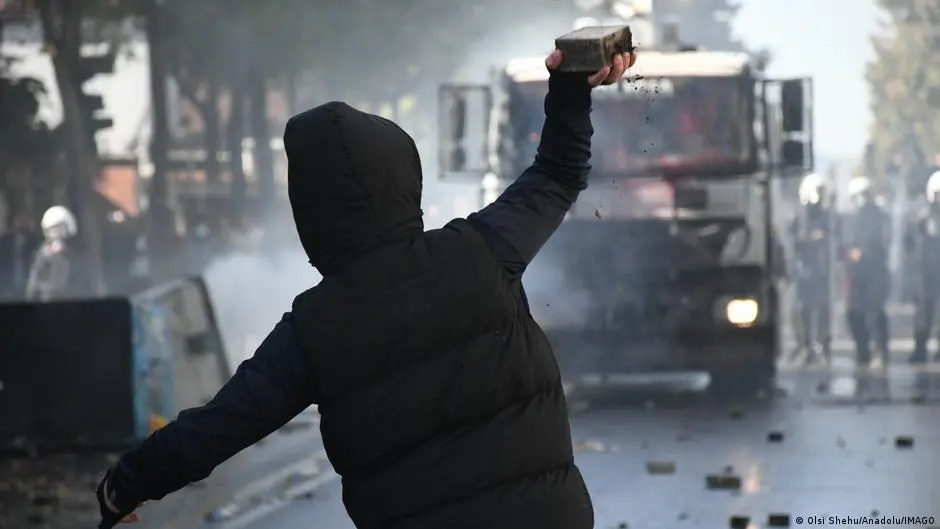
The physical marks of the October 13 unrest remained unmistakably fresh when students and academic faculty from the University of Tirana gathered once again outside the Ministry of Education in the heart of Albania’s capital. Smashed glass windows on the government building had yet to be replaced, and the exterior walls remained streaked with dark soot from fires ignited during the earlier confrontation. Despite the visible wreckage, demonstrators returned to the plaza on Tuesday to reaffirm their grievances and make clear that their campaign of civil resistance was far from over.
What began nearly five months ago as a series of peaceful demonstrations has transformed into one of the most volatile political crises Albania has experienced in recent memory. The public anger was originally ignited when government plans surfaced revealing that Jared Kushner, the son-in-law of former US President Donald Trump, alongside various business associates, intended to construct a luxury hotel and resort complex within an ecologically protected nature reserve. For many citizens, the development proposal was viewed as a blatant symbol of state-sanctioned exploitation of national resources.
Over the succeeding weeks, the initial environmental opposition widened into a sweeping anti-government and anti-corruption movement. College and high school students across Tirana and beyond have increasingly joined the front lines, leading to near-daily clashes with security forces. The confrontations reached their peak intensity during violent exchanges the previous week, marking a decisive shift from orderly marches to intense street confrontations.
Protesters are directing their anger at systemic issues within the country, including widespread official corruption, the chronic mismanagement of public universities, and the steeply escalating cost of education. Overarching these specific grievances is an uncompromising political demand: the immediate resignation of Prime Minister Edi Rama, the Socialist Party leader who has held power continuously since 2013.
The tensions on the ground were evident outside the Education Ministry on Tuesday. Among those standing in the crowd was a young woman dressed in a black hooded jacket, her face masked beneath a tightly wrapped scarf to guard her identity against government surveillance and potential retribution. Introducing herself only as Sara because of her fear of official retaliation for speaking to international journalists, she described the underground nature of the student movement.
According to Sara, the demonstrations rely entirely on decentralized, private communications to coordinate their actions. "We communicate via text messages — that’s the only way," she explained, highlighting how activists avoid conventional platforms that could be easily intercepted or monitored by the authorities.
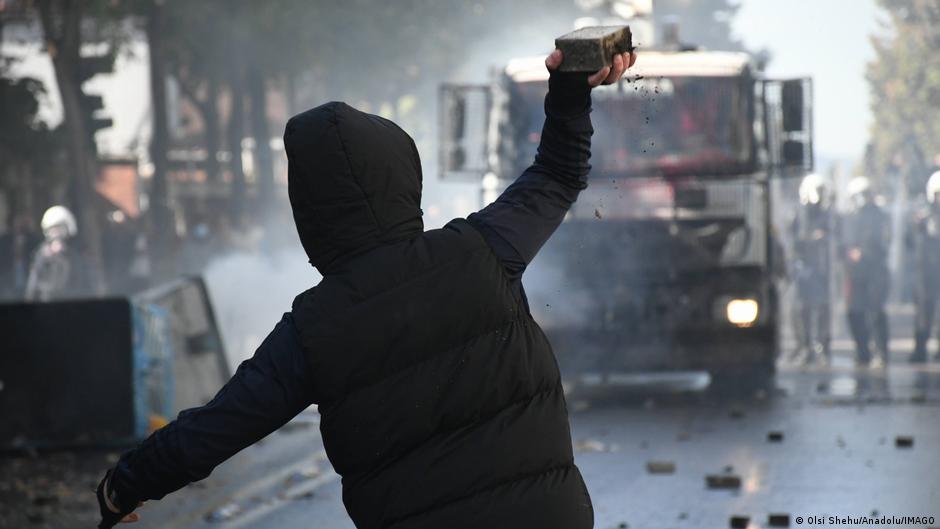
Her interview was abruptly halted as a faction of protesters began hurling stones and debris at the scorched facade of the Education Ministry. Anti-riot units responded immediately, deploying heavy water cannons to push back the crowds and forcing both demonstrators and observing reporters to scramble for cover.
The tactical evolution of the demonstrations reflects a generational shift in how political resistance is conducted in Albania. Besmir Semanaj, a prominent Albanian cybersecurity advocate, observed that modern communications technology has entirely superseded traditional political spaces in the country.
"Social media is the most important public space today — more so than physical spaces," Semanaj said. He noted that the youth driving the current unrest have abandoned the conventional organizational mechanisms favored by older generations. "Young Albanians no longer organize through traditional structures such as political parties, associations or public appeals. Instead, they organize themselves where they spend much of their daily lives: on their cellphones."
According to Semanaj, the mobilization relies on a multi-layered ecosystem of digital tools tailored to specific functions within the student body. "The most important communication channels include Instagram, WhatsApp groups for academic-year cohorts, departments and dormitories, Telegram channels for general announcements, and TikTok for sharing videos," he said. For activists with heightened security concerns who face the risk of state surveillance, the encrypted messaging application Signal has become the preferred standard.
This architectural shift in communications has fundamentally altered the dynamics of the protests, shielding them from traditional counter-measures. "This is a horizontal organizational structure, without individual ‘leaders’ and without a central command structure," Semanaj observed. "That is exactly why the government is having such a hard time understanding and controlling the situation."
Among these platforms, Semanaj highlighted Telegram as an especially effective operational instrument for orchestrating demonstrations across Tirana. "Telegram channels allow you to reach tens of thousands of people at once," he explained. "Notifications are sent out within seconds, and external control is more difficult to establish than on traditional platforms."
Rama: ‘Hybrid war’
Confronted with the escalating youth uprising, Prime Minister Edi Rama has refused to concede ground, instead adopting an aggressive, combative tone toward the demonstrators. Rama has openly characterized the student-led movement as a form of "hybrid war" directed against the state, portraying the young demonstrators as intellectually hollow and driven by destructive impulses.
In public statements addressing the unrest, the prime minister dismissively claimed that the demonstrators operated under the illusion that they could "make Albania a better country through TikTok and without even being able to string together more than seven coherent words." While Rama stopped short of branding every young person on the streets as an outright terrorist, he maintained that the participants had fallen prey to dangerous influences. He asserted that they were "hostages to a certain mindset, a new ideology that has only one goal: to destroy, to turn everything upside down, to raze everything to the ground."
Rama’s narrative surrounding the protests has repeatedly shifted throughout the five months of sustained demonstrations. At various points, the prime minister has blamed external forces for engineering the public dissent, pointing to alleged machinations by foreign governments. He has publicly suggested that the authorities of Greece, Russia, and Iran were actively working behind the scenes to stir up domestic instability and direct anti-government sentiments in Albania.
Most recently, Rama advanced a new allegation, asserting that the decentralized global anti-fascist movement commonly known as "Antifa" was the actual force coordinating the unrest. Seeking to link domestic protesters to extremist movements abroad, Rama claimed that the youths had been radicalized through international networks.

"These are young people who have been radicalized and ideologically indoctrinated and who are acting under the pressure or influence of a new, dark force that has emerged in Europe and the United States, a force that the President of the United States has designated as a terrorist organization: Antifa," Rama asserted in an attempt to delegitimize the student campaign.
Security and conflict researchers have dismissed the prime minister’s claims of an organized foreign conspiracy. Redion Qirjazi, a researcher specializing in security affairs, violence prevention, and conflict resolution, argued that the government’s rhetoric lacked any factual foundation.
"That is a serious accusation — one that requires equally compelling evidence," Qirjazi said. "To date, no verifiable evidence has been presented to prove the existence of an organized Antifa structure in Albania, let alone its involvement in coordinating the protests."
Qirjazi also criticized Rama’s invocation of rhetoric from the United States regarding Antifa, emphasizing that the prime minister was misrepresenting the fundamental nature of the movement. "Antifa is not a unified international organization with a centralized structure or leadership," Qirjazi explained, "but rather an umbrella term for various movements and groups united by the fact that they are, at their core, anti-fascist."
On the streets, students have expressed sharp resentment over the prime minister’s attempt to brand them as ideological extremists and foreign assets. Sara explicitly rejected the labels used by Rama to describe the student body, insisting that the majority of demonstrators are driven by genuine domestic grievances rather than a desire for chaos.
"There are groups that are willing to use violence — that’s true — but I have nothing to do with them," she said, clarifying the divide between spontaneous property destruction and the broad student base. "As soon as I see violence, I walk away; I’m against it."
Is Rama deflecting?
Political figures outside the ruling party argue that the government’s rhetoric is a calculated attempt to avoid confronting the material realities driving thousands of young people to protest. Arlind Qori, the chairman of the Together Movement, a social-democratic opposition party that holds a single seat in Albania’s parliament, dismissed the notion that the youth movement was fueled by foreign ideologies or fringe political agendas.
Instead, Qori framed the unrest as the inevitable outcome of economic stagnation and governmental neglect that have accumulated over Rama’s more than a decade in office. "Young Albanians are outraged by the current socioeconomic conditions: the poverty, the fact that many of their parents have emigrated because they couldn’t support their families, the decline of the education system, the lack of postgraduation prospects," Qori said.

He emphasized that the central objective of the demonstrators was clear and pragmatic, rather than revolutionary. The students’ overarching aim is securing the resignation of the prime minister, "not a socialist revolution," Qori said.
"People aren’t demanding anything radical," Qori added, arguing that the calls for political accountability are entirely standard democratic reactions to long-standing corruption. "They merely want a corrupt head of government to resign — that’s a fundamental and moderate demand. But Edi Rama continues to meet this demand with police violence and arrogance."
According to security researcher Qirjazi, Rama’s repeated accusations of external intervention and ideological extremism follow a well-established political playbook designed to neutralize domestic unrest. By framing domestic socio-economic dissatisfaction as a foreign national security threat, the government attempts to alter the public discourse.
"When a government faces protests and public discontent, linking demonstrators to extremism and foreign influence may serve to divert attention away from the actual causes and toward a national security narrative," Qirjazi explained. He noted that such messaging fulfills calculated domestic objectives: "This can serve several political purposes: to delegitimize the protesters, to weaken their support among the public, and to justify a tougher crackdown in the name of law and order."
Cybersecurity expert Semanaj agreed with this assessment, pointing out that depicting protests as foreign-backed hybrid warfare allows the state to bypass the substantive issues being raised by the youth.
"Protests are portrayed as acts of violence," Semanaj said. "Young people are cast as manipulated, and their legitimate concerns — conditions at universities, tuition fees, corruption and a lack of prospects — vanish from the news agenda."