
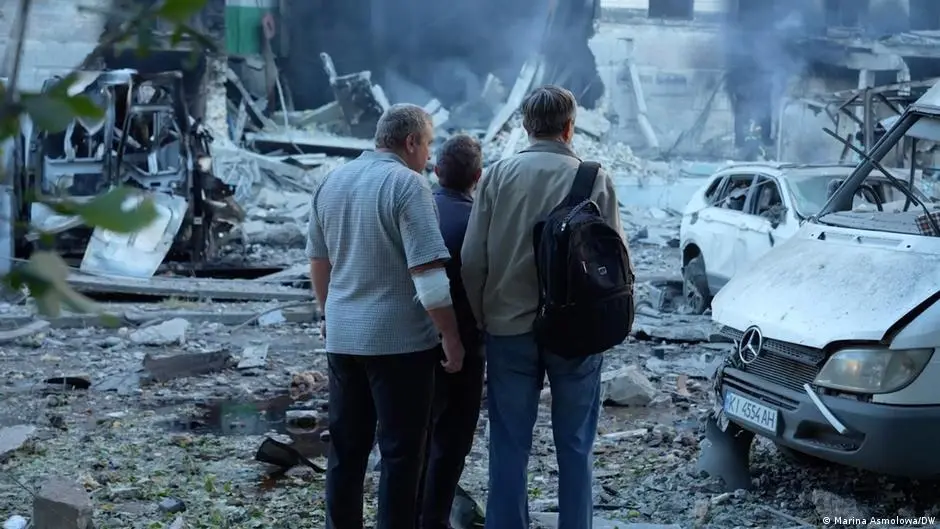
Until only a few months ago, daily life across Kyiv retained a relative, fragile semblance of peace when weighed against the brutal destruction unfolding near the war’s active front lines in eastern and southern Ukraine. In cities and towns near the contact zone, such as Sloviansk, relentless bombardment has long reduced normal civilian routine to a struggle for basic survival. Yet as the Russian military escalates and expands its aerial assault against the capital, that distinction has begun to fade. More than four and a half years into the full-scale conflict, Kyiv is increasingly experiencing the grim realities of a front-line city.
For the capital’s four million residents, the most immediate consequence of this intensified campaign is a desperate shortage of safe shelter. The city’s existing protective infrastructure was never designed to shield a metropolis of this scale from near-nightly barrages, forcing civilians to rely on the subterranean corridors of the municipal transit network. Every evening, deep beneath the pavement, Kyiv’s subway stations undergo a quiet, sorrowful transformation, shifting from bustling commuter arteries into vast, makeshift dormitories.
The transition generally begins around 10:00 p.m. Long before midnight, entire platforms and pedestrian tunnels are blanketed with roll-up foam mattresses, synthetic sleeping pads, folding cots, and compact camping tents pitched directly onto the cold granite floors. The scenes that play out beneath the vaulted ceilings reflect an exhausting search for safety: young children snuggle close to their parents, trying to sleep amidst the harsh artificial lighting, while family pets—dogs wrapped in coats and cats curled in travel crates—huddle against their owners or settle in among strangers stationed along the frigid tiled walls.
For many, the pilgrimage underground has become a preventative ritual rather than a reaction to an immediate alarm. "We’re alive," Halyna said, tightly embracing her 5-year-old son, Roman, amidst the station crowds. "We’ve been lucky once again."
Halyna makes the journey down into the subway system with Roman on most evenings, packing blankets and essentials even when the city’s wailing air-raid sirens have not yet sounded. Her cautious routine is driven by geography: her apartment is located in the Lukyanivka neighborhood, a historic, central district that has been targeted repeatedly and systematically by Russian strikes over the course of the war’s four years and eight months. In neighborhoods like hers, waiting for the sirens to confirm incoming fire often feels like a gamble no parent can afford to take.
‘These sick monsters don’t care who they kill’
The deadly reality of staying at home became painfully evident in September, when an aerial attack struck a residential apartment building in Kyiv’s central Pechersk district. Inside one of the upper apartments, 14-year-old Daniel Umanskyj had been sitting at his desk doing homework when an explosive Russian drone crashed directly into the building, killing him instantly.
In the immediate aftermath of the explosion, neighbors were left to confront the arbitrariness of survival. One resident, Vlad, had been standing out in the hallway alongside his young daughter at the precise moment the drone struck.
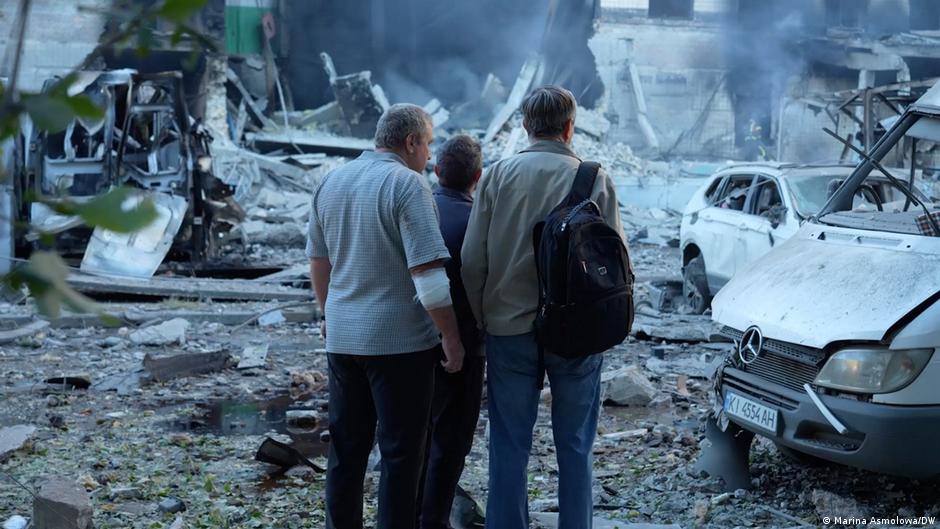
"We were late that day — and this saved our lives," Vlad recalled, shaking his head at the slender margin that separated life and death in their hallway. "Daniel’s death is a tragedy."
Staring at the blackened scars on the facade of the building, Vlad expressed the raw fury and despair shared by many who live under constant aerial threat: "These sick monsters don’t care who they kill."
In the weeks following the strike, a quiet memorial took root at the scene. Neighbors, classmates, and relatives brought soil and planted flowers directly in front of the charred residential complex, leaving bright petals beneath the shattered concrete in memory of the 14-year-old whose life ended at his study desk.
The strike in Pechersk was not an isolated incident; Russian attacks have repeatedly struck places where children live, learn, and gather. In early October, another drone slammed into an educational building in southwestern Kyiv. On that occasion, mass casualties were averted solely because the strike occurred when pupils, faculty, and administrative staff were already sequestered safely underground.
"We’ve been teaching all the pupils in person because we have a large shelter that can accommodate more than 500 students," explained Valentyna Chorna, the principal of the struck school.
Because the school’s underground civil defense basement is large enough to house the entire student body and staff simultaneously, the administration has managed to maintain continuous, in-person instruction for children from the first through the ninth grades. When the alarms echo through the district, classes are evacuated subterraneanly without delay, enabling hundreds of young students to continue their education beneath thick concrete slabs while debris falls above.
Danger at home, at school — everywhere
Yet for most families across the capital, the daily pursuit of education has become a complicated logistical hazard. Whether classes proceed in person does not simply rest on administrative planning or parental desire; it is governed entirely by whether an individual school possesses certified shelter space and how long the air-raid warnings drag on.

When early-morning alarms echo across Kyiv while students are still in their bedrooms, morning commutes are abruptly aborted, and children are often forced to stay home for the remainder of the day.
"This is an enormous burden for parents," said a journalist working in the capital’s news bureau, whose daughter is enrolled in the local school system. "You have to go to work — and the child stays home alone."
Even the simple act of traveling between home and the classroom has turned into a calculated risk. "Even the walk to school is dangerous because an air-raid alarm can go off at any time," she said.
Her daughter’s school sits in relatively close proximity to the Antonov aircraft plant, an industrial site that has long made the surrounding neighborhood a potential target for incoming fire. The psychological strain on the children is unrelenting.
"One day she texted me: ‘You can’t imagine what a huge explosion that was!’" the mother recounted. "I don’t know if something was shot down or if there was a strike somewhere. Things like that really scare children."
Yet staying inside one’s residence offers no guarantee of protection. In September, a Russian drone struck the very residential building where the journalist and her daughter reside. By pure chance, the daughter happened to be away at school that morning, and their individual apartment escaped structural destruction.
Nevertheless, the near-miss served as an unsettling reminder that civilian survival has been reduced largely to luck. When the citywide alert blares across the district, no one can predict where the trajectory will lead or who will ultimately be spared.

Kyiv’s population persists
The human toll of this protracted bombardment shows that Russian strikes on the capital have grown noticeably deadlier over the course of 2026. Data recorded by the Kyiv military administration underscores the accelerating danger: during the first eight months of 2026 alone, 140 civilians were killed in the capital by Russian attacks.
By comparison, the death toll for the entirety of 2025 stood at 172. If the current trajectory of sustained, heavy bombardment continues through the remaining months, 2026 is projected to become the deadliest calendar year for Kyiv’s civilian population since Russia launched its full-scale invasion in February 2022.
The strikes have also begun to systematically erode the city’s domestic stability and supply chains. Targeted aerial strikes on regional storage facilities and logistics warehouses have recently triggered noticeable shortages on supermarket shelves—a level of retail disruption and supply strain that residents had not encountered since the chaotic initial months of the invasion.
At the same time, late September brought a return to emergency power outages across Kyiv’s grid following renewed attacks on the electrical network. One strike temporarily paralyzed the city’s vital metro system, stranding passengers and cutting off the primary conduit of municipal transit. With energy infrastructure suffering repeated damage ahead of the freezing season, local authorities and service providers face severe uncertainty regarding their ability to reliably supply heat, electricity, and running water to four million residents throughout the upcoming winter.
Despite the systematic effort to wear down civilian morale and make urban life unlivable, the resolve of the local population appears remarkably intact. According to polling conducted in September by the Kyiv International Institute of Sociology (KIIS) and released in early October, 72% of the capital’s residents stated that they are prepared to endure the hardships of the war for as long as necessary.
In response, municipal authorities continue striving to preserve a functioning civic rhythm within the battered metropolis. The city’s official night curfew was recently shortened, running from 1:00 a.m. to 5:00 a.m., granting residents and businesses more operational flexibility during the evening.
Under the revised municipal civil-defense framework, certain public facilities and commercial establishments are now permitted to remain open during "yellow" alerts, which signal moderate aerial risk. However, during "red" alerts—triggered by the detection of ballistic missiles, cruise missiles, or massive combined drone and missile swarms—all routine operations must instantly cease, and every resident is instructed to take cover immediately. In a city pushed steadily closer to the front line, that boundary between daily life and subterranean refuge remains the fragile line separating survival from tragedy.