
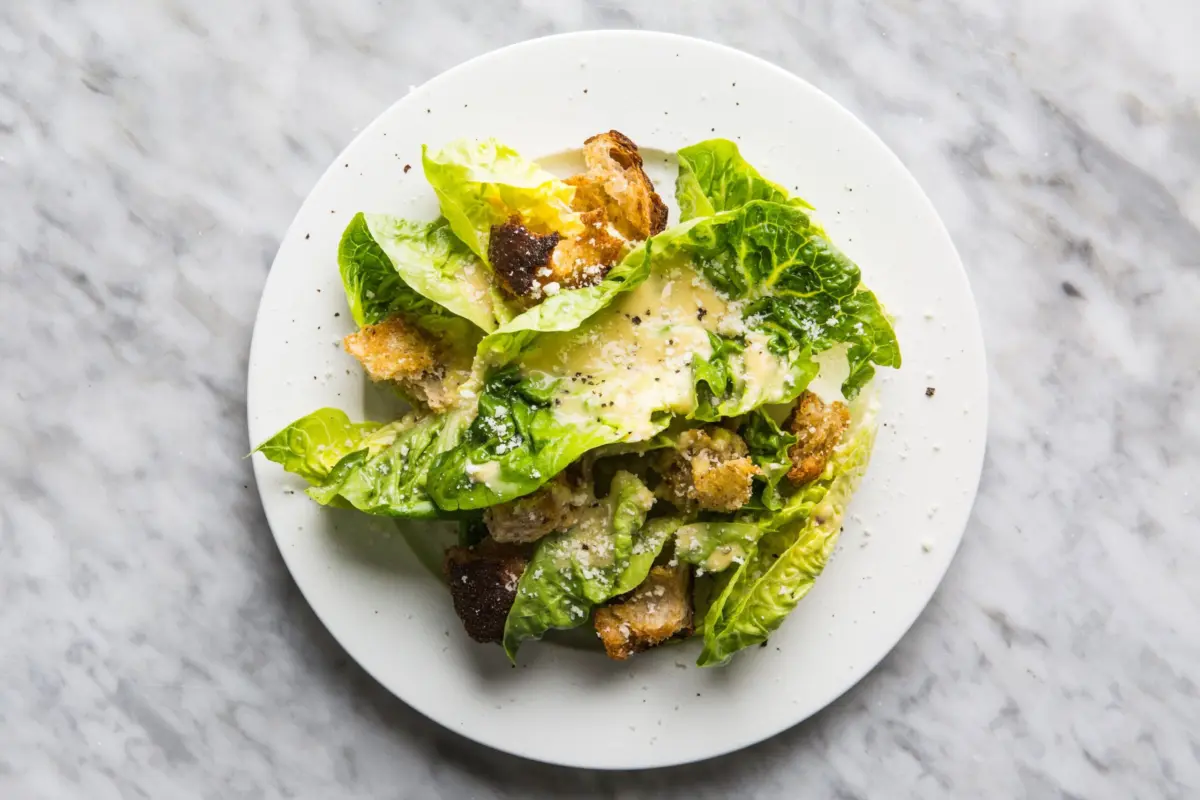
Homemade Caesar dressing should be creamy, punchy, and unapologetically savory. When prepared with care, this classic version achieves its signature profile through a deliberate balance of oil-packed anchovies, pungent garlic, sharp Parmesan cheese, tangy Dijon mustard, and a rich egg yolk, all brought together with just enough acidity to keep the flavor bright and lively rather than heavy.
While bottled versions line supermarket shelves with varying degrees of success, culinary professionals and home cooks alike continue to return to the scratch-made method for its unmatched vibrancy. The foundational ingredients are deceptively simple, but the magic lies entirely in the execution and the science of building the emulsion.
The key to a successful homemade Caesar dressing is building that emulsion slowly and with intention. Culinary technique dictates that the oil must be added drop by drop at first, accompanied by constant, vigorous whisking. Once the mixture turns thick and glossy, signaling that the emulsion has successfully formed, the cook can transition to drizzling in the remaining oil in a slow, steady stream. Finally, the dressing is thinned with a careful splash of water until it reaches the consistency of heavy cream—lush enough to thoroughly coat crisp romaine lettuce without weighing it down or turning the salad soggy.

Beyond the traditional bowl of crisp romaine tossed with crunchy croutons and shaved cheese, this versatile dressing possesses a culinary utility that extends far beyond the standard salad bowl. It can be spooned generously over deeply roasted vegetables to add a rich, savory punch, spread across artisan sandwiches as a flavorful, creamy alternative to mayonnaise, or served simply as a robust dip for crudités and appetizers.
Yet, achieving this standard at home often invites questions regarding technique, ingredient substitutions, and adjustments for various dietary preferences. Culinary experts address these common considerations to help home cooks master the craft.
Caesar Dressing FAQs
Can I make Caesar dressing without anchovies?
Anchovies provide Caesar dressing with its signature savory depth and foundational umami character, which is why culinary traditionalists recommend keeping them in the recipe if at all possible. For home cooks who find whole canned fillets unappealing, a practical alternative is found in tubes of concentrated anchovy paste, which can be whisked directly into the base with ease. Alternatively, Worcestershire sauce—using about two teaspoons—can provide a similar salty, deeply savory profile. However, cooks must note that traditional Worcestershire sauce contains fish derivatives; those requiring a strictly vegetarian or vegan option should specifically seek out plant-based Worcestershire alternatives.

Why is my Caesar dressing too salty?
Both anchovies and aged Parmesan cheese naturally contribute a significant amount of salt to the dressing, and their flavor intensity can vary widely depending on the brand and preparation. When seasoning the mixture, cooks are advised to start conservatively, tasting as they go, and to consistently use kosher salt rather than finer table salt, which dissolves and concentrates much more rapidly, leading to accidental over-salting.
Can I make Caesar dressing in a blender or food processor?
A traditional blender or food processor can certainly make the emulsification process faster and easier, but this shortcut comes with a specific limitation regarding volume. A standard batch of Caesar dressing is often too small in quantity to make direct contact with the blades of a full-sized countertop appliance, meaning cooks generally need to increase the batch size to get things moving effectively. Personal-sized blenders or immersion blenders can also be used with great success for smaller quantities. In either case, whether using motorized equipment or manual tools, the oil must still be added gradually, just as it would be when whisking by hand, to ensure the emulsion holds.
Can I make Caesar dressing without raw egg?
The traditional egg yolk supplies crucial richness and acts as the primary emulsifying agent that holds the oil and liquids together into a smooth, cohesive sauce. For individuals who prefer to avoid raw eggs due to dietary restrictions, food safety concerns, or personal preference, mayonnaise can serve as a seamless substitute, a shortcut utilized in streamlined variations like simplified Caesar salad preparations.