
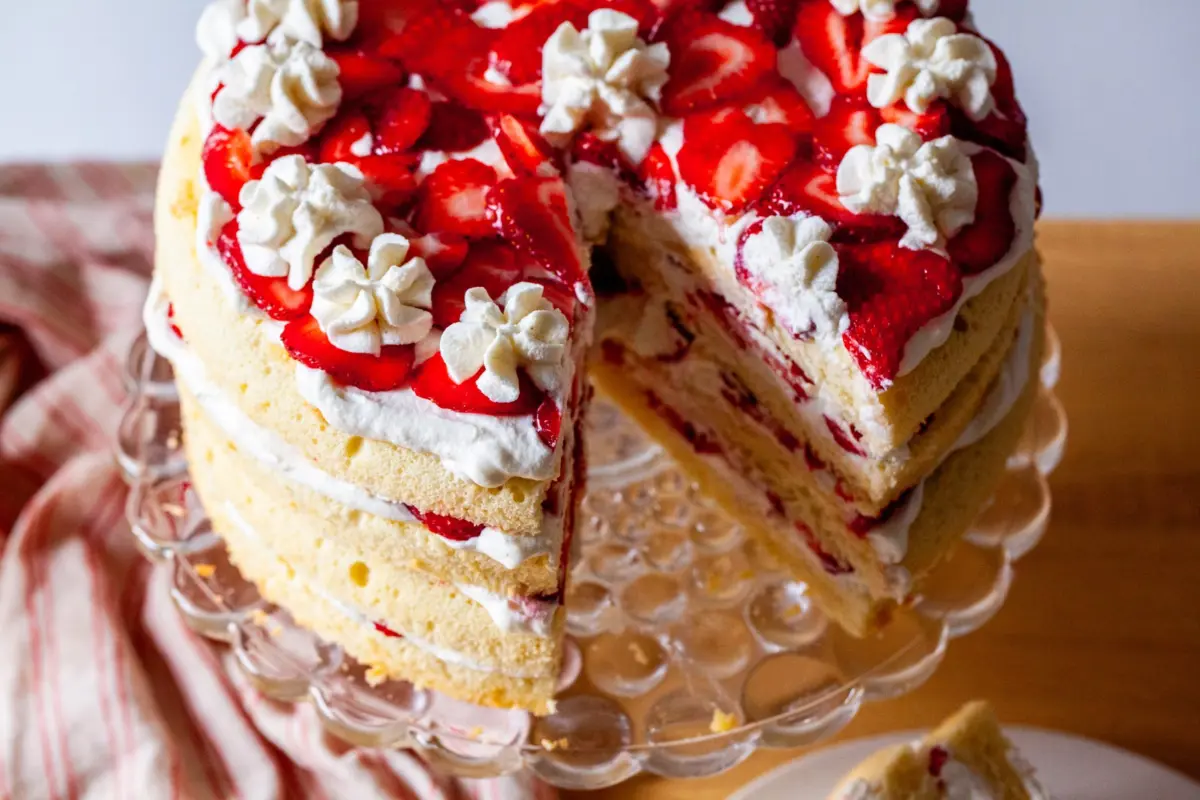
Nearly two decades after first introducing a towering, featherweight dessert to her early blogging audience, culinary writer and recipe developer Deb has returned to one of her most memorable creations. The original strawberry chiffon shortcake, first baked for a friend’s rooftop birthday barbecue in June 2007, has undergone a comprehensive modernization. The updated recipe aims to strip away the notorious rigidity and fussiness traditionally associated with chiffon cakes, transforming a classic baking challenge into an accessible, real-life dessert that has already won over crowds at recent birthday celebrations.
When the chiffon shortcake first debuted on the site nineteen years ago, the baking process demanded considerable patience and precision. Chiffon cakes have long held a reputation among bakers for being particularly demanding. Traditional methods require meticulous sifting, specialized ingredients such as cake flour instead of standard all-purpose flour, and superfine sugar in place of regular granulated options. Furthermore, bakers must contend with uneven ratios of egg yolks to egg whites, the addition of cream of tartar, and a minimum of three separate mixing bowls just to prepare the delicate cake layers. Compounding these hurdles is the characteristic tendency of chiffon cakes to dip and sink in the center as they cool, a common pitfall that has deterred many home cooks over the generations.

Despite these hurdles, the final product offered undeniable rewards. The combination of airy cake layers, freshly whipped cream, and ripe summer strawberries made for an unforgettable seasonal treat. However, as the recipe recently resurfaced in an editorial review queue, the author recognized an opportunity to revisit the formula. The goal was to eliminate unnecessary complications while preserving the ethereal, cloud-like texture that makes chiffon cakes uniquely suited for warm-weather gatherings.
Along the way, a newfound appreciation for the chiffon cake category blossomed. Far from being merely a fleeting summer novelty, the modern version boasts an impressive shelf life. The baked layers have proven to keep remarkably well, maintaining their structural integrity and fresh-baked taste even days after emerging from the oven. This durability offers a significant practical advantage for home bakers planning ahead for events or dinner parties.

The newly refined recipe recently took center stage at a weekend birthday celebration, where a supersized, four-layer iteration of the cake was served. The reception proved instantaneous and overwhelming. After stepping away briefly to walk a guest to her car, the baker returned to find that the massive cake had vanished from the serving tables, leaving behind only empty plates and a single isolated slice. Guests had bypassed the formalities of cutting individual portions, instead devouring the dessert directly from the serving platters the moment it was set out.
Attendees were quick to offer high praise, describing the dessert as weightless and melt-in-your-mouth. One friend jokingly demanded that double the amount be prepared for future gatherings, lamenting that she was unable to secure a coveted third serving. The overwhelming response confirmed that the modernized recipe had struck the right balance between elevated flavor and effortless enjoyment.

Strawberry Chiffon Shortcake, Perfected
The updated approach simplifies the preparation process while maintaining the signature lightness of the original dessert. For bakers looking to scale up the presentation, the recipe can be easily doubled to construct a tall, four-layer showstopper suitable for large parties.
The preparation begins by heating the oven to 325 degrees Fahrenheit. To prepare the pans, the bottoms of two nine-inch round cake pans are lightly coated with nonstick spray, followed by fitted circles of parchment paper. The oil serves solely to anchor the parchment; the sides of the pans are deliberately left ungreased to allow the delicate batter to climb during baking. Additionally, two cooling racks are lightly coated with nonstick spray in preparation for the cooling phase.

In the primary mixing bowl, egg yolks are whisked together with lemon zest and one cup of granulated sugar. Although the mixture initially appears stiff and dry, persistent whisking for approximately one minute transforms the batter into a pale, thick consistency resembling frosting. Cooking oil is then incorporated, followed by water and vanilla extract. The dry ingredients—consisting of half the flour, salt, and baking powder—are sprinkled over the mixture, followed by the remaining flour, and whisked until smooth. At this stage, the batter remains quite dense.
In a separate bowl, an electric mixer is used to whip egg whites until they begin to hold firm peaks. The remaining quarter-cup of sugar is gradually incorporated while continuing to beat the mixture. Whipping proceeds until the whites become very thick and form firm peaks that gently flop over at the tips when the beaters are lifted. A splash of lemon juice is then beaten in to complete the meringue.

To combine the components without sacrificing volume, a quarter of the whipped egg whites is whisked directly into the dense yolk mixture to loosen the batter. The remaining egg whites are then gently folded in across two separate additions, requiring a careful touch to prevent deflation. The batter is divided evenly between the prepared pans and baked for twenty to twenty-five minutes, or until a toothpick inserted into the center emerges clean.
To combat the traditional tendency of chiffon cakes to shrink and dip, a specific post-baking routine is employed. The moment the pans are removed from the oven, each layer is dropped a few inches onto the kitchen counter, a physical shock that helps stabilize the structure. The cakes are then inverted and cooled completely upside down in their pans, supported by the pre-greased cooling racks.

Assembly and Storage
Once the cake layers are thoroughly cooled, the pans are inverted back to their normal position. A knife is run carefully around the perimeter of each layer to separate it from the ungreased pan walls before turning the cakes out onto a rack. Using a long, serrated knife, each layer is carefully split horizontally to create four thin rounds.
The filling is prepared by whipping heavy cream, powdered sugar, and vanilla with an electric mixer until soft peaks form. Sour cream or crème fraîche is then incorporated, and the mixture is beaten further until it thickens enough to hold its shape while remaining creamy and smooth.

Assembly proceeds on a serving platter or cake stand. The first cake layer is topped with a slightly heaped cup of whipped cream and roughly one-quarter of the sliced strawberries. This process is repeated for the remaining layers. Any leftover whipped cream can be transferred to a piping bag fitted with a star tip to add decorative accents to the top of the finished dessert.
When it comes to serving, the cake is sliced into wedges. Its delicate, wobbly nature means it resists standing perfectly upright, a characteristic that only adds to its charm.

The dessert also offers remarkable flexibility in terms of scheduling. The baked cake layers can be prepared five to six days in advance and kept wrapped at room temperature without losing their freshness, while longer storage can be achieved through freezing. For fully assembled cakes, refrigeration preserves the quality for nearly a week, though in practice, the dessert rarely lasts long enough to test the limit.