
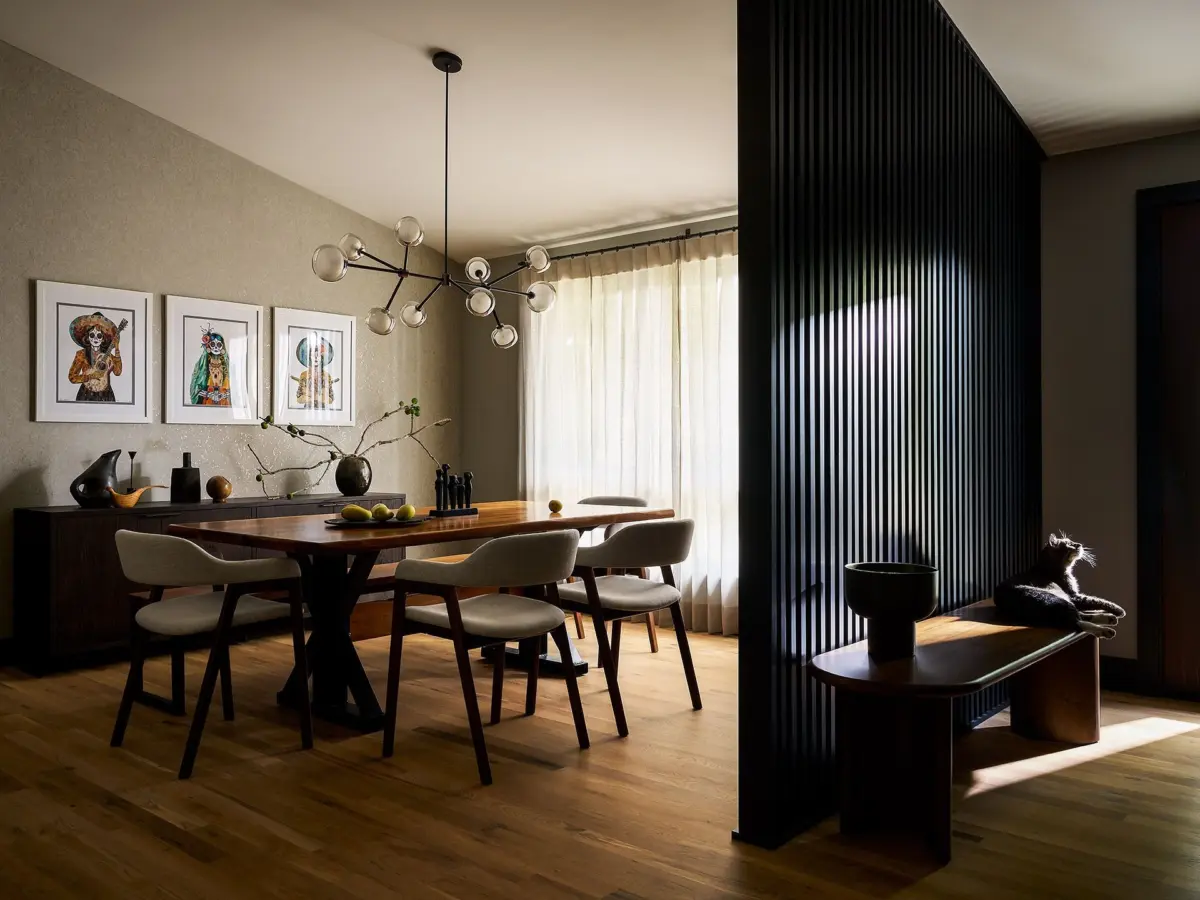
of the Home
While candlelight dining has long held a romantic reputation in literature and film, interior designers point out that it is hardly practical for everyday modern life, given the sheer volume of melted wax it leaves behind. Instead, contemporary dining room lighting demands thoughtful, deliberate planning. Professionals across the country are advising homeowners to weigh their actual eating habits, room proportions, structural architecture, and budgets before purchasing fixtures. The decision-making process requires balancing the aesthetic and functional merits of pendant lights, chandeliers, flush mounts, and wall sconces, all while keeping bulb types and electrical configurations in mind.
Lighting has evolved into a remarkably involved architectural discipline, prompting industry publications to consult top interior designers nationwide for their brightest and most innovative ideas. Although these design considerations have grown increasingly complex, experts emphasize that modern lighting schemes can achieve the very same romantic ambiance as traditional candlelight.
The evolving design landscape is opening the door to more thoughtful layers and innovative concepts regarding how illumination can shape a room, according to Mike Shively of the Chicago-based firm En Masse Architecture and Design. In today’s residential design sphere, both lighting and spatial coziness are closely associated with luxury, and neither trait is strictly dependent on a high price tag.

Across the country, high-end residential projects are showcasing this shift. In fashion designer Marysia Reeves’s Venice Beach home, a breezy, lantern-like fixture hovers gracefully above a warm wood dining table, establishing an effortless coastal atmosphere. Meanwhile, other designers are rethinking traditional silhouettes, materials, and placement methods to completely redefine what a dining space can look like.
Rethinking Heights, Finishes, and Fixture Styles
One of the most prominent trends in modern dining spaces involves breaking away from the standard, centered flush-mount fixture. Pendant lighting, for instance, becomes significantly more playful when each individual element hangs at a varying height. This technique works exceptionally well in rooms with vaulted ceilings, creating a dynamic interplay of light and shadow.
In a residential pavilion project featuring high, vaulted ceilings, Lucas Goldbach of En Masse Architecture and Design utilized a creative hanging strategy. A cluster of glass pendants hung at staggered heights worked in tandem with a pair of table lamps positioned on a nearby sideboard to produce a warm, deeply layered luminous environment. The varying suspension points give the lighting fixture added spatial dimension, drawing the eye upward and accentuating the room’s architecture.
For homeowners dealing with more subdued or minimalist architectural lines, alternative overhead solutions are gaining traction. In a striking Los Angeles home designed by the design collective the Archers, a Le Corbusier-inspired dining table is illuminated cleanly by simple, overhead can lights equipped with dimmable capabilities, proving that minimal hardware can still make a powerful statement.

Beyond placement and form, interior designers are strongly advocating for unexpected finishes. Sarah Goesling of the Chicago-based Goesling Group notes that conventional materials and finishes should be rethought wherever possible. Rather than sticking to standard stainless steel for a chain-mail fixture, designers are opting for a striking yellow gold. Similarly, where braided metal hardware might traditionally call for rugged wrought iron, polished gunmetal introduces a refined, sophisticated sheen.
In a dining room belonging to a midcentury-modern home, the Goesling Group selected a retro, 1950s-inspired Nabila chandelier designed by Tooy. To further modernize the piece through materiality, the team incorporated smoked glass elements surrounding the bulbs, blending historical homage with contemporary polish.
Historic Preservation and Alternative Illumination
The pursuit of unique dining room illumination is also driving a renewed interest in vintage and antique pieces. When homeowners discover a vintage fixture they adore, industry professionals suggest that investing in a professional rewiring is frequently worthwhile. Prospective buyers are scouring online marketplaces like eBay, Etsy, and 1stdibs, browsing local flea markets, or exploring family basements and attics for historical heirlooms.
In one distinctive dining room designed by En Masse Architecture and Design, the central light fixture was originally purchased decades ago by the homeowner’s parents. Refurbished expertly by Archistoric, the heirloom piece became the foundational design inspiration for many of the metal finishes utilized throughout the rest of the renovated space.

For those who prefer to bypass overhead ceiling fixtures entirely, designers note that wall sconces, floor lamps, and even table lamps are fully capable of carrying the lighting load. Refusing to force a traditional chandelier where it does not fit can yield surprisingly chic results, as demonstrated in the eclectic Paris apartment of Amélie Colombet.
Natural materials are also commanding significant attention, with alabaster fixtures standing out as a perennial favorite. Valued for the warm, glare-free glow they emit, alabaster pieces feature natural veining that ensures no two fixtures are identical. Available in linear forms, mini pendants, and semi-flush-mount ceiling options, alabaster ranges in price from around $300 for a single pendant to $3,000 for an expansive linear installation. Despite the investment, the stone is celebrated for its durability and longevity.
In a cozy dining nook designed by the Goesling Group, a minimalist alabaster pendant creates an arresting visual impact. The solid alabaster stone piece is illuminated all the way around its perimeter, casting a soft, celestial glow that resembles the moon.
Tailoring Light to Space and Style
When shopping for dining room illumination, professionals recommend aligning the choice of fixture with the specific geometry and style of the dining table itself. While an exact geometric match is not strictly required, a clear proportional relationship must exist. Russell Groves of the New York-based firm Groves & Co. explains that an overly large or elongated chandelier will easily overpower a small table, while a diminutive bulb will look disproportionately tiny above a massive dining surface.

The stylistic pairing requires equal consideration. A traditional farmhouse table pairs naturally with a rustic fixture or can provide a striking modern contrast when paired with ultra-contemporary lighting. In either scenario, the table and the light source must be conceptualized as a cohesive unit.
Homeowners looking to customize existing fixtures can often achieve dramatic transformations simply by altering the lampshade. A reflective interior lining inside a shade helps direct illumination back down toward the table surface, while perforated shades break light into a subtle, sparkling effect. Textured fabrics like raw silk introduce warmth and soft shadows, whereas opaque shades direct the bulk of their glow exclusively onto the tabletop.
For those seeking to move entirely away from conventional dining room aesthetics, surreal and experimental styles are emerging as a major trend. Goesling points to blown-glass designs featuring off-kilter stripes, along with chain-mail, tapestry, and wrought iron reimagined through non-traditional geometric patterns. These unconventional materials are increasingly shaping sculptural, cast lighting forms.
Unique accent lights frequently double as functional works of art. In a Chicago penthouse designed by Kuchar Studio, a dining room fixture features a dramatically sinuous, sculptural gold form. Sarah Kuchar-Parkinson, owner and creative director of the studio, notes that selecting bold, unconventional light fixtures has become standard practice among her residential clientele, bringing not only brightness but distinct architectural character and a sense of whimsy to the interior.

Installation and Technical Considerations
Proper installation is just as critical as initial selection, particularly when dealing with suspended pendants and chandeliers. Hanging a fixture too high can make it feel visually pinned and constricted against the ceiling, while hanging it too low obstructs the view across the table, frustrating diners who wish to converse with one another. Designers advise stepping back to evaluate the height from multiple angles before committing to a final position, ensuring the fixture remains safely out of eye level when guests are seated.
For spaces featuring simple pendant silhouettes with minimalist cords, designers encourage treating the cord itself as an intentional design element. Cords can be zigzagged along walls around corners, tacked in decorative swags across ceilings, or looped gracefully over wall-mounted hooks.
To counteract the harshness of overly bright overhead installations, professionals insist upon the inclusion of a dimmer switch. Sam Allen of Sam Allen Interiors strongly advocates for dimming capabilities, emphasizing that without a dimmer, a dining room chandelier lacks the crucial ability to transition into an intimate setting. Dimmers allow bulbs to mimic the warm, gentle glow of candlelight. Furthermore, modern dimmers are available in refined traditional and contemporary wall-plate designs that elevate the surrounding wall surfaces far beyond standard plastic switches.
Achieving a truly multifunctional dining room often requires supplementing the primary overhead source. Supplementing candles or overhead pendants with strategically placed sconces or downlights ensures the space remains functional for alternative activities, such as working or home DIY projects. Layering smaller-scale lamps and vintage accent pieces around the perimeter adds depth, warmth, and an inviting atmosphere, particularly as seasonal daylight diminishes.

Finally, achieving optimal light quality relies heavily on selecting the correct bulb. Warm white, cool, and bright illumination levels can be tailored precisely through careful bulb selection. Vintage-inspired filament bulbs deliver rich ambiance, while decorative bulbs enhance exposed-bulb fixtures. For maximum energy efficiency, LED technology continues to offer up to 90 percent greater efficiency than traditional incandescent alternatives, completing a well-rounded approach to modern dining room illumination.