
For years, the standard operating procedure for reviewing kitchen gear involved completely bypassing product manuals and user guides. This tendency to skip step-by-step instructions is common, often driven by fast-paced cognitive styles where the brain races ahead of written directions, paired with a stubborn preference for figuring things out independently. Yet, a rogue, do-it-yourself approach to household products rarely ends favorably, turning minor oversights into expensive lessons.
Failing to educate oneself on proper filter maintenance can inadvertently cut the lifespan of a heavily invested-in cordless stick vacuum short. Similarly, decade-old car ownership can persist while fundamental dashboard buttons remain an absolute mystery. While user error can easily be brushed off with a humorous punchline, the financial consequences are very real. Dismissing the manual for specialized cookware, such as a nonstick frying pan or an enameled cast-iron Dutch oven, often leads to ruined surfaces when improper cleaning habits like running them through a dishwasher or using metal utensils take over.
When it comes to cleaning products, however, the stakes climb much higher, particularly in an era marked by shifting regulatory oversight and evolving food safety standards. What seems like a straightforward household chore requires a closer look at the actual chemistry and chemistry-adjacent claims printed on everyday bottles sitting under the sink.
Cleaning Spray Versus Disinfecting Spray
Before examining the detailed instructions tucked away on the back of a cleaning spray bottle, consumers need to pay rigorous attention to the front label, because not all kitchen cleaning sprays are created equal. Even products labeled as all-purpose cleaners serve vastly different functions depending on their chemical formulation.
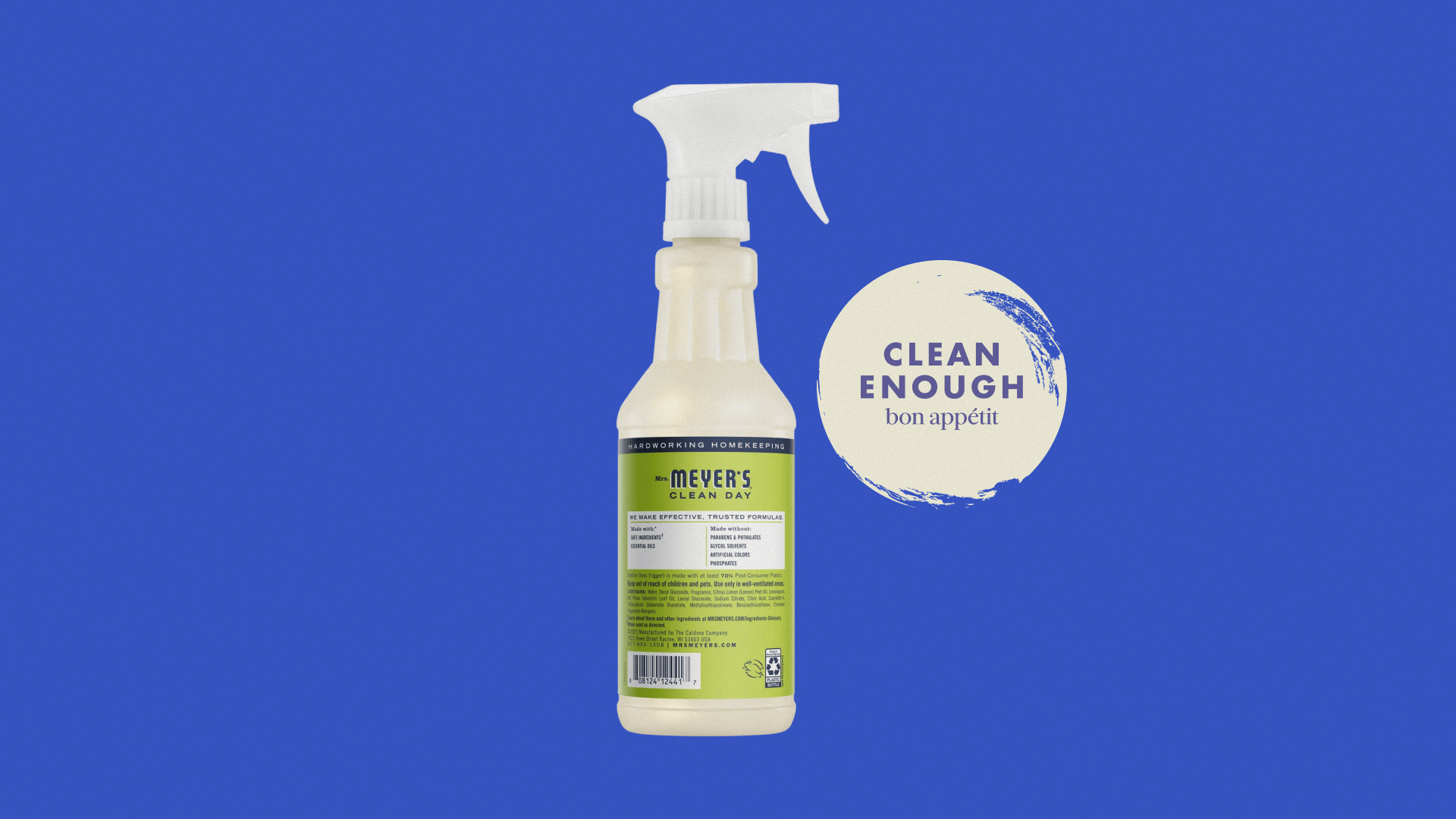
Basic everyday cleaning sprays, including popular plant-based or vinegar-infused options from brands like Mrs. Meyer’s and Aunt Fannie’s, are fundamentally designed to perform one primary task: cleaning physical surfaces. These formulations rely on surfactants, which are chemical compounds that help dislodge grease, food particles, and stubborn gunk so they can be easily wiped away with a cloth or paper towel. While these sprays may possess minimal, naturally occurring properties derived from ingredients like essential oils or vinegar, simply removing discernible debris does not yield a germ-free countertop.
Achieving a truly hygienic space requires a specialized disinfectant capable of destroying both bacteria and viruses. This distinguishes them sharply from sanitizers, which are typically formulated to reduce only bacterial populations to safe levels. For households aiming for the highest standard of cleanliness, relying on both products sequentially is often necessary. Spraying a disinfecting solution directly on top of a messy spill fails to treat the counter beneath the mess; instead, it merely sanitizes the outer surface of whatever food debris is currently stuck to the countertop.
Understanding Dwell Time and Fine Print
The critical distinction that catches many consumers off guard lies in the precise instructions printed on the back of disinfecting and sanitizing sprays. To achieve the germ-reduction rates claimed boldly on the front of the packaging, a product cannot simply be sprayed and immediately wiped away. It must remain in direct contact with the surface for a designated duration, ranging anywhere from two to ten minutes depending on the chemical composition and the target pathogen.
This crucial window is known in the industry as the dwell time or contact time. For a product to truly execute its intended function, the treated surface must remain visibly wet throughout the entire duration specified by the manufacturer.
A prime example is found in common multi-purpose disinfectants, such as certain formulations offered by Lysol. While marketing claims on the front label frequently highlight the elimination of a vast majority of viruses and bacteria, achieving that high level of disinfection often hinges on a ten-minute dwell time. A quick glance at the asterisks directing readers to the fine print on the back label reveals the necessary contact time alongside the specific strains of bacteria and pathogens the product is tested against.
Industry competitors echo similar warnings. Online product descriptions and packaging for alternatives like Clorox Multi-Surface Disinfecting Mist emphasize proper application repeatedly, noting specific protocols for food-preparation surfaces that require a thorough rinse following the mandatory ten-minute dwell time.
Ultimately, realizing the full protective and sanitary benefits of household cleaning agents demands strict adherence to the fine print. Compounding this challenge, scientific research highlights that the tools used to apply these products degrade over time. A notable 2010 study published in scientific literature demonstrated that microfiber cleaning cloths lose a significant portion of their contaminant-removal efficacy the more frequently they are washed and reused, suggesting that even the best cleaning techniques can be compromised by worn-out hardware. Maintaining a truly pristine kitchen, therefore, requires a combination of chemical awareness, strict adherence to dwell times, and regular updates to basic cleaning tools like microfiber towels, trash cans, dishwashers, and garbage disposals.