
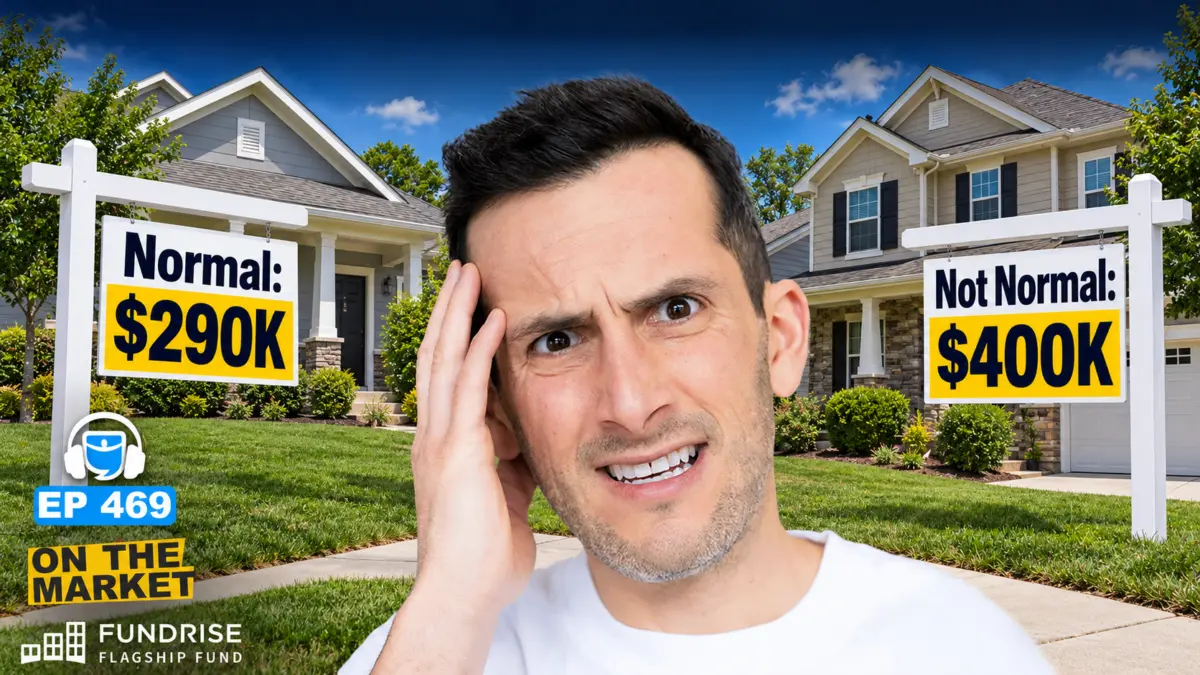
The housing market is not returning to a pre-pandemic definition of normal anytime soon, and according to new data and analysis, it could take significantly longer than many industry participants and prospective buyers expect. With mortgage rates hovering around 7.5 percent and median home prices sitting near $446,000 while wages fail to keep pace, the fundamental question facing the economy is whether relief will come from falling interest rates, declining home prices, rising incomes, or a combination of all three.
Dave Meyer, housing analyst and chief investment officer at BiggerPockets, recently broke down the math behind housing affordability on the "On the Market" podcast, revealing an uncomfortable reality for buyers, sellers, and real estate investors alike.
Defining a Normal Housing Market
To understand how long a recovery will take, it is necessary to first define what a normal housing market actually looks like. The analysis relies on two primary benchmarks: long-term historical averages dating back to 1989, and the baseline metrics from 2019, which marked the final year before pandemic-fueled inflation fundamentally altered the real estate landscape.
Housing affordability is driven by three core components: home purchase prices, mortgage interest rates, and real wage growth. Economists frequently measure this balance using the payment-to-income ratio, which calculates the percentage of a typical household’s gross income required to cover a standard monthly mortgage payment.
Historically, going back nearly 40 years, the long-term average payment-to-income ratio stands at 18.5 percent. This figure encompasses both robust economic expansions and severe recessions. By comparison, in 2019, the market was functioning under relatively stable conditions, with a payment-to-income ratio of approximately 15.5 percent, offering consumers better-than-average affordability.
Today, however, the financial landscape looks vastly different. The payment-to-income ratio has surged to approximately 24.6 percent based on recent data, and climbs even higher when adjusted for current autumn interest rates near 7.5 percent. This means consumers are dedicating roughly a quarter of their gross income to housing costs—a stark contrast to the historical 18.5 percent and the 15.5 percent recorded in 2019.
Since 2019, average home prices have climbed roughly 63 percent, while family incomes have grown by only 37 percent. Combined with significantly elevated borrowing costs, monthly mortgage payments have more than doubled, surging 116 percent over the same period. This severe affordability squeeze is the underlying cause of the current sluggish transaction volume across the national housing market.
The Limits of Wage Growth, Mortgage Rates, and Price Corrections
To evaluate potential paths to recovery, analysts often examine the three levers of affordability independently while holding the others constant. However, a close examination of each lever reveals the unlikelihood of a quick or isolated fix.
The most socially desirable path to improved affordability would be significant wage growth while home prices and mortgage rates remain stable. Yet, historical data demonstrates that real, inflation-adjusted wages grow very slowly. Since 1968, real median wage growth has averaged just 0.8 percent annually. Achieving 2019-level affordability through wage growth alone would require decades of sustained increases—an unrealistic expectation, particularly in an economic environment where real wage growth has recently turned negative and technological shifts threaten white-collar salaries.
The second lever, mortgage rates, is frequently cited by consumers hoping for a return to the ultra-low borrowing costs seen during the pandemic. However, the math reveals daunting hurdles. To return to 2019 affordability levels through interest rates alone, mortgage rates would need to plummet to 2.7 percent—a scenario economists view as virtually impossible outside of an extreme economic catastrophe. Even a return to the long-term average affordability would require rates to drop to 4 percent.
Achieving such low rates depends heavily on bringing inflation down below the Federal Reserve’s 2 percent target, likely requiring core inflation closer to 1 percent to influence the bond market and 10-year U.S. Treasuries downward. While mortgage rates may ease modestly from their current peaks into the 5 or 6 percent range over the coming years, relying on a return to historical lows to restore market normalcy is fundamentally flawed.
The third lever involves a significant drop in home prices. Restoring affordability to 2019 levels through pricing corrections would require a national home price crash of roughly 36 percent, while returning to the 40-year historical average would necessitate a 25 percent decline. This would bring the median home price down from its current level of roughly $446,000 to approximately $335,000 for the long-term average, or down to $284,000 for 2019 levels.
Such a nationwide collapse exceeds even the peak-to-trough declines seen during the Great Financial Crisis of 2007–2008, when home prices fell roughly 20 to 22 percent. Furthermore, the fundamental drivers of that era—widespread subprime lending, lax underwriting, and massive forced selling by over-leveraged homeowners—do not exist in today’s market.
Instead, the modern housing market is heavily insulated by the "lock-in effect." Roughly 80 percent of existing mortgages feature interest rates below 6 percent, with half below 4 percent and 20 percent below 3 percent. Because current homeowners are reluctant to trade their low rates for much higher ones, inventory remains constrained, and early-stage housing distress and foreclosure rates remain remarkably low compared to historical benchmarks. While regional corrections are unfolding in specific over-valued Sunbelt markets and select western cities, a broad national price crash remains unlikely.
Long-Term Outlook and Strategy for the Market
Because no single lever can restore housing affordability independently, any return to a balanced market will require a prolonged combination of flat or slowly adjusting prices, modest wage growth, and gradual interest rate declines.
Model projections indicate that even under optimistic baseline assumptions—such as mortgage rates easing to 6 percent, home prices remaining relatively flat, and real wages outpacing inflation by a modest margin—it could take upwards of seven years for the broader housing market to return to historical affordability metrics. Alternative scenarios involving slightly higher rates or sluggish wage recovery push that timeline out significantly further.
For real estate agents, loan officers, and industry professionals, this extended period of low transaction volume represents a challenging environment. For investors and prospective buyers, however, the current market dynamics suggest that waiting passively for a rapid recovery is an ineffective strategy. Navigating the current cycle requires a disciplined focus on purchasing assets significantly below current market comparables or executing strategic value-add improvements to manufacture equity, mirroring the playbook successful investors used to navigate the years following the last major economic downturn.