
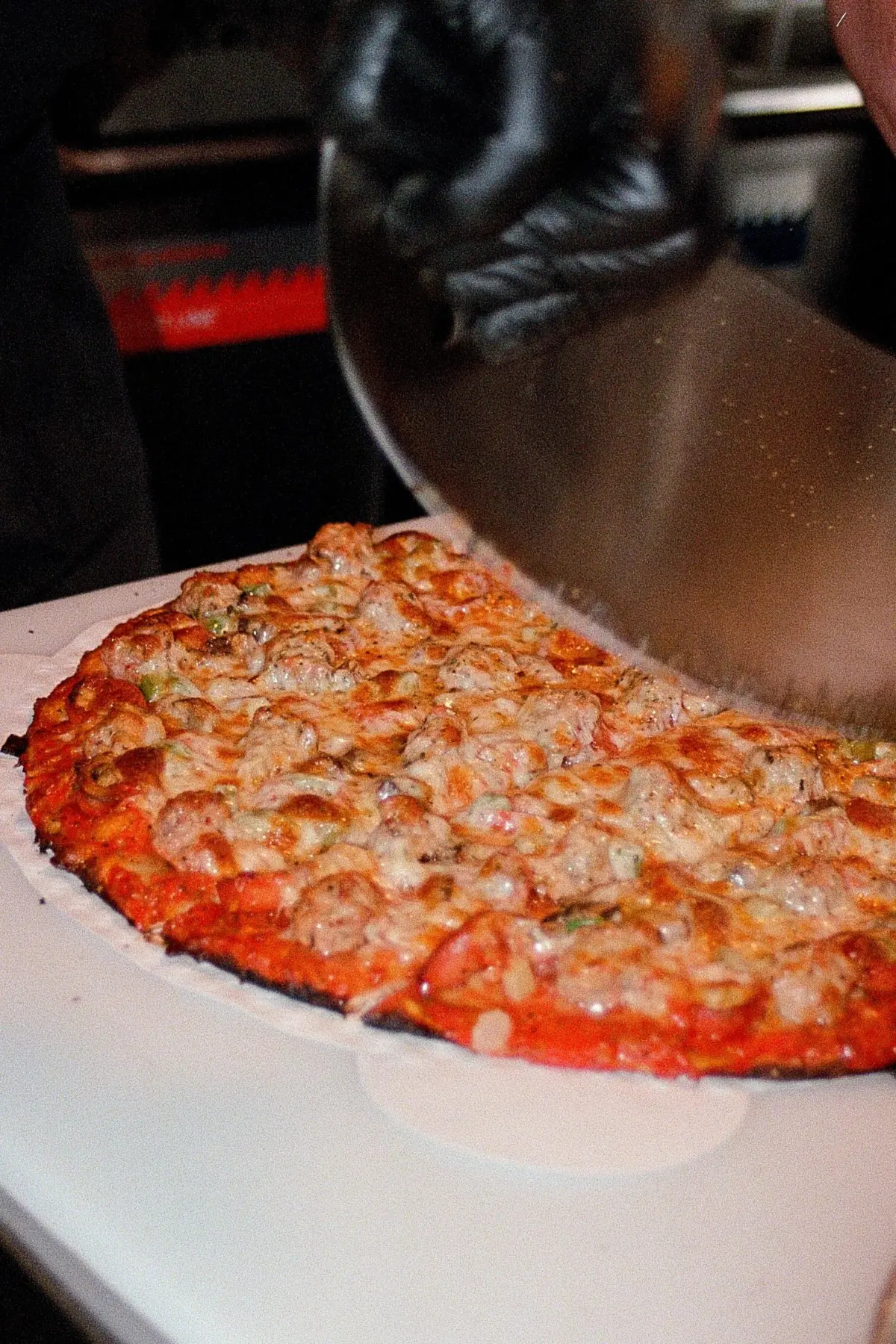
In the suburbs of Chicago where they both grew up, it was simply known as pizza. For Brittany and Brennan Grosvenor, the couple behind Proof in Portland, Oregon, ordering a pie on a Friday night always came down to a familiar local debate. It was a choice among thin-crust, deep-dish, or double-dough, as Brittany recalls of her family’s weekend tradition. Today, the Grosvenors sell the former at Proof, though the traditional Chicago-area language of "thin crust" has given way to a more nationally recognized phrase: "tavern-style." This unpretentious, crispy pie has emerged as a major pizza trend sweeping across the United States from coast to coast in recent years.
Outsiders often associate the Windy City with its famous, tourist-beckoning deep-dish pizza, but Brittany notes that this stereotype is hardly reflective of everyday reality. She characterizes deep dish as a much less frequent treat compared to the Midwestern thin-crust style that is rapidly gaining popularity nationwide. The pizza people order every week, or encounter at a child’s birthday party or a neighborhood gathering, is almost always tavern-style, she explains.
Tavern-style pizza—which is deeply prevalent across the Midwest, with Chicago, Milwaukee, Minnesota, and St. Louis all touting their own similar iterations—is renowned for its thin, cracker-like crust. Unlike the traditional radial slices of New York or Neapolitan pies, tavern-style pizza is famously cut into a grid of squares, often referred to as a "party cut." Depending on the region and the specific neighborhood pizzeria where one’s culinary nostalgia lies, the sauce might lean sweet or spicy. However, lightness and crispness remain the style’s defining characteristics and unique selling points.
Writing for Esquire in 2023, food writer Omar Mamoon described the variant—which was then still on the rise—as a direct foil to the famously thick Detroit-style pizza that experienced a massive boom in popularity in the late 2010s. The beauty of the tavern-style pie lies in its inherent shareability. A circular pizza yields significantly more portions when cut into a grid rather than traditional triangles, explains Bradley Shorten, the culinary force behind Kim’s Uncle Pizza in his hometown Chicago suburb of Westmont, Illinois, and the recently opened La Merna in Washington, D.C.
Pizza cut into small squares makes for exceptional drinking food, Shorten points out, largely because the pieces are compact enough to fit neatly on a cocktail napkin. According to Shorten, the hallmark of a truly great tavern-style pie is that every single square features a balanced bite of every ingredient, with the toppings and cheese distributed all the way to the very edge of the crust. While culinary purists often joke that the four small, crust-heavy corner pieces are not necessarily the "best" slices on the pie, Shorten observes that they are invariably the ones everyone reaches for first, especially diners who grew up in the Chicago area.

Over the past few years, as neighborhood taverns have become growing fixations for a cadre of innovative restaurateurs, party-cut pizzas and tavern-style concepts have become ubiquitous. Recent high-profile openings include Keepers in New York City; One Trick Pony in Fort Worth, Texas; Tillie’s Tavern Pizza in Wheat Ridge, Colorado; and Zarella and Dimmi Dimmi Corner Italian in Chicago, where the style has always been a cornerstone of local dining culture. For many displaced Chicagoans, these new openings across the country represent a long-awaited opportunity to correct the record regarding their hometown’s true pizza identity, while other Midwesterners are eager to claim their own stake in the region’s rich pizza heritage.
When Mike Fadem opened the second location of his popular New York City pizzeria Ops—a spot widely known for its wood-fired, Neapolitan-esque pies featuring leopard-spotted crusts and pliant dough—he wanted to offer something distinct. Fadem originally hails from St. Louis, where the city’s namesake pizza is exceptionally thin. Despite his deep fondness for it, Fadem readily admits that it might not be the absolute best version of tavern pizza, acknowledging its many vocal critics who take issue with its traditional use of Provel, a gooey processed cheese blend.
The historical trajectory of tavern-style pizza resembles an expansive game of culinary telephone, Fadem explains. St. Louis-style pizza is ultimately derived from Chicago thin-crust pizza, which itself traces its lineage back to traditional Neapolitan roots. Noticeable divergence has accompanied each geographic jump and generational shift.
Meanwhile, one of Fadem’s employees at Ops is from New Jersey, a state that proudly claims its own distinct thin-crust, tavern- or bar-style pizza tradition, much like the devoted following enjoyed by the bar pies of the Boston area. This environment sparked a creative question for the owner: Could they craft an Ops-specific interpretation of the style?
Given that Ops is already widely known for its exceptional sourdough, Fadem also wanted to highlight the rich, complex flavor profile of whole grains in the crust. Furthermore, he wanted the finished pie to be exceptionally crispy—a textural quality he knew would instantly appeal to New Yorkers. Fadem’s unique take was ultimately added to the menu under the regionally agnostic name "tavernetta." Though St. Louis and New Jersey served as his initial inspirations, Fadem notes that the best examples he encountered during his extensive research were actually found in Milwaukee. Today, the tavernetta has not displaced the other established pies at the restaurant; instead, it is routinely ordered as an addition, with most dining groups getting at least one for the table.
In June, Los Angeles cocktail lounge Bar Next Door celebrated its third anniversary by expanding its offerings to include a dedicated food menu. Previously, the establishment had permitted patrons to bring in pies from Prince Street Pizza next door, facilitated by the fact that Prince Street co-owner Lawrence Longo is a partner in the bar.

According to owner and bar director Brynn Smith, however, adding an in-house food option was about pacing the guest experience. After consuming a heavy slice of traditional square pizza, diners often feel too full and decide to head home for the evening, Smith explains. The primary goal for Bar Next Door was to encourage patrons to linger a little longer and continue ordering drinks. The team determined that tavern-style pizza would be the perfect vehicle for this. The fact that these pizzas—which are specifically listed on the menu as "bar pies" to better complement the establishment’s beverage-focused identity—are made exclusively for the bar by Prince Street provides yet another compelling reason for locals to visit, Smith notes.
The underlying idea of the tavern as a warm, social, and convivial space is fundamentally inseparable from the tavern-style pizza itself. Shorten’s primary goal with La Merna—which he operates alongside his wife Meg Schmitt, who grew up in St. Louis—was to recreate the relaxed atmosphere of a classic Chicago dive bar or a traditional Wisconsin supper club. They envisioned a space defined by dark wood-paneled walls and checkered floors, where patrons could comfortably slide into a red leather booth, order pitchers of beer and square-cut pizza, and settle in for an extended evening.
As explored in previous culinary commentary regarding dining trends, the rising appeal of the "tavern" aesthetic across restaurants nationwide is deeply rooted in the desire to provide a homey, lived-in environment. At these neighborhood spots, diners are encouraged to sprawl out, stay awhile, cast off modern pretense, and tap into something deeply welcoming in its familiarity. For countless Americans, this comforting ethos is perfectly exemplified by the archetype of the hometown pizza shop, which remains permanently tethered in the cultural imagination to the trappings of a simpler era.
It is precisely for this reason that the Grosvenors in Oregon have recently introduced their own regional interpretations, including Bosco sticks—the nostalgic stuffed breadsticks familiar from Midwestern school cafeterias—and Italian beef sandwiches topped with giardiniera. While they could occasionally find certain Midwestern staples around Portland, they were frequently frustrated by the inability to find everything under one roof. As Brennan Grosvenor puts it, they are simply trying to embody the authentic feeling of walking into a neighborhood tavern in Chicago and wondering what else might be waiting on the menu.