
In the hyper-competitive world of hospitality, standing out before a single plate has been served or a cocktail poured has become an art form in its own right. Across social media platforms, a growing wave of independent business owners—from restaurateurs and bartenders to coffee shop proprietors and specialty grocers—are turning their stressful, chaotic, and often unpredictable buildout phases into gripping long-form video series. This phenomenon is transforming the traditional path to opening a venue, replacing silent construction sites and mysterious papered-up windows with digital soap operas that cultivate eager, emotionally invested audiences long before opening night.
This emerging trend marks the final installment of the industry series "Getting on the Map," presented by Apple Maps, which explores how the most creative bars and restaurants are marketing themselves to cut through the noise of crowded urban scenes. Rather than relying solely on traditional public relations firms or last-minute grand opening flyers, modern entrepreneurs are inviting the public directly into the inner sanctum of their businesses, offering an unfiltered look at the financial strain, design dilemmas, and construction milestones that dictate the birth of a new hospitality venture.
Take, for instance, Michael Bishop-Myers, a longtime New York City bartender embarking on the journey of opening his very first establishment, a Brooklyn bar named Susu’s. In a video that quickly amassed over 103,000 views and a cascade of enthusiastic comments on Instagram, Bishop-Myers pulls back the curtain with disarming simplicity. "Hey, I’m Mike," the video opens, setting a conversational and intimate tone. "I’ve been a bartender for a long time in New York City and I’m opening my very first bar. Let’s go inside."
Subsequent clips feature Bishop-Myers meticulously combing through draft menus, while background footage captures the gritty reality of the buildout: industrial drills whining against in-progress bar counters and workers carefully leveling wall frames. Earlier dispatches from the venue chronicled technical details, such as the installation of a high-end sound system featuring 12 Klipsch speakers and a Powersoft amplifier. For a niche audience of hospitality nerds and neighborhood locals, this level of granular detail is not tedious; it is thrilling.
This strategy of chronicling the grind is gaining momentum internationally. In Chicago, chef Jacob Potashnick used TikTok videos beginning in 2022 to meticulously document the creation of his tasting menu restaurant, Feld. The restaurant officially opened in 2024 and has since achieved critical acclaim, winning a James Beard Award and earning a coveted Michelin star—milestones that Potashnick now weaves into his ongoing digital narrative. Similarly, Vancouver’s Cowdog Coffee, launched by content creator Joe Lee, leaned heavily on social media to share its physical evolution from an empty shell into a functioning neighborhood hub.
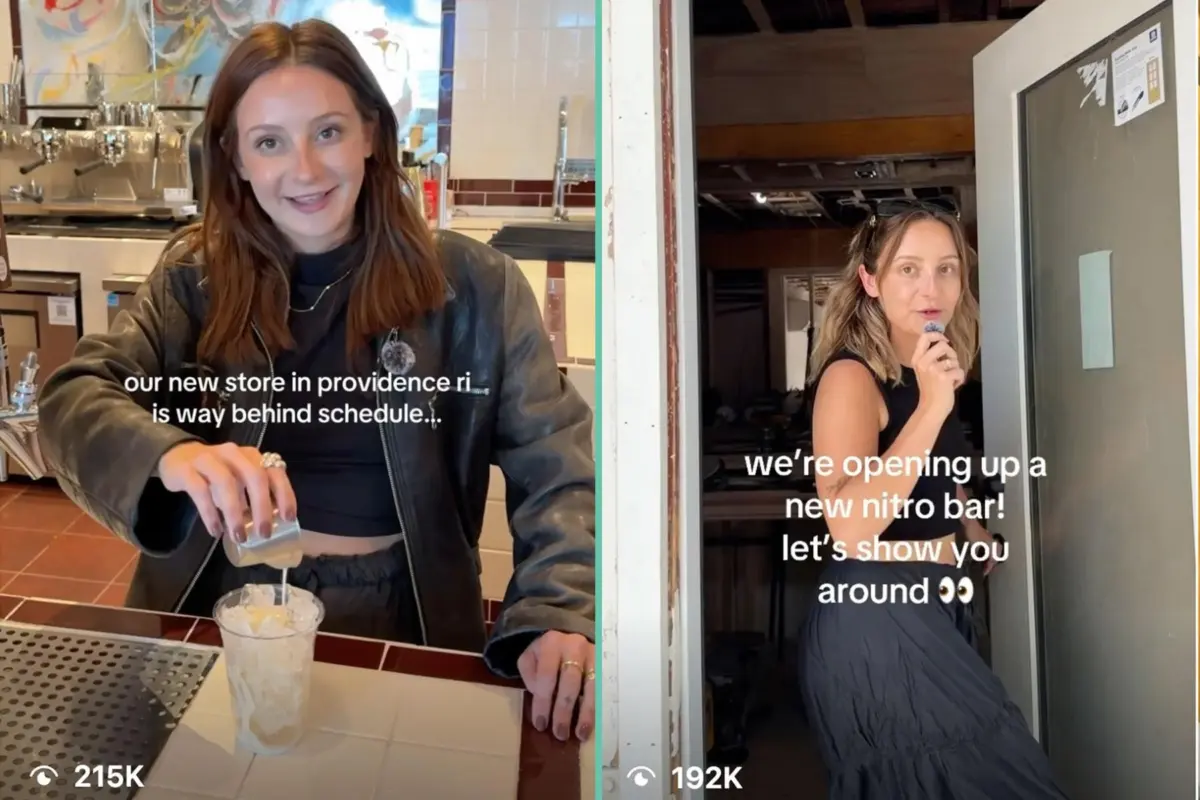
In Providence, Rhode Island, The Nitro Bar has long operated at the bleeding edge of food and beverage social media. Owner Audrey Finocchiaro has mastered the delicate balance between brand identity and chaotic internet culture, famously posting videos where she presents her staff with absurd or unfiltered prompts. Beyond her comedic short-form content exploring the daily realities and absurdities of running a coffee shop, Finocchiaro has expanded her footprint by documenting the high-stakes process of bringing The Nitro Bar to New York City through long-form YouTube videos. One video follows her through intensive interior design meetings, while another, pulling in more than 54,000 views, offers an exclusive tour of her new production space.
As Rachel Karten, author of the social media-focused publication Link in Bio, has observed, this approach relies on establishing a "my show is on" mentality around a commercial enterprise. When discussing Finocchiaro’s methodology at an industry event, Karten noted that the business operates much like a television production: the owner acts as the host, the employees form the cast, and the physical shop serves as the set. Finocchiaro herself has described her philosophy as treating the coffee shop as "its own person"—an entity distinct from its creators that customers can genuinely desire to befriend.

The crossover appeal of these buildout diaries bridges the gap between home-improvement television like HGTV and culinary programming on the Food Network, tailored specifically for consumers whose dining habits are increasingly driven by parasocial relationships. Cookbook author and food personality Jake Cohen recently capitalized on this dynamic by announcing a digital series tracking his DIY transformation of a Brooklyn warehouse into his dream event space and test kitchen. Standing in a raw, unfinished bathroom space, Cohen poses questions to his followers about design choices—stainless countertops, stone, or butcher block—inviting collective participation in the creative process. Through these serialized transformations, a business ceases to be a sterile commercial transaction and becomes a living character that viewers passionately want to support.
Perhaps the most extreme and widely discussed example of this hyper-transparent marketing model belongs to Sammy Nussdorf, who documented the arduous journey of opening his high-end New York City grocery store, Meadow Lane. According to analyses by industry publications, Nussdorf’s digital chronicle spanned more than 430 days, survived multiple permitting snafus, and generated nearly 700 individual TikTok posts. By the time Meadow Lane finally opened its doors in late 2025, Nussdorf had evolved from a first-time store founder into a polarizing, highly recognizable media figure akin to a reality television star. The protracted "will-it-open-or-won’t-it" narrative provided the grocery store buildout with the compulsive cliffhanger appeal typically reserved for serialized prestige television.
Nussdorf’s candid reflections on the process resonated widely. As he noted in interviews with mainstream publications following the store’s debut, the more an enterprise pulls back the curtain on the private, often opaque mechanics of running a small business, the more deeply engaged the public becomes. This digital-first strategy proved immensely potent, generating massive opening-week crowds with lines stretching down the block and drawing national attention from retail observers far beyond New York City.
This push toward radical transparency is reshaping the broader restaurant and hospitality landscape. As independent Substack publications and short-form video algorithms empower founders to bypass traditional gatekeepers and speak directly to consumers, the industry is seeing an unprecedented wave of detailed operational disclosures. Chefs and restaurateurs around the globe, from Stockholm to Manhattan, are increasingly willing to share the nuts-and-bolts realities of restaurant life. For instance, the new New York City restaurant Legion opted to publish a written series titled "The Opening Files" on Substack leading up to its debut, detailing the unglamorous minutiae of launching an eatery without relying on traditional food media to judge public interest.
Legacy media outlets have also taken note of the public’s insatiable appetite for these behind-the-scenes narratives. Projects tracking prominent restaurateurs through the agonizing phases of touring commercial spaces, negotiating leases, navigating failed deals, and decoding the complex mathematics of rent concessions and municipal permits have found a ready and eager readership.
At its core, the surging popularity of the restaurant buildout series taps into a fundamental human truth about contemporary media consumption: people are inherently curious about how things work, how money is spent, and what happens behind closed doors. By transforming the sweat, tears, and drywall dust of opening a venue into an open-source narrative, today’s hospitality entrepreneurs have turned curiosity into their most powerful marketing asset.