
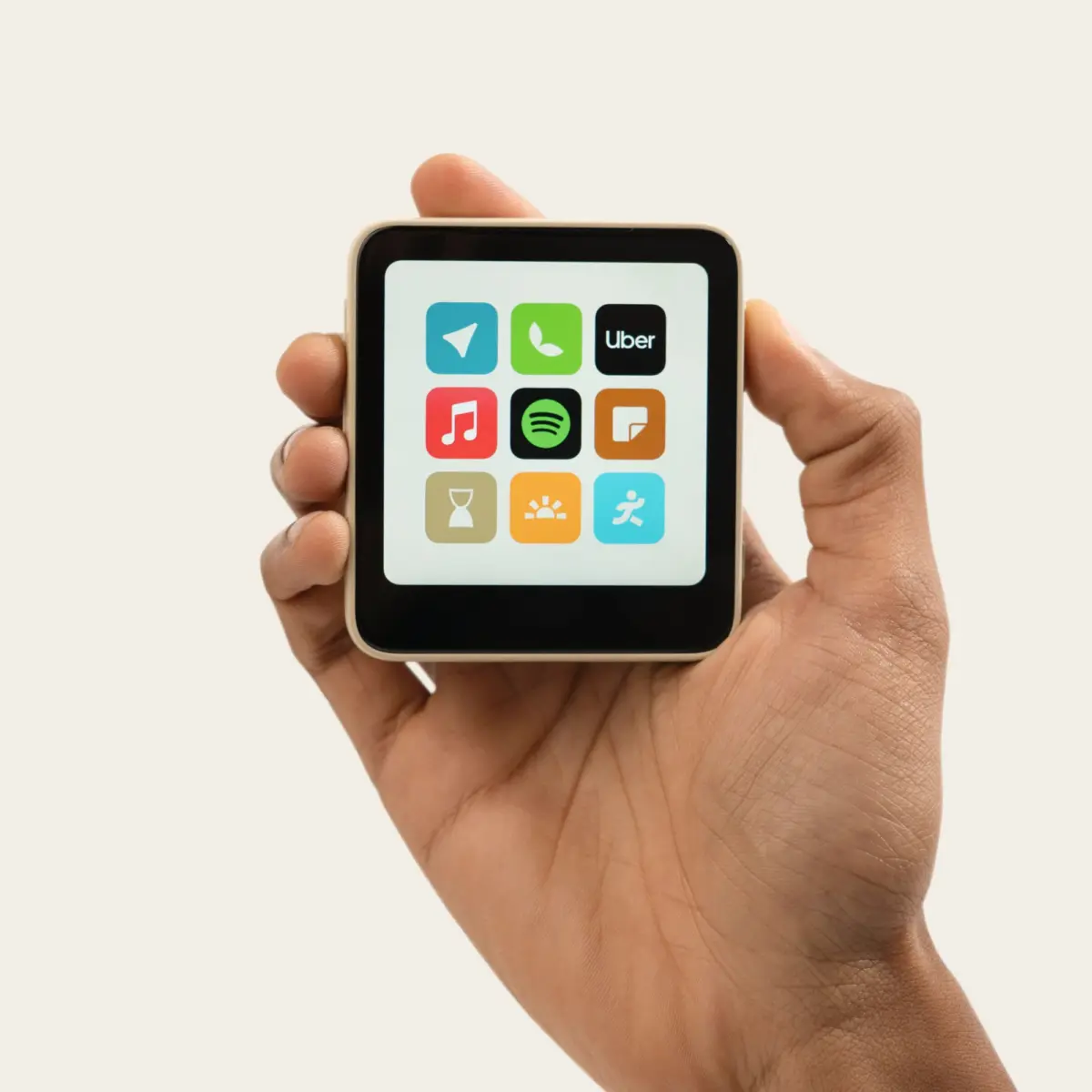
I held my breath as I walked into the concert venue and showed the bouncer a ticket barcode displayed on a tiny, three-inch square screen.
“If it doesn’t go through, I can try something else,” I said quickly, worried that the barcode wouldn’t register on the scanner. But just as Meadow founder Shreyas Narlanka had promised me earlier that day, the code I scanned onto the startup’s minimalist phone worked without a hitch.
“Cool phone,” the bouncer remarked, quickly ushering me inside the bustling venue.
I had done it. Using Meadow’s barebones smartphone, I had successfully hailed an Uber, streamed Apple Music during the ride, and scanned my ticket to enter the show. Not once during the entire evening did I need to touch my primary iPhone, which I had brought along purely as a safety net in case the ticket scan failed.
The device is the latest entrant into a rapidly growing market of hardware designed to help people escape the constant pull of notifications, social media feeds, and screen addiction. While existing options range from complete smartphone replacements like the Light Phone to hybrid flip phones with touchscreens like the Commodore Callback, Meadow is carving out a unique middle ground. It is not designed to replace your primary phone entirely, but rather to act as a selective, intentional supplement for when you want to step away from the digital noise.
A Different Philosophy on Unplugged Living
The modern backlash against hyper-connectivity is well-documented. Go online today, and you will find a rising tide of content and commentary from people across the globe who feel suffocated by constant screen time and algorithmic feeds. This collective fatigue has given birth to an entire device category promising a much-needed reprieve.

However, Narlanka argues that many existing alternatives miss the mark on why people actually want to disconnect.
“With so many dumb phones, the Brick, and everything, the messaging is like, ‘Slow down, focus on your work’ or whatever,” Narlanka says, explaining the philosophy behind Meadow’s design. “But the reason we’re different is because we’re all about getting outside and unplugging and having a sick social life.”
This sentiment resonates deeply in a cultural landscape where reducing screen time is discussed with the universal agreement usually reserved for healthy eating or dental hygiene. Even cultural figures are hitting a breaking point. During the concert I attended, the headlining artist, a 22-year-old pop star named ADELA, used her manager’s phone to publish a celebration post after her debut album climbed to number four on the Billboard charts.
“I have deleted social media because i want to stay sane!” the young pop star wrote to her followers on Instagram.
Her fans, by contrast, remained firmly tethered to their screens, with several attendees recording the entire concert on their iPhones. While capturing a quick photo or a short video clip is common practice, watching crowds view entire live performances through a 6-inch glass panel highlights the very problem Meadow aims to solve.
Bridging the Gap Without Going Entirely Off the Grid
Unlike devices that force users to completely abandon modern infrastructure, Meadow runs on Android and supports essential utilities. It handles navigation via Maps, fitness tracking through Strava, ridesharing via Uber, and music streaming through Apple Music and Spotify. It also includes native applications for core utilities such as calling, text messaging, voice memos, notes, location sharing, and ticket scanning. It supports Bluetooth and allows users to connect wired 3.5mm headphones using a standard USB-C adapter.

“I knew there were going to be times where I needed my phone,” Narlanka explains. “I didn’t want a full replacement.”
There is a catch, however. Users cannot make calls or send texts using their usual cellular phone number out of the box. Instead, setting up the device requires a separate subscription plan through Meadow, which assigns a distinct secondary phone number to use while on the go.
To manage communication without missing emergencies, Narlanka recommends that users take advantage of built-in smartphone features like Apple’s "Driving" focus mode. By default, this tool automatically texts top contacts to let them know you are on the road. With a minor customization, users can change the automated reply to state that they are out using their Meadow device. This allows individuals to filter out the relentless chatter of group chats while ensuring that anyone who genuinely needs to reach them can still do so.
“We’re not Luddites that are going to be like, ‘Streaming’s bad, and this is bad,’” Narlanka notes. “It’s just we don’t want social media, browsing and that kind of stuff.”
Hardware Built for Intentional Friction
Physically, the Meadow presents an unusual form factor. In the hand, the small, square device feels unfamiliar, though entirely functional. Because it is deliberately engineered to discourage prolonged, mindless use, it lacks the ergonomic comfort of a modern flagship smartphone—a feature, rather than a bug, of its design.
The hardware includes a few distinct quirks, particularly regarding its camera. While the camera performs reasonably well during daylight hours for casual snapshots outdoors, image quality dips significantly in low-light environments like a dimly lit concert venue.

Furthermore, the camera app operates entirely differently from standard consumer devices. Users can snap as many photos and videos as they desire while out, but the device intentionally withholds instant viewing. The captured media cannot be reviewed until the user returns home and syncs the device with the Meadow application on their main smartphone. Additionally, rather than featuring a front-facing selfie camera, the device incorporates a tiny physical mirror beside the lens, allowing users to manually frame their shots.
Display brightness and battery life held up reliably during testing. If anything, the display can occasionally feel overly bright in dark environments, but that same attribute ensures the screen remains easily readable under direct sunlight outdoors.
As a nascent product that has thus far only shipped its initial bulk batch to pre-order customers, Meadow still experiences occasional growing pains. During my time with the device, I encountered a minor software glitch where an Uber ride status lingered on the screen long after I had stepped out of the vehicle, causing a brief moment of concern that I might have accidentally booked a second car. Narlanka confirmed that this specific bug has since been addressed through software updates.
Ultimately, for users willing to navigate the slight friction of managing a secondary phone number, Meadow offers a viable pathway toward digital moderation—allowing individuals to disconnect from algorithmic feeds without vanishing entirely from modern convenience.
Building on Past Success
Though Narlanka is only 25 years old, Meadow is not his first entrepreneurial venture. He previously dropped out of the University of California, San Diego in 2020 when his last startup, Scoutapp AI, gained significant market traction. That company, an inventory management platform built for online merchants, was eventually acquired by fashion resale giant StockX.
Meadow marks Narlanka’s first foray into physical hardware development, a pivot that has already attracted notable backing from the venture capital community. The startup secured funding in December 2024 in a round led by Alana Goyal of Basecase Capital. The financing also saw participation from prominent angel investors, including Terrence Rohan, Discord founding CMO Eros Resmini, Vercel founder Guillermo Rauch, and Diagram founder Jordan Singer.