
On September 8, 2023, a violent magnitude earthquake struck Morocco’s Al Haouz province, ripping through the rugged terrain of the High Atlas Mountains. The disaster claimed the lives of more than 2,900 people, left more than 5,500 injured, and leveled centuries-old villages, reducing tens of thousands of traditional homes and modern structures to vast fields of rubble.
Three years after the disaster, the landscape of recovery across the mountainous province tells two profoundly different stories. In some settlements, rapid reconstruction and government subsidies have allowed families to leave behind emergency encampments and move into permanent dwellings. In other communities just a short drive away, bureaucratic delays, stringent eligibility criteria, and administrative hurdles have left vulnerable residents stranded in canvas tents or living amidst the precarious ruins of their former lives.
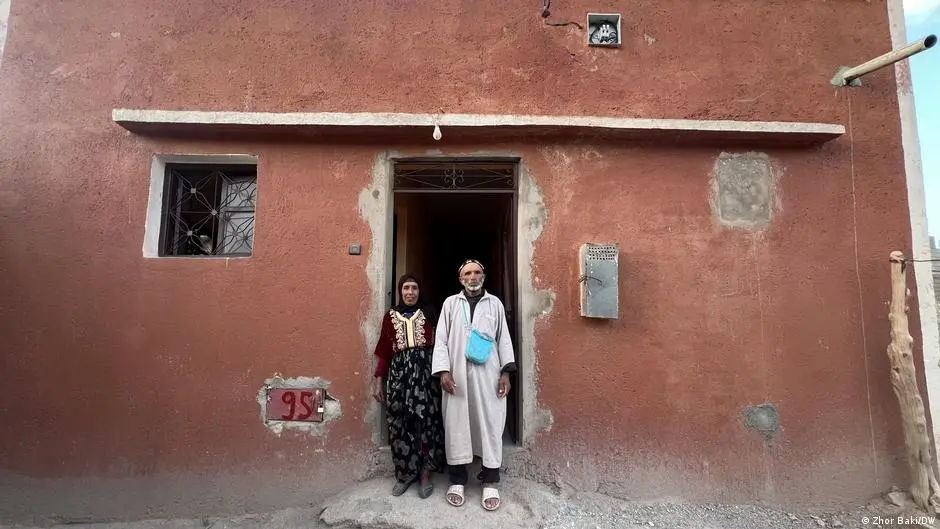
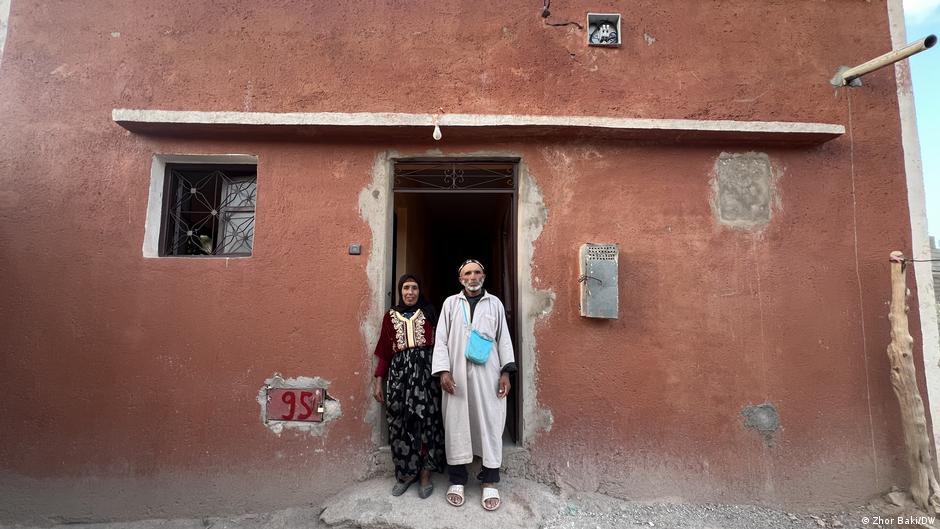
In the village of Ighermane, nestled in the High Atlas roughly 50 kilometers (30 miles) southwest of Marrakech, 72-year-old Mohamed Ait Belaid reflects on a recovery process that has largely worked in his favor. For months following the disaster, Ait Belaid and his family survived in temporary humanitarian tents, enduring freezing mountain winters and intense summer heat. Today, he lives in a newly constructed home built on the footprint of his destroyed property.
While the new structure is noticeably smaller than the spacious family house he lost in the tremors, it provides structural safety and shelter.
"I benefited from partial [state] support and received 80,000 dirhams [around €7,300] for rebuilding," Ait Belaid said. "I added about 100,000 [€9,110] dirhams from my own pocket. And thanks to God, I like my new house and I’m comfortable in it. I’m at peace because my wife, my children and I are all healthy and I haven’t lost any of them."
Yet just 40 kilometers away, across winding mountain roads in the town of Azgour, the atmosphere is defined by anger, exhaustion, and unresolved loss. There, fellow 72-year-old Larbi Ait Jelloulat spends his days sitting before a mound of concrete fragments, stones, and dust that was once his home.
A former local municipal council employee, Ait Jelloulat invested his life savings into building a large residence intended to serve as a family haven during his retirement. The 2023 earthquake destroyed the building entirely. Since then, instead of receiving reconstruction grants, he has found himself trapped in administrative gridlock, unable to satisfy local bureaucratic requirements requiring him to prove his continuous residency in the area.
"I want to know where my rights have gone," Ait Jelloulat said. "Who took what’s rightfully mine? For three years, I’ve been going from one department to another, from one complaint to another, from one petition to another, just looking for an answer. Why have I been excluded? Am I not a Moroccan citizen?"
For Ait Jelloulat, the exclusion feels like an erasure of decades of service and investment. "My only dream was to spend the rest of my life in my own home, a rest after years of service," he said. "Now they say I’m not a resident … Where’s the logic in that?"
Why such different experiences?
The stark contrast between Ighermane and Azgour highlights the uneven pace of recovery that has characterized the post-earthquake reconstruction effort across the High Atlas region.
In Ighermane, community coordination and steady administrative processing have allowed the majority of households to make substantial progress. Omar Saeed, a representative from the local Ighermane Association for Development and Solidarity, noted that approximately 90% of the village has been successfully rebuilt, enabling most families to reestablish their daily routines and livelihoods.
Of the approximately 150 families residing in Ighermane, 114 qualified for and received state financial support. While the grants were rarely sufficient on their own—requiring most households to supplement the funds with personal savings, family contributions, or loans—the financial injection provided the necessary foundation to clear debris, purchase raw materials, and hire local masons.
In Azgour, however, the scale of destruction was far more severe. Located closer to the high-impact zone, Azgour emerged as the most battered village in its immediate district. Three years later, the community remains fractured.
According to Ait Jelloulat, around 76 local families were approved for state reconstruction assistance, while 56 other families remain completely excluded or are still awaiting decisions on their appeals. Even for those who secured funding, the transition back to normal life has been fraught with structural delays.
"What’s more, the 76 families who rebuilt their homes in a different location are also having problems connecting to water and electricity," Ait Jelloulat explained, noting that the relocation of entire neighborhoods has overwhelmed local infrastructure networks.
Rebuilding difficult in remote mountain villages
On a macro level, state authorities maintain that the broader reconstruction campaign represents a significant logistical achievement given the geographical challenges.

According to figures released in a March statement by the High Atlas Development Agency (ADHA)—a specialized body created in October 2023 to oversee relief, recovery, and long-term infrastructure rehabilitation in the disaster zone—54,425 homes have been fully constructed or rehabilitated across the affected provinces. More than 3,000 additional houses remain actively under construction.
To finance the massive undertaking, the Moroccan government has disbursed more than 7.2 billion dirhams (approximately €656 million or $770 million) directly to affected populations. These expenditures encompass both direct reconstruction subsidies paid in installments and monthly emergency living stipends designed to support displaced households while their homes are rebuilt.
From an engineering and urban planning perspective, professional observers argue that the overall pace of work has been substantial given the immense physical barriers. Mohamed Belmejjad, an architect based in Marrakech who has closely followed the post-disaster recovery, considers the broader timeline reasonable.
"I believe the progress so far, relative to the timeframe, to be positive," Belmejjad said, pointing out that initial timelines had to account for extraordinary natural and infrastructural obstacles.
In the immediate aftermath of the earthquake, many isolated mountain communities were entirely unreachable by road due to major rockfalls and structural fissures along mountain passes. Heavy earthmoving machinery could not access affected settlements until transport corridors were secured. Once access was restored, thousands of metric tons of rubble had to be removed from tight, hillside alleys before any new foundations could be poured.
Beyond the initial cleanup, the rebuilding phase encountered severe supply-chain bottlenecks. Many high-altitude villages lie far from paved transit corridors, making the haulage of gravel, cement, steel, and timber expensive and technically demanding.
Furthermore, geological surveys revealed that several former settlements were at acute risk of future rockslides, forcing planners to identify entirely new land plots, complete zoning assessments, and design new municipal layouts from scratch. In these relocated sites, establishing basic water distribution and electrical grid connections has proven to be a complex, multi-year process.
Planners have also had to navigate the delicate balance between modern seismic resilience standards and traditional local architecture, which relies on stone, earth, and regional Amazigh masonry practices. Rebuilding safely meant ensuring that modern engineering was integrated without eroding the cultural heritage of the High Atlas.

Compounding these issues is a systemic shortage of technical labor in the rural interior. "We also lack the necessary expertise here, whether that’s in terms of architects, design offices, contractors or even the labor required for construction," Belmejjad noted. Factoring in these constraints, he suggested that the completion of tens of thousands of homes could be viewed as on or even ahead of schedule.
‘No one has remembered us’
Despite the official figures and infrastructural milestones, grassroots civil society organizations argue that statistical aggregates obscure the deep suffering of thousands of families who have slipped through administrative safety nets.
The National Coordination for Al Haouz Earthquake Victims, an advocacy group formed to represent impacted citizens, reports that it has registered complaints from more than 3,000 households that have received no state financial assistance whatsoever.
Montasser Itri, an active member of the coordination group, explained that rigid bureaucratic criteria have caused widespread disenfranchisement. A major point of contention involves internal migrant workers. Many residents from the High Atlas maintain family homes in mountain villages but relocate temporarily to larger urban centers for employment. When administrative census teams reviewed national identity cards, individuals whose official documents listed addresses outside the designated disaster boundaries were often disqualified, regardless of the physical destruction of their ancestral or primary family homes.
"The government is trying to make us, the victims of the Al Haouz earthquake, into mere statistics linked to the progress of construction and the removal of tents," Itri said, "rather than treating us as human beings and with dignity."
Frustrated by what they describe as a lack of responsiveness from regional administrative bodies, the coordinating committee has repeatedly demanded an independent and transparent inquiry into how local commissions assessed damages and distributed financial aid. The organization has previously staged demonstrations in the capital, Rabat, gathering outside the national parliament to demand fair compensation, transparent re-evaluations, and secure housing alternatives, while accusing local administrators of failing to deliver on government pledges.
In the commune of Amizmiz, located at the foot of the mountains, lingering discontent has increasingly intersected with national politics ahead of the upcoming general election scheduled for September 23.
Local resident Fawzia Aliban remains trapped in an uninhabitable, severely damaged structure marked by deep cracks and unstable walls. Despite the obvious structural hazards, she was deemed ineligible for rebuilding funds.

"[Prime Minister Aziz] Akhannouch promised us a solution to the issue and God knows we are waiting," Aliban said. "We hope the problems will be resolved because I was denied benefits even though my house is on the verge of collapse."
For others in Amizmiz, cynicism toward political promises runs deep. Mohamed Belkaid continues to live in a weathered humanitarian tent alongside his four children, having spent three full years under canvas. Because local aid guidelines prioritized property owners over renters, Belkaid was excluded from receiving direct reconstruction subsidies.
"Three years have passed, and no one has remembered us … but recently some political figures turned up and promised to solve the problem," Belkaid said, pointing out the sudden appearance of candidates in the disaster zone.
"They promised to review our files, asking us to trust them and to vote for them," he said. "But this is exploitation. If they truly wanted to solve the problem, they would have done so before the elections. Where have they been all these years?"