
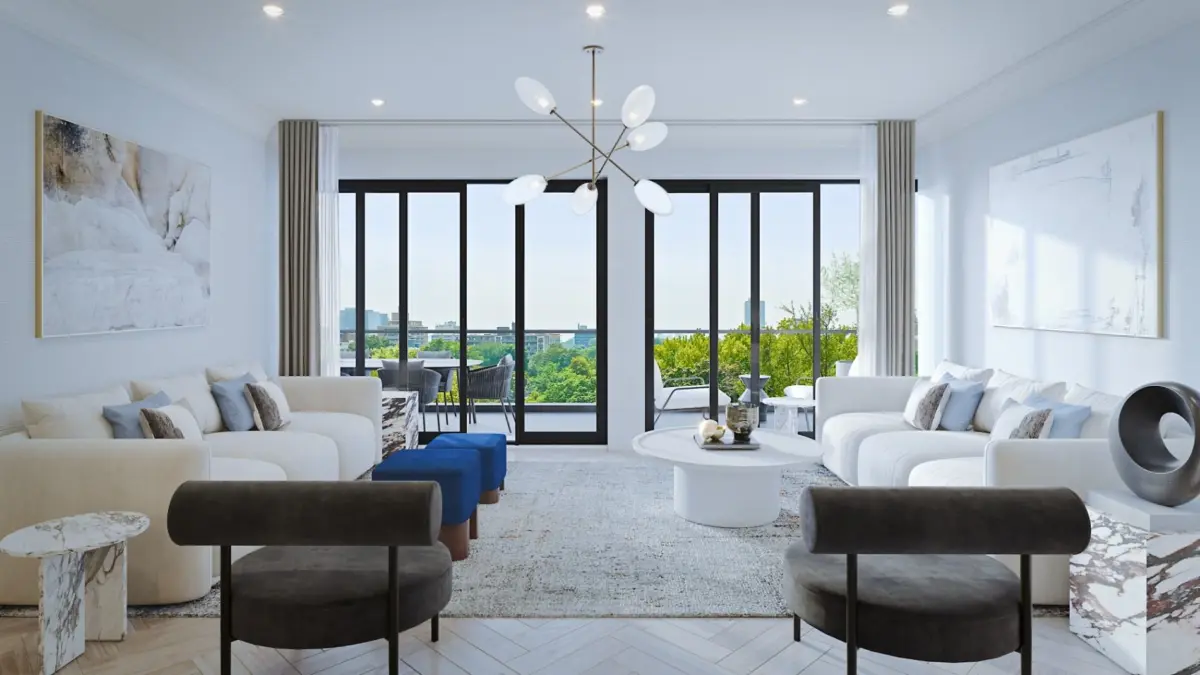
The landscape of Toronto’s real estate development is undergoing a profound structural shift. As the Greater Toronto and Hamilton Area (GTHA) navigates what is widely regarded as one of the toughest presale markets in decades, local condo developers are finding that traditional playbooks no longer apply. While buyers are still stepping forward to purchase new properties, they are rejecting the compact, investor-focused units that defined the city’s last major condominium boom, opting instead for larger, customizable spaces tailored for long-term living.
This evolution in market demand is vividly illustrated by the strategies unfolding at two prominent residential projects in the city: Sierra Building Group’s One Ten Avenue Road boutique development near Yorkville and the Annex, and Gupta Group’s Yonge City Square at Yonge Street and York Mills Road. Both developers are successfully navigating a remarkably sluggish economic and real estate environment, but they are doing so by fundamentally reimagining their product offerings, pivoting away from speculative investors and catering directly to end-users who intend to call their developments home.
Presales Remain Near Historic Lows
The urgency behind these strategic pivots is underscored by broader market data tracking the dramatic contraction of the GTHA’s presale sector. For the first time in at least thirty years, the market hit an absolute wall. Market analytics firm Urbanation Inc. reported that not a single new condominium project was launched across the GTHA during the first quarter of 2026. During that same three-month window, just 246 new condos were sold—representing a staggering 35-year low and a drop of 94 per cent compared to the region’s ten-year historical average.
While sales activity saw a modest rebound in the second quarter of 2026, rising to 702 units according to subsequent Urbanation data, the market remained severely depressed, sitting 86 per cent below the ten-year average. Crucially, a significant portion of this second-quarter improvement was driven not by traditional individual presale buyers, but by completed projects, including bulk institutional purchases by investment groups.
Faced with a prolonged slump in traditional presales, developers have been forced to reevaluate how to bring new projects forward. The experiences of Sierra Building Group and Gupta Group demonstrate that while buyers remain active, capturing their attention requires a deliberate shift toward livability, customization, and larger floor plans.
Who Is Still Buying?
At One Ten Avenue Road, a planned 72-residence boutique luxury development situated near the prestigious Yorkville and Annex neighborhoods, sales have reached approximately 40 per cent since launching presales in the spring. According to Jeffrey Kansun, managing partner of Sierra Building Group, the demographic driving these sales looks entirely different from the investor class that dominated previous market cycles.
Kansun notes that the vast majority of purchasers at One Ten are downsizers—affluent individuals transitioning away from large, high-end detached homes who still demand luxury living but wish to escape the burdensome maintenance associated with a private yard, swimming pool, and extensive property upkeep. This shift in buyer profile has fundamentally changed the transaction dynamic.
Reflecting on the contrast between the current market and the speculative frenzy of past years, Kansun points out that the luxury sector operates under completely different rules. The previous market environment relied heavily on speculators and investors treating residential units as interchangeable commodities, enabling projects to effortlessly churn through 50 or 100 sales over a single weekend and rapidly hit their financing presale targets.
Today, however, developers like Sierra are selling homes to real people with distinct choices and personal stakes in where they live. Because these end-user buyers are purchasing homes for their own occupation rather than for quick short-term gains or rental yields, they exercise a much higher degree of deliberation, resulting in a naturally slower sales cycle.
Buyers Are Combining Units
This deliberate approach among luxury buyers comes with a distinct set of operational trade-offs, but it also reveals clear insights into what modern consumers value. While pricing at One Ten Avenue Road starts at approximately $1 million, Kansun explains that many purchasers are opting to combine smaller suites into much larger, customized living spaces. Consequently, the typical purchase price for these combined homes is landing around $3 million before factoring in personalized interior customization.
To accommodate and encourage this demand for personalized design, Sierra Building Group introduced a specialized initiative known as the "Crafted by You" program. This offering gives purchasers the opportunity to collaborate directly with project architect Richard Wengle alongside one of four prominent interior design firms to fundamentally alter layouts and finishes before construction is finalized. Kansun notes that this program was born out of direct feedback from prospective buyers who inquired early on about the feasibility of modifying standard floor plans before the project officially launched.
Gupta Scales Back Units, Scales Up Suite Size
Farther north along the Yonge Street corridor, Gupta Group has responded to evolving consumer preferences with an even more dramatic structural redesign of its Yonge City Square project. Originally conceived as a dense residential development comprising roughly 700 units, the developer chose to significantly scale back the overall density, reducing the planned count to approximately 500 residences.
This reduction was achieved by amalgamating units to create a much higher proportion of spacious two- and three-bedroom homes. According to Gupta Group founder and chairman Steve Gupta, roughly half of the newly configured residences are dedicated two-bedroom suites, while another 15 per cent comprise expansive three-bedroom floor plans designed to accommodate families and downsizers alike.
Gupta observes that the historical industry trend favoring hyper-compact, micro-condos designed primarily for investors has run its course. Emphasizing that market sentiment has shifted toward genuine livability and comfort, Gupta notes that modern residents are placing a much higher premium on their daily living conditions and require functional spaces that support a higher quality of life. Current pricing at Yonge City Square ranges from $1.5 million to $5 million, complemented by an exclusive collection of penthouses valued at around $10 million. Like Kansun, Gupta identifies downsizers as a critical engine of current demand.
Building Before the Sales Are There
The divergence from traditional development models extends beyond floor plan adjustments into the realm of construction financing and project timelines. Under standard market conditions, condo developers typically wait until they have pre-sold 70 to 80 per cent of a building’s units to secure conventional construction financing from institutional lenders. However, the prolonged stagnation in the presale market has forced some developers to chart alternative paths.
Gupta Group initiated construction work on Yonge City Square in January 2025. Despite the project achieving a sales rate of approximately 33 to 35 per cent, the developer has elected not to wait for additional presales before pushing forward with construction. Gupta explains that the firm is utilizing its own corporate capital to fund the building process, deliberately choosing to self-finance rather than lose valuable time waiting for a sluggish market to catch up.
At One Ten Avenue Road, Sierra Building Group is targeting the commencement of construction in early 2027. Kansun notes that the boutique project must still achieve a specific presale threshold to satisfy its financing requirements, though he declined to disclose the exact target. Nevertheless, he expresses confidence in the project’s trajectory, noting that they are not terribly far from reaching their goal.
Condo Sales Ticking Up Across Price Ranges
Broader market metrics compiled by real estate analytics platform HouseSigma provide additional context on how transaction activity is shifting across various price tiers within the Greater Toronto Area. Data provided to real estate media shows that 60 GTA condominiums priced at $2 million or more were sold between May and July, representing a 9.1 per cent increase compared to the 55 luxury transactions recorded during the same period in the previous year. While this translates to an absolute increase of just five additional sales, it highlights sustained pockets of resilience at the high end of the market.
Conversely, mid-tier condo sales spanning the $1 million to $2 million range experienced a 7.3 per cent decline over the same comparative period. Across the entire GTA condominium market, total transactions registered a modest overall increase of 3.9 per cent.
Notably, HouseSigma’s findings also revealed a significant surge in lower-priced transactions, with sales of condos priced below $500,000 rising by 64 per cent. These lower-priced units accounted for 37 per cent of all condo transactions during the tracked period, up sharply from 23 per cent a year earlier. Joannah Connolly, head of content and PR at HouseSigma, cautioned that this pronounced shift toward lower price points could be indicative of falling market prices, a structural change in the types of inventory being actively traded, or a combination of both market dynamics.
A New Way of Doing Things
Neither of these major residential projects suggests that the broader Toronto presale market has suddenly turned a corner or shaken off its overarching lethargy. Prospective buyers remain undeniably cautious, and convincing a sufficient volume of purchasers to walk through the sales office doors remains a formidable operational hurdle for developers across the region.
Even so, both Gupta Group and Sierra Building Group are actively moving their respective projects forward through distinct adaptations. Gupta Group has chosen to cut roughly 200 units from Yonge City Square while deploying its own private capital to back construction, whereas Sierra is giving One Ten Avenue Road’s sales cycle more time to mature while offering high-end buyers unprecedented flexibility in layout customization.
For Kansun, the underlying lesson of these evolving strategies is straightforward and rooted in the fundamentals of residential real estate. As he observes, when a developer builds something that is genuinely suitable and desirable for everyday living, people ultimately want to buy it.