
The British government has formally accused the Iranian state of orchestrating a major security alert outside a strategic military airbase in southern England, setting off a sharp diplomatic confrontation between London and Tehran. The incident, which triggered a significant counterterrorism operation outside RAF Fairford late last month, has prompted immediate punitive measures from Westminster, including the summoning of the Iranian ambassador, targeted economic sanctions against senior operatives, and a strongly worded multilateral rebuke endorsed by close international allies.
British authorities revealed that the alert centered on the activities of a group of British nationals detained outside the Gloucestershire installation, an airbase vital to Western military operations and heavily utilized by the United States Air Force. The government’s assessment points directly toward the upper echelons of the Iranian security apparatus, alleging that state elements in Tehran sought to coordinate hostile activities on British soil utilizing proxy criminal assets.
The diplomatic fallout escalated rapidly following official statements in London. Five British nationals were initially apprehended in the immediate vicinity of the RAF Fairford perimeter on September 27 on suspicion of serious offenses under terrorism legislation and the Explosives Act. While those suspects were subsequently released on bail under strict monitoring conditions, a sixth suspect was arrested in the days that followed. The ensuing counterterrorism investigation quickly expanded beyond domestic policing into a high-stakes intelligence inquiry regarding foreign interference.
From the early stages of the probe, specialized counterterrorism investigators acknowledged that they were actively examining the potential involvement of a foreign hostile state. That working hypothesis gained significant weight due to the sensitive nature of RAF Fairford itself. Situated in a rural expanse north of Swindon, roughly two hours west of London, the airbase serves as an essential forward-operating hub for American strategic aviation in Europe. It routinely accommodates long-range American heavy bombers, including supersonic B-1 Lancers and long-range B-52 Stratofortresses, aircraft possessing ample operational range to conduct missions across the Middle East, including reaching Iran.
What Did Prime Minister Andy Burnham Tell Parliament?
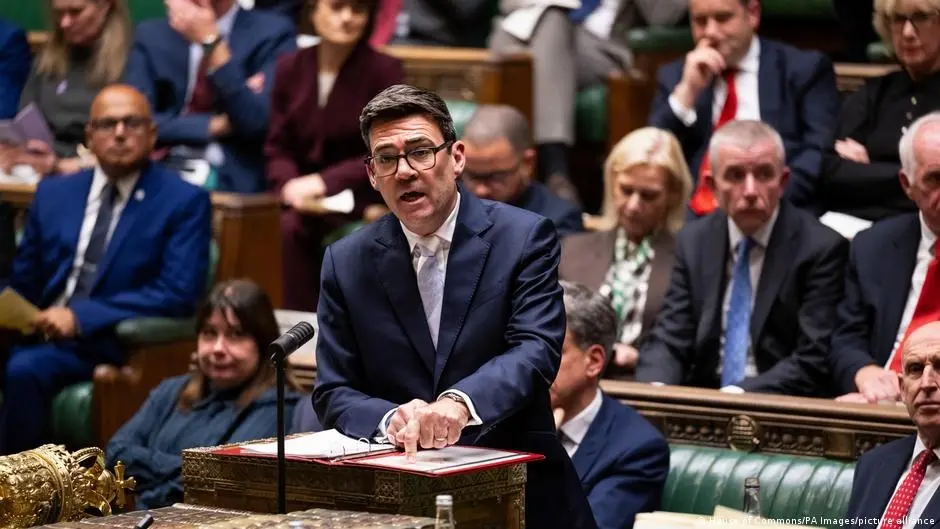
Addressing lawmakers during an urgent statement in the House of Commons, Prime Minister Andy Burnham confirmed the intelligence findings and delivered an unsparing assessment of the incident, warning that the United Kingdom was prepared to introduce further punitive measures against Tehran if necessary.
Burnham told the Commons that intelligence agencies had reviewed the circumstances surrounding the Fairford operation and identified unmistakable links pointing back to Iranian state organs. The prime minister made it clear that London had concluded the security incident was not merely an isolated domestic disturbance, but rather an operation guided from abroad.
"I can confirm our assessment that it is highly likely to have been coordinated in Iran, almost certainly directed by Iran’s Islamic Revolutionary Guard," Burnham informed members of parliament, referring to the IRGC, the ideological military organization tasked with safeguarding Iran’s political system and conducting covert external operations. He emphasized that the British state would respond decisively to preserve national integrity: "We will not tolerate these threats on our soil."
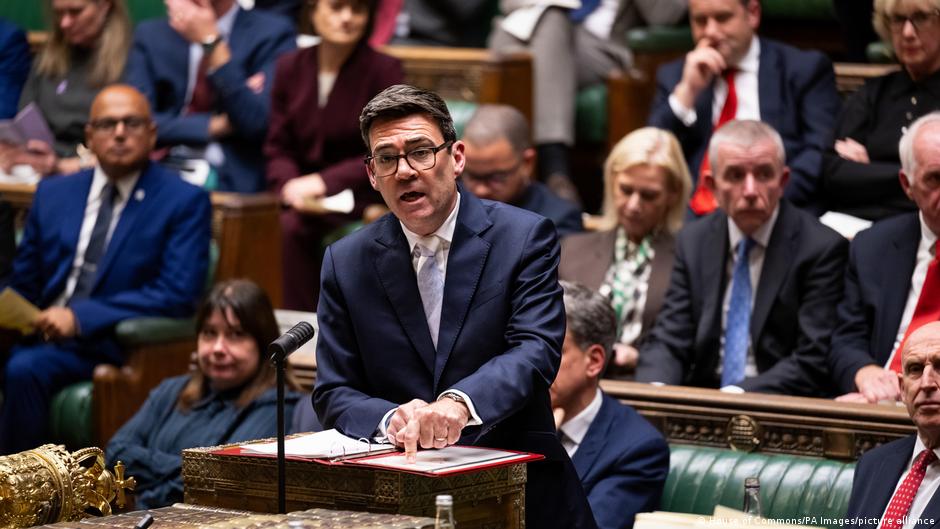
The prime minister detailed the operational mechanisms through which foreign intelligence services seek to mask their hand, particularly by enlisting local actors. Burnham pledged that the United Kingdom would deploy its comprehensive legal and security powers to disrupt the conduit between overseas handlers and domestic syndicates.
"We will crack down on Iran’s use of criminal networks, using our full range of powers to target them and their funding streams, and we will bring further sanctions to restrict the capacity of Iran and the IRGC to do us harm," Burnham said.
Despite the severe geopolitical implications, investigators have presented a complex portrait of the suspects’ operational capabilities. The degree of competence exhibited by the group—identified as young British men originating from London—and the actual physical danger they posed to the heavily secured perimeter remain subjects of scrutiny. Security analysts have noted that the potential threat appeared somewhat limited when contrasted with the extensive scale of the emergency response.
Initial investigative findings indicate that while the discovery of the men’s transport triggered an expansive security cordon and the urgent deployment of military explosive ordnance disposal teams, forensic specialists ultimately did not locate viable, assembled explosive devices inside the vans. Nevertheless, search teams did recover hazardous combustible accelerants, specifically petroleum, raising concerns that the suspects intended to execute an arson attack, construct an improvised device, or cause widespread disruption around the installation’s entrances.
Even if the operational execution was amateurish or flawed, the incident succeeded in causing a major disturbance at one of the West’s most sensitive military facilities, triggering an international incident that reverberated through the highest levels of government and forced an operational reassessment by military planners.
Foreign Secretary Miliband Says Iranian Ambassador Summoned
Parallel to the prime minister’s address to parliament, Foreign Secretary Ed Miliband took decisive diplomatic action, summoning Iran’s ambassador to the United Kingdom to the Foreign, Commonwealth and Development Office in London for a formal reprimand.
Miliband announced that the ambassador had been called in to hear firsthand London’s condemnation of the alleged plot and to "reiterate" the unequivocal message that the British government "will not tolerate attacks on our soil." The foreign secretary emphasized that state-sponsored operations targeting domestic infrastructure, allied military assets, or British communities would be met with an uncompromising diplomatic and legal response.

The Iranian mission in the United Kingdom moved swiftly to reject the accusations. According to accounts carried by Iran’s official state news agency, IRNA, Iranian Ambassador Ali Moussavi categorically dismissed the British government’s assertions as baseless. The ambassador mounted a firm defense of his government, calling upon British authorities to present substantive, verifiable evidence supporting their allegations if London possessed any genuine proof.
Unmoved by Tehran’s denials, Miliband confirmed that the British government was imposing immediate and targeted financial and legal sanctions against two key figures linked to the apparatus responsible for hostile overseas ventures. Under the measures announced, both named individuals are subject to an asset freeze, an absolute ban on entering the United Kingdom, and formal director disqualifications preventing them from conducting commercial enterprise under British jurisdiction.
The sanctioned individuals were identified by the foreign secretary as Ruhollah Bazghandi and Shahram Ali Reza Tamarzadeh Jakki. Bazghandi was identified as the head of counterespionage operations within the IRGC, placing him directly within the chain of command responsible for clandestine overseas security planning. Tamarzadeh Jakki was characterized by British authorities as an alleged operational facilitator operating on behalf of the Zindashti criminal network, an international syndicate that Western intelligence services have linked to previous state-sponsored operations abroad.
Miliband stated that the sanctions were enacted specifically to hold the two men accountable for "their role in facilitating or engaging in hostile activity on behalf of the Iranian regime, with the clear intent of threatening, planning or conducting attacks overseas." The Foreign Office emphasized that leveraging organized crime syndicates to conduct acts of terror or subversion is a tactic designed to provide plausible deniability, a practice British enforcement agencies are committed to systematically identifying and dismantling.
Joint Statement From 29 Countries Condemns ‘Iran’s Use of Violent Attacks’
The confrontation in London quickly gained wider international momentum as a coalition of nearly thirty allied nations rallied behind the British government’s stance. Shortly after the announcements in parliament and the Foreign Office, a total of 29 countries issued a joint diplomatic statement denouncing Tehran’s external operations.
In their unified declaration, the signatory nations denounced "in the strongest terms Iran’s use of violent attacks" across foreign jurisdictions. The collective statement went on to detail a disturbing pattern of state-directed aggression, specifically citing "the acts of lethal plotting, arson, sabotage, cyber-attacks, and other hybrid activities against us and our partners."
The breadth of the international coalition reflected significant alarm across the Western security architecture. All member states of the Five Eyes intelligence-sharing alliance—comprising the United Kingdom, the United States, Canada, Australia, and New Zealand—joined the condemnation. They were joined by a predominant majority of European NATO members, with signatories explicitly including major regional powers such as France, Germany, and Spain, alongside non-NATO partners like Ireland.

The multilateral response underscored widespread apprehension among allied defense ministries regarding hybrid warfare tactics, wherein hostile states deploy non-traditional methods, including cyber operations, local proxy groups, and arson, to challenge national defenses below the threshold of open military conflict.
The operational repercussions of the Fairford alert were felt almost immediately at the installation itself. In the tense days following the September 27 incident, the United States military adjusted its tactical footprint in the region. Advanced American B-1B Lancer bombers, known for their sophisticated strike capabilities and low-altitude performance, were withdrawn from RAF Fairford and ordered back to their home bases. Meanwhile, the larger, venerable fleet of B-52 Stratofortress heavy bombers maintained its presence on the Gloucestershire tarmac, ensuring that allied strategic air capabilities in Western Europe remained operational.
RAF Fairford occupies a distinct place in Anglo-American military cooperation. It represents one of several key installations across southern England that maintain an extensive American operational footprint, serving as a designated forward operating location for US Air Force heavy bomber rotations during heightened global tensions.
The base carries an extensive military heritage. Like many vital air installations scattered across the English countryside, Fairford’s operational origins trace back to the Second World War. During that conflict, as Nazi Germany occupied mainland Europe, the base played an integral role as Allied air forces staged bombing campaigns and carried out crucial logistics and troop-transport operations in the meticulous preparations leading up to the Allied D-Day landings in Normandy. Decades later, the airbase remains an indispensable node in transatlantic defense, an enduring strategic value that made the recent security breach a focal point of urgent concern across European capitals.