
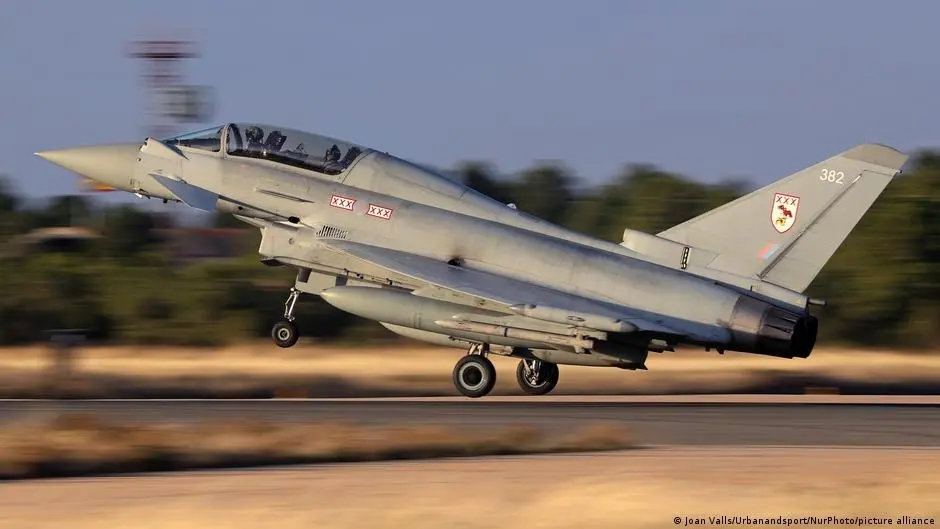
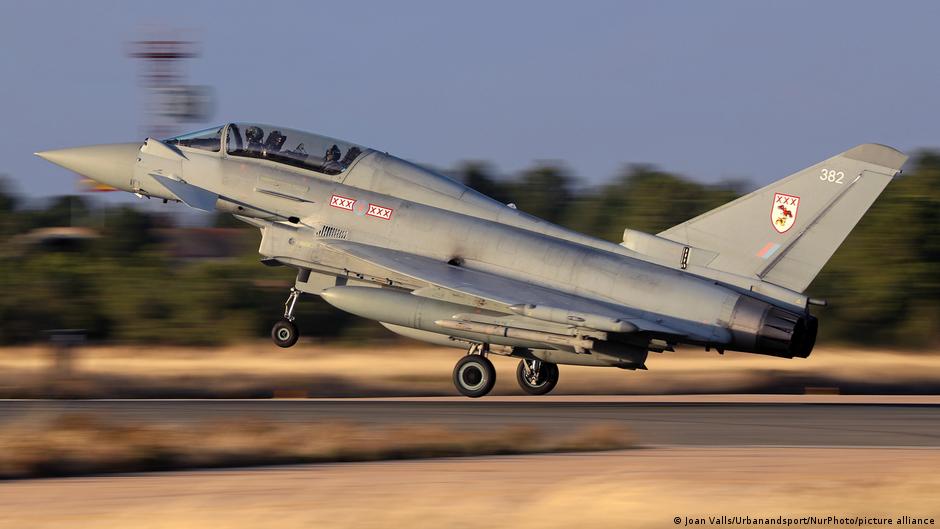
LONDON — Britain will deploy Royal Air Force Typhoon fighter jets to Saudi Arabia to assist in defending the kingdom against an intensifying campaign of missile and drone strikes launched by Yemen’s Houthi movement, the British government announced on Tuesday.
The deployment marks a notable expansion of direct British military involvement in the defense of Saudi sovereign territory, responding to an urgent request from Riyadh following a sharp escalation in cross-border aerial assaults. According to the UK Ministry of Defence, the primary mission of the advanced multirole combat aircraft will be to intercept incoming unmanned aerial systems and ballistic or cruise missiles aimed at major Saudi population centers and vital national infrastructure.
British officials made clear that the Royal Air Force (RAF) assets operate under a strictly defined mandate. The Typhoons are deployed solely for defensive air patrol and interception duties within Saudi airspace and will not participate in offensive operations or counter-strikes targeting Houthi positions inside Yemen.
British Defence Secretary Wes Streeting issued a sharp condemnation of the sustained rebel bombardment, underscoring London’s security commitment to its Gulf partner amid deteriorating regional stability.
"The continuing attacks from the Houthis on our ally Saudi Arabia are absolutely despicable," Streeting said in an official statement detailing the deployment.
The Defence Secretary specifically highlighted the deliberate targeting of civil aviation, drawing attention to repeated strikes against the kingdom’s primary commercial travel hub. Riyadh’s international airport has been targeted 20 times since the beginning of October alone, representing an unprecedented barrage against the capital’s principal civilian air corridor.
The sustained campaign against the international airport has extracted a severe humanitarian toll. Aerial strikes on the facility have killed at least 18 people and wounded hundreds of others over the course of the month, causing extensive disruptions to commercial aviation, shattering passenger terminals, and creating profound security alarm across the capital.
The UK Ministry of Defence emphasized that the deployment of the Typhoons is intended to bolster the kingdom’s multi-layered surface-to-air missile shields, providing airborne early warning integration and high-speed interception capabilities capable of downing low-flying loitering munitions and cruise missiles before they reach populated municipal districts or strategic installations.
What Additional Military Support Is Britain Providing?
The dispatch of the Typhoon detachment represents the cornerstone of a broader, comprehensive security package delivered at the direct request of the Saudi government, dramatically expanding bilateral military assistance measures initially unveiled by London in September.
Alongside the deployment of the fighter squadron, the Ministry of Defence confirmed that Britain will dispatch an Atlas A400M military transport aircraft to the region. The four-engine turboprop tactical airlifter will provide essential operational mobility, logistics transport, and supply-chain continuity for deployed forces, facilitating the rapid movement of technical equipment, spare parts, and personnel between British air bases and operational hubs in the Gulf.
Furthermore, London is deploying a cohort of specialized British military advisers to the kingdom. These personnel will work alongside the Royal Saudi Air Force and joint air defense commands to enhance operational coordination, improve radar integration, and refine tactics for countering mixed salvos of asymmetrical aerial threats, including autonomous attack drones and precision-guided rocketry.
To sustain current aerial operations, the British government has also formally extended its agreement to provide air-to-air refueling support for Saudi military aircraft operating against the Houthis. The logistical arrangement, which enables Saudi warplanes to extend their patrol endurance and loiter time along critical border sectors and maritime approaches, has been prolonged for an additional 90 days.
This expanded British assistance arrives at a critical juncture, as Yemen’s protracted civil war experiences a violent and dangerous resurgence. The renewed fighting follows the comprehensive breakdown in September of a fragile, years-long truce that had previously offered the Arabian Peninsula a protracted respite from high-intensity conflict.
Following the collapse of that negotiated ceasefire, hostilities have rapidly spiraled into high-intensity warfare. Rebel forces have dramatically intensified their cross-border offensives, moving past localized frontline engagements to target high-value targets deep within Saudi Arabia. The aerial campaign has increasingly singled out Saudi energy infrastructure, including state-run oil processing facilities, bulk fuel storage farms, and civilian installations essential to the kingdom’s domestic utility networks.
Simultaneously, the conflict has spilled over into vital maritime corridors flanking the Arabian Peninsula. Houthi forces have enforced an aggressive naval blockade across surrounding waters, deploying anti-ship missiles, waterborne improvised explosive devices, and armed aerial drones to attack commercial tankers and merchant shipping. The disruption has severely threatened primary maritime routes, impeding crude oil exports from the world’s most critical petroleum-producing region and triggering acute volatility across international energy markets, driving up global fuel prices.
Within Yemen, the resurgent warfare has unleashed catastrophic violence on ground forces. Highlighting the scale of the renewed internal clashes, Yemeni authorities reported that a massive Houthi strike on Monday struck a military training camp housing Saudi-backed government security forces, killing at least 58 personnel and injuring dozens of recruits.

The rapid proliferation of sophisticated military hardware in the hands of the rebel movement has renewed fierce international scrutiny over foreign backing. Both Saudi Arabia and the United States have repeatedly accused the government of Iran of covertly supplying, training, and financing the Houthi movement with ballistic components, loitering munitions, and anti-ship systems. Officials in Tehran have consistently denied allegations that they provide direct military equipment to the rebel forces.
How Is the Conflict Affecting Saudi Arabia’s Economy?
The dramatic escalation in aerial attacks is exacting a profound toll on Saudi Arabia’s overarching domestic transformation strategy, threatening to undermine the foreign investment climate critical to its long-term modernization plans.
In a stark indicator of the prevailing regional insecurity, Saudi authorities have officially postponed the kingdom’s flagship Future Investment Initiative (FII) summit, rescheduling the high-profile gathering until 2027. Informally christened "Davos in the Desert," the annual gathering serves as Riyadh’s premiere global economic showcase, traditionally gathering thousands of heads of state, Wall Street chief executives, global central bankers, and sovereign wealth fund managers to broker multi-billion-dollar deals in the capital.
The summit had been slated to take place between October 26 and October 29. It was anticipated to draw the world’s foremost financial leaders to discuss institutional partnerships, technology transfers, and massive infrastructure capital projects.
However, mounting security anxieties fundamentally altered the viability of holding the marquee event. Major international banking conglomerates, Wall Street investment houses, and global private equity firms communicated urgent security apprehensions to host organizers regarding the advisability of sending senior executive delegations into Riyadh amid ongoing, near-daily missile and drone alerts.
With Riyadh’s international airport targeted repeatedly throughout the month and suffering civilian fatalities, the physical vulnerability of corporate leadership, commercial flights, and event venues presented insurmountable logistical and safety risks.
The deferral of the economic conference strikes at the very heart of the kingdom’s broader developmental trajectory. The Future Investment Initiative is central to Riyadh’s strategic blueprint to transition its domestic economy away from historic oil dependence, generate non-hydrocarbon state revenues, and attract foreign direct investment into burgeoning sectors such as manufacturing, tourism, logistics, and renewable energy.
By repeatedly striking energy assets, disrupting key international shipping lanes, and penetrating air defenses protecting the capital city’s commercial gateways, the Houthi campaign has elevated sovereign risk profiles for the Gulf state. With vital infrastructure under constant threat, the British military deployment provides an urgent defense buffer, intended to stabilize Saudi airspace, safeguard civilian lives, and mitigate the destabilizing economic shocks reverberating across the wider region.