
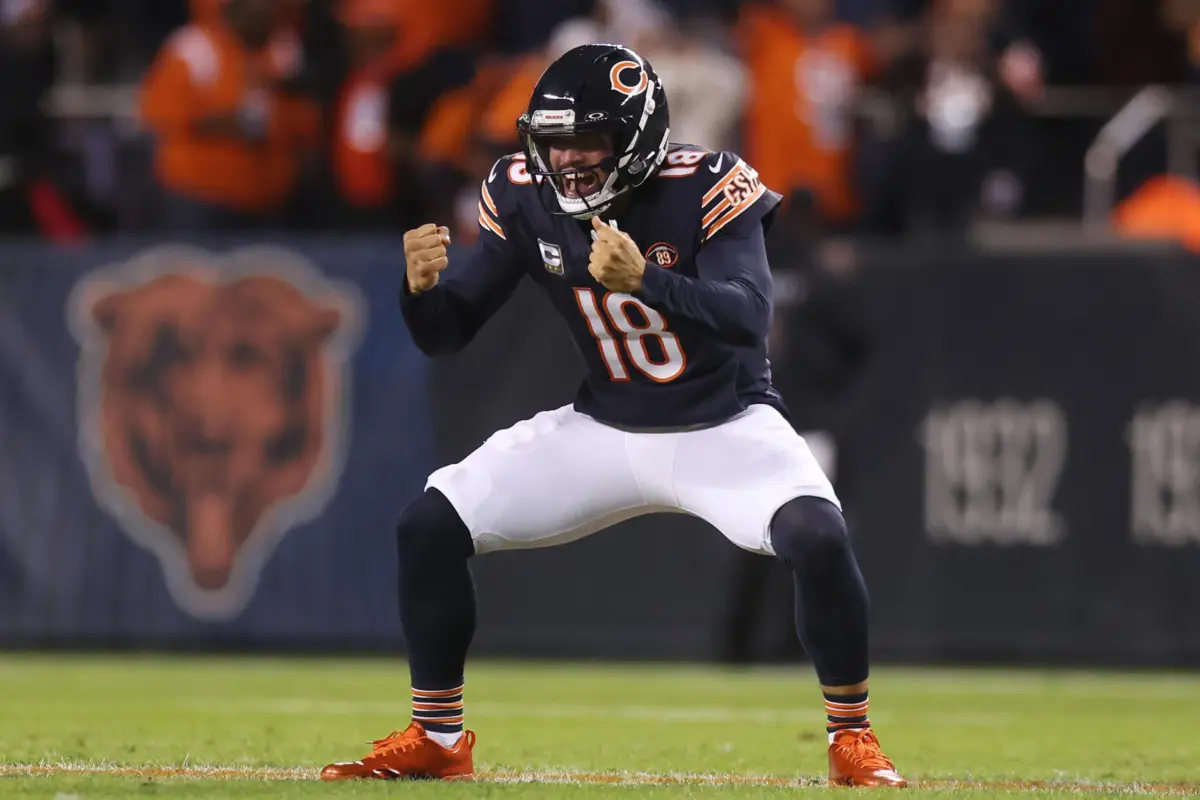
Fourth-wave sports culture has officially found a new frontier: the delay take.
It would have been easy enough to write a fiery, reactionary piece declaring the Chicago Bears the undisputed Super Bowl favorites following their monstrous, statement-making win over the Seattle Seahawks on Monday Night Football. That was the night when the world watched Jeffrey Simmons and Montez Sweat go to town on the defending champions, while Caleb Williams, D’Andre Swift, and an army of dynamic pass catchers diced up Seattle’s vaunted defense. They moved the ball with the precision of expert fugu sushi chefs, specially trained to carve up pufferfish in a delicate, high-stakes manner so that instead of causing disaster, it becomes a brilliant delicacy. But that hasty declaration was intentionally avoided.
Instead, the take was delayed until after one of the most ridiculous, out-of-control carnival explosions of a football game imaginable. Even after watching Caleb Williams throw four interceptions against the Tampa Bay Buccaneers in an afternoon of general, beautiful football drunkenness, the conclusion remains unchanged: the Chicago Bears should be Super Bowl favorites. It is still what the tape showed on Sunday Night Football, it is still the reality observed on the field, and now, that perspective has become infinitely more interesting. The chaotic turnovers against Tampa Bay provided a glorious layer of nuance to a thesis that is bound to become the gold standard of sports commentary in five years.
Looking at the broader landscape, the Bears are not yet the consensus Super Bowl favorites according to betting markets, though the top tier of the NFL features a shockingly tight race. On FanDuel, the Bears sit at 8 to 1 odds, trailing only the San Francisco 49ers and the Buffalo Bills, who are deadlocked for the top spot at 6 to 1. That represents one of the tightest betting ecosystems seen this far into an NFL season in recent memory, directly reflecting the absence of an assumed institutional favorite of yesteryear—the kind of unquestioned juggernaut status once held by the New England Patriots, the Kansas City Chiefs, or the Los Angeles Rams in their prime windows. Meanwhile, the Jacksonville Jaguars, who notably traded for safety Jessie Bates III right as this analysis was being formulated, are breathing down the Bears’ necks at +850.
Despite the current odds, the argument stands that Chicago belongs ahead of both Buffalo and San Francisco, even after Sunday’s fascinating exercise in testing just how many turnovers a team can commit and still manage to walk away with a victory. The internet was fully prepared and waiting to unleash its harshest criticisms on Drake Maye following his three interceptions against the Green Bay Packers in the Patriots’ blowout loss. Yet, when Caleb Williams went out and threw four picks—and still managed to win—it caused widespread confusion across the football landscape.
Much of that outcome stems from the fact that the Buccaneers never mounted a serious downfield passing game. For Tampa Bay to win the turnover margin by three and still lose points to a stark mismatch in raw offensive ability. The Bears could not always move the ball effortlessly when they needed to on Sunday night, but they moved it just enough to overwhelm an opposing offense that simply had nothing going for it.
That might sound like a tepid endorsement, but it merely represents the offensive floor for this Chicago team. Their ceiling is, quite simply, the most explosive and unstoppable attack in the NFL. When Luther Burden III is slicing through the middle of the field and Rome Odunze is routinely winning his matchups on the outside, the offense possesses limitless potential. D’Andre Swift continues to put together an excellent season on balance, even if he experienced a rare off night, and the eventual return of running back Kyle Monangai promises to elevate the ground game to even greater heights.
Because Caleb Williams plays the game with an arm that appears to have been surgically replaced with a bionic slingshot-railgun-beam-cannon, he is one of the very few quarterbacks in the league capable of dragging his team out of virtually any bad situation. Much like Drake Maye, Williams operates under the absolute conviction that he can fit any pass into any narrow window and layer any throw over any number of defenders. And the truth is, he pulls it off far more often than probability suggests he should. However, his youth occasionally yields those "oh my god, what was he thinking?" interceptions. It is rarely a matter of failing to see the defender; rather, he sees the defender clearly and genuinely believes he can beat him anyway.
When weighed against the surrounding talent, the breathtaking offensive heights reached under Williams far outweigh any concerns over those occasional over-ambitious mistakes. Any coach or analyst would rather possess the dynamic quarterback who can improvise his way out of a jam alongside Ben Johnson—a playcaller trusted to construct the right game plan—than lack that caliber of quarterback and simply be trapped in the jam.
Then there is the factor of the defense, anchored by the addition of Jeffrey Simmons, a move that transformed this unit from solid to potentially dominant virtually overnight. Admitting initial hesitation regarding the trade is only fair; surrendering two first-round picks for an interior defensive lineman is a massive gamble. Yet, Simmons has clearly unlocked the full potential of both the pass rush and the run-stopping capabilities since arriving just a couple of weeks ago. There is every reason to believe this defense will only continue to tighten its grip as familiarity and chemistry grow.
By contrast, the Bills and the 49ers carry defensive question marks that do not exist with the Bears. No doubt, the public hype train will quickly re-board the 49ers in the NFC after they smoked the Raiders following their bye week. But it is difficult to simply hand-wave away their earlier loss to the Atlanta Falcons as if it never happened—a jarring performance against a team that has hardly established itself as a powerhouse. The Bills, meanwhile, surrendered 29 points in a loss to the Patriots, alongside narrow wins in which they yielded 34 points to the Rams and 30 to the Raiders. Those defensive vulnerabilities make it hard to buy in completely just yet.
Ultimately, philosophy matters in modern football. Aggressive teams that refuse to punt and actively seek to put their opponents into an analytical straitjacket possess a distinct modern edge, especially when backed by a defense that can be trusted to hold the line. That formula presents a far more reliable investment thesis than anything currently offered by the rest of the league. Whether it is far too early to dust off the historic "Super Bowl Shuffle" remains up for debate, but the foundation in Chicago is undeniably real.