
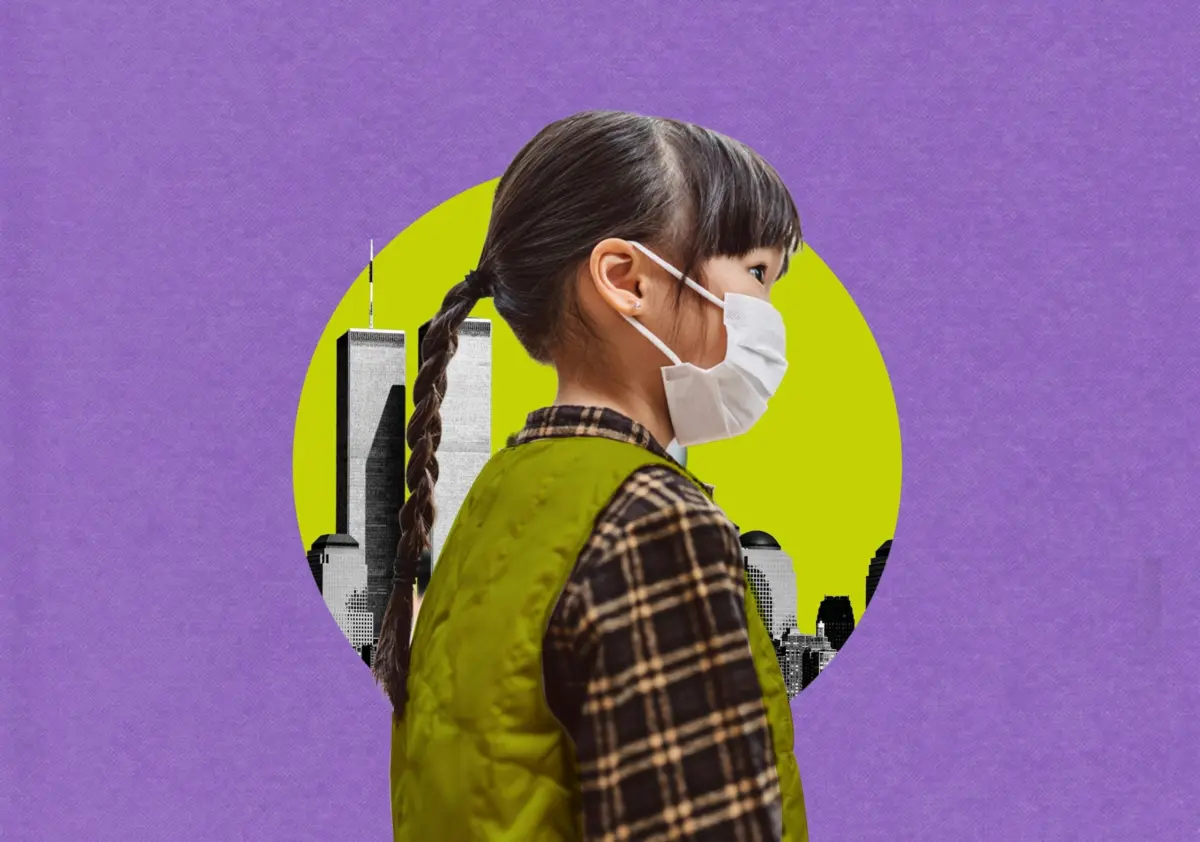
I think most parents today have that moment, that specific story we share with one another: Where were you on September 11, 2001? In the same way our parents told us about the assassinations of John F. Kennedy and Martin Luther King Jr., or the monumental broadcast of the Apollo moon landing, that Tuesday morning impacted everyone—even those of us who weren’t directly involved in the tragedy. These cultural flashpoints ripple out across each generation, shaping us and defining our collective consciousness in ways we will likely always struggle to fully describe. Yet, their impact remains utterly irrefutable.
These are the historical fault lines where everything shifts, and they carry a particularly profound weight when they occur before we reach adulthood. While we are still making sense of life, these destabilizing moments in history forge how we view the world and how we move through it. Our parents had those defining moments, we had ours, and our children will inevitably have their own.
Just as my parents did years ago, I have sat down with my own kids to tell them the story of that sunny September day when I was a high school senior in rural southwestern Pennsylvania. My story is not particularly unique; it is so identical to millions of tales from that fateful morning that it feels almost generic in its familiarity. I remember my math teacher desperately trying to ignore the chaos unfolding outside the classroom, the frantic, nervous energy that coursed through the hallways as word of the first plane hitting the World Trade Center spread. Then, I remember my biology teacher busting into the room, breathless, demanding that we turn the television on immediately. My classmate Mark did, clicking on the screen just as the second plane slammed into the South Tower in New York City.
Like everyone else across the country that day, we pieced together fragmented information as best we could. By mid-morning, the grim reality had settled in that United Flight 93 had crashed into a reclaimed strip-mine field in southwestern Pennsylvania, uncomfortably close to one of our favorite local camping spots.
I have friends who were college students in Manhattan at the time and had to run for their safety amid the choking dust; I have other friends who watched that quiet field in Shanksville billow smoke from the windows of their childhood homes. I know people who lost loved ones on that early fall morning, and I have listened year after year as those names are read aloud in solemn memory while church bells toll in the distance. During what had been an otherwise comfortable and happy childhood, September 11 was the precise moment I realized the world was far less safe than I had been led to believe. It was a naive worldview born of privilege, and it was shattered in a single, terrifying instant.
For my children, however, 9/11 is inherently different. In the exact same way I know about the moon landing or the civil rights-era assassinations from history textbooks, my kids know about that day as a historical event. Early reader books detailing the life of Martin Luther King Jr., the events of September 11, and the history of World War II—the defining global conflict of our grandparents’ generation—sit lined up side-by-side on our bookshelves with equal weight.
For them, it materializes as a worksheet about the Twin Towers brought home in a school folder with a neat "10/10" scrawled in red ink next to a cheerful smiley face. It is a dog-eared picture book that my teenager practically wore out as a little kid, and a brief archival clip on the evening news each fall that attempts to summarize unspeakable horrors into a neatly packaged segment edited to fit seamlessly between commercial breaks.
It manifests as a few digital learning lessons they click through rapidly just to make it to recess on time, and a tale told by their teachers—educators who recount where they were, what they were doing, and how it fundamentally altered their world.
Several years ago, I took my children, who were then ages 10, 8, 8, and 3, to visit the Flight 93 National Memorial. We took part in a guided tour and completed the National Park Service’s Junior Ranger program, earning little wooden badges emblazoned with the memorial’s name that now sit in a plastic bin alongside assorted souvenirs from our various family travels.
The park ranger explained the harrowing events of that morning to a group of children who stood far more solemnly than one would normally expect, seemingly absorbing the heavy weight of the hallowed space. I know I certainly felt it. The memorial itself is simplistic in its architectural design, purposefully centered on highlighting the flight path of the hijacked airliner and honoring the everyday heroes who brought the plane down right where we stood. The following summer, we took the kids to the Pentagon Memorial during a family trip to Washington, D.C., and our travel plans for the coming years include a trip to New York City, where I am certain we will pause to pay our respects at the National September 11 Memorial and Museum at the World Trade Center site.
My children will grow up with memories of these physical monuments. Decades from now, when they are in their forties, they will look through boxes of childhood trinkets and souvenirs I inevitably pass on to them, and they will hold a cheap little wooden badge and mentally connect it to a monumental moment in human history.
Yet, for our kids, the events that shifted the landscape of their reality are fundamentally different. For this generation, the COVID-19 pandemic stands as the defining, overarching trauma of their childhood. It was not localized to a single devastating morning, but rather manifested as a multi-year crisis that roiled and disrupted their formative years. They will remember the week I spent hospitalized in 2020, and they will likely retain a digital clip of themselves receiving their COVID-19 vaccines while being interviewed for a public radio segment. There are real, lingering feelings, emotions, and pains associated with that global health event, and someday, they too will sit down to tell their own children about it.
As I sit here reflecting on that morning a quarter of a century ago, I am left with a few overlapping thoughts. The first, inevitably, is the realization of my own aging—that high school was twenty-five years ago, and yet somehow feels as though it happened just last week.
Deeper than that personal reflection, however, is the profound realization that every single generation’s defining moments ripple outward through the generations that follow. In both big and small ways, the landmark events that shaped my parents as children molded them into the adults who ultimately raised me. The same holds true for my husband and me on our own parenting journey. The edifying experiences, just as much as the traumatic historical shifts, shape us into the adults and parents we eventually become.
My children may not have experienced September 11 firsthand, but they have been raised entirely within a post-9/11 world that dictates everything from global security policies down to what items they are permitted to pack in their carry-on bags when traveling to amusement parks. In the exact same fashion, the turbulent events currently shaping their childhood—including a global pandemic, ongoing wars across Eastern Europe and the Middle East, and intense domestic civil unrest—will forge the character of the adults and future parents they will one day become.
It is clear that all the disparate puzzle pieces that make up a childhood, and all the foundational building blocks that create a human life, affect us and shape us indelibly. It is an inevitable process, and perhaps not an entirely negative one. Hanging in our dining room is one of my favorite poems, "Good Bones" by poet Maggie Smith. In the verse, she writes about how stark and terrible this world can feel at times, but how we, as parents, live with that persistent weight while intentionally raising our children to take it on and make it better. That remains my ultimate hope for our collective children: that they take all the mess they have inherited and are currently living through—the bad balanced against the good—and somehow manage to create something lovely out of it.