
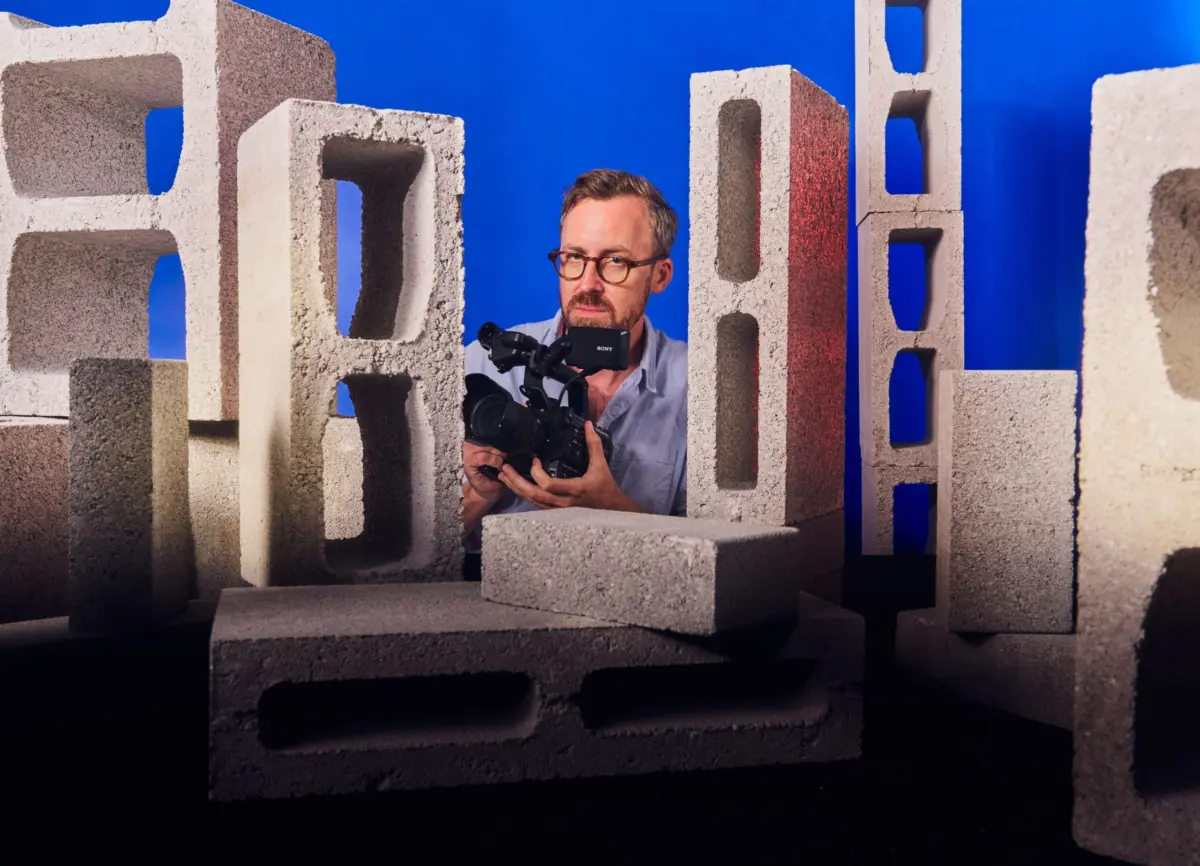
Filmmaker John Wilson and I are seated in a kitchen on the 35th floor of One World Trade Center, the tallest building in the United States. Like most of Manhattan, this colossal tower worships at the altar of concrete, which makes up its core, foundation, and floor slabs. In this single structure alone, there is enough of the material to pave more than 4,000 New York City blocks.
Concrete—the second-most-used material on earth, just behind water—is also what brought Wilson from his home in Ridgewood, Queens, to Lower Manhattan. On September 18, his first feature-length film, The History of Concrete, will be released in theaters, including Low Cinema, the intimate 40-seat venue he recently rehabilitated alongside a business partner.
Wilson is still figuring out how to precisely describe The History of Concrete, characterizing it as "a million things at once." Running an hour and 40 minutes, the project is ostensibly what its title suggests: a documentary about concrete, the foundational substance that comprises most of the world’s towers, sidewalks, streets, and houses. But much like his Emmy-nominated HBO docuseries How to With John Wilson, that material investigation serves merely as an entry point to a much more complex, multifaceted story about how the built world goes up and what ultimately takes it down.
It functions as a meditative exploration of impermanence, as well as a candid portrait of the trials and triumphs of making independent art under capitalism. Above all, Wilson delivers an urgent plea for society to think more deliberately about the urban environment, challenging audiences to imagine the possibility of a thousand-year city rather than resigning themselves to the "50-year" version he believes we currently inhabit.
As viewers, our journey through these dense themes begins close to home, right inside Wilson’s own Ridgewood residence. There, a failing, cracked foundation causes stormwater to gurgle up from the depths of the earth. The concrete that has historically kept his house from sinking into the ground is severely degraded, prompting Wilson to attempt patching it himself, ultimately leaving behind a craggy, keloid-like scar on his patio.

"Most people just hire a contractor," he reflects during our conversation, "but I got a bunch of books and wanted to understand concrete on a more molecular level, to figure out what my house is even made of, and whether or not repairing it now is going to save me a headache in the future."
This domestic frustration led him to embark on a global journey to trace some of the earliest examples of concrete, such as structures in Italy that still stand strong nearly two millennia after the decline of the Roman Empire. If this ancient material has managed to endure for centuries, Wilson wonders, why is his own home falling apart? And, more broadly, why does nearly everything else in our modern built environment seem to be deteriorating as well?
Throughout the feature, Wilson continues the distinct auteur style of filmmaking he has meticulously honed over the past decade and a half, including across three acclaimed seasons of his HBO series. He and his dedicated production team document the vibrant, chaotic life on the streets of New York—and occasionally venture elsewhere, finding humor in ludicrously mundane Las Vegas trade shows—capturing the kinds of outrageous yet ordinary moments that most passersby register only fleetingly without ever stopping to engage.
His camera patiently lingers where others look away. Stitched together, these disparate scenes form a meandering, essayistic narrative that responds directly to Wilson’s own personal curiosities, while simultaneously acting as an aperture onto thornier, deeply existential topics. Throughout the cinematic experience, Wilson serves as our modern Virgil, guiding us both physically and emotionally through the urban landscape via his signature disembodied voiceover.
In The History of Concrete, the filmmaker spends a significant portion of his runtime observing the city’s steadily failing infrastructure: its aging public pools, gum-spackled sidewalks, and the complex triple-cantilever of the Brooklyn-Queens Expressway, a crumbling yet vitally important thoroughfare that carries roughly 130,000 vehicles every single day.

At one point in the film, Sam Schwartz, the city’s former traffic commissioner—who stands as close to an A-list celebrity as the world of transportation engineering has to offer, having famously coined the term "gridlock"—stands directly beneath the highway, pointing toward a concerning patch of exposed, rusted rebar. Without immediate and substantial intervention, Schwartz warns, catastrophic structural failure might simply be a matter of time.
Notably, since the final cut of the movie was completed, the city announced a massive $4-billion, 10-year rehabilitation plan aimed at this specific section of the expressway, a project promising to extend the aging infrastructure’s operational lifespan by another 40 years.
Wilson also tracks notable instances of architectural fiascos across New York City, ranging from sudden awning collapses to the deeply troubled engineering history of 432 Park Avenue, the ultra-luxury supertall situated along Billionaire’s Row. The latter example serves as a stark reminder that even the city’s wealthiest residents are ultimately imperiled by the exact same material failures as the rest of the populace.
Though some of the residential units inside the 11-year-old tower have recently commanded market listings of over $80 million, the building’s concrete has proven to be plagued by structural cracks, with its facade occasionally shedding chunks of hazardous material onto the streets below.
Beyond exploring what gets built badly, Wilson proves just as preoccupied with what never gets built at all. He describes The History of Concrete as "one of the most NIMBY movies I’ve ever seen," and his camera takes audiences directly into the fractious, emotionally charged milieu of local civic hearings and neighborhood protests.

The acronym NIMBY, which stands for "not in my back yard," describes residents who fiercely resist real estate developments or infrastructural projects proposed for their immediate communities. In Wilson’s world—which is, of course, our own shared reality—both much-needed affordable housing projects and local skate parks routinely fall into the crosshairs of local opposition. While nearly everyone involved appears to agree that these additions are fundamentally good ideas, precious few individuals seem willing to cede any portion of what is theirs to make them actually happen.
While audiences will undoubtedly find plenty of signature deadpan humor throughout the film, its underlying subject matter remains remarkably serious, a gravity that Wilson shares. He gestures not only to the structural woes of 432 Park Avenue but also to the partial collapse of the Pfizer World Headquarters in Manhattan over the summer—a high-profile site that was heavily integrated into New York’s ambitious office-to-residential conversion initiatives.
"These all seem like isolated incidents, but they are going to continue happening," he cautions.
While Wilson is quick to note that he is not a trained architect, self-effacingly describing himself as a "Mr. Bean" type of observer, his storytelling expertly wanders through the city from one seemingly unplanned pocket of interest to another. Urban and media critics might recognize this observational wandering as a dérive, an intentional drift through the urban environment.
His language remains accessible, and the design and engineering failures he documents are immediately recognizable to anyone who has spent time walking the pavement of New York City. Yet, one gets the distinct sense that this humble presentation is entirely intentional—that beneath the surface lies a carefully crafted argument formulated by a filmmaker who has spent a decade deeply immersed in urban theory.

During our conversation, Wilson cites Jane Jacobs, the legendary 20th-century urban critic and author of The Death and Life of Great American Cities, as having "lit a fire" for him back in 2008.
"It’s influenced a lot of what I do," he acknowledges.
He similarly points to James Howard Kunstler’s The Geography of Nowhere and William H. Whyte’s seminal 1980 study The Social Life of Small Urban Spaces as formative texts. Like Wilson, Whyte observed everyday street life with the detached curiosity of a wildlife photographer studying birds, watching how ordinary humans naturally adapt to environmental constraints such as benches, running water, and sunlight.
"[Whyte’s work] proves a point that wasn’t really proven up until then—that there are certain needs we have as people, and as social creatures. Being able to identify the ways that the city tries to suppress that is important," Wilson explains.
He views the various complex topics explored in the film—crumbling infrastructure, historic preservation, entrenched NIMBYism, and the spiraling affordable housing crisis—as matters of utmost urgency.

"When I made this, I was thinking about it constantly, and it affected me emotionally," he admits. "I was living with the full dosage of a lot of really depressing trivia about concrete."
Whether our endless societal cycle of building, decay, failure, and rebuilding—what might be called our collective architectural samsara—represents a natural state of things or a more insidious condition of modern capitalism is a question Wilson largely leaves for the audience to decide.
However, there is a telling moment early in the film that highlights the broader thematic stakes: teasing out a bit of metanarrative commentary, the director approaches actor Michael Imperioli while the star is struggling to secure funding for his own documentary projects. When Wilson asks what Imperioli would recommend to aspiring young filmmakers hoping to get a movie made, the actor barely hesitates before offering his advice: "To make it as inexpensively as they can, and to get it done."
As Wilson’s observant lens ultimately demonstrates, much the same could be said for the very places we construct to live our lives.