
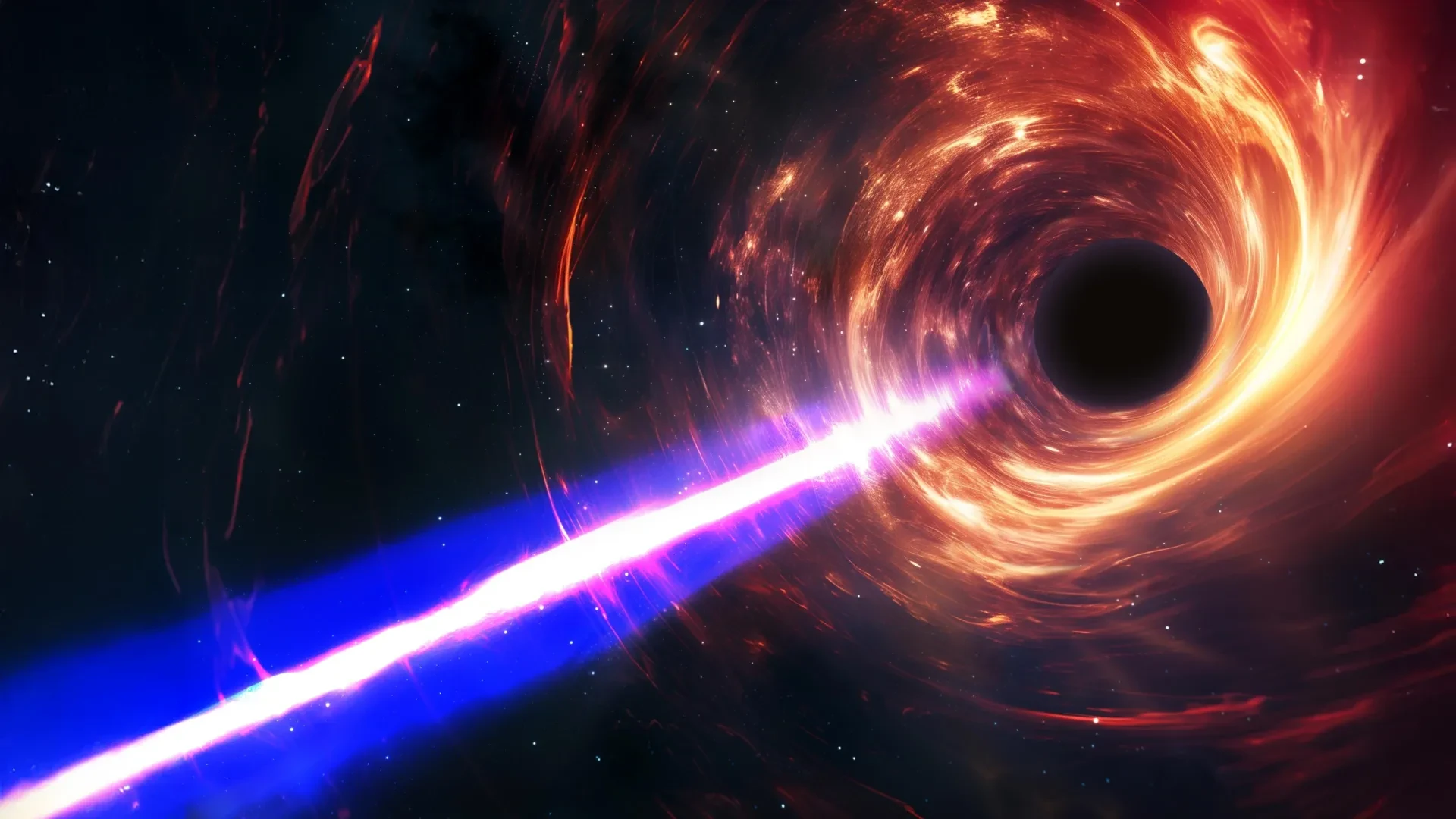
An international team of astronomers, co-led by a scholar at the Institute for Advanced Study, has identified what appears to be a universal rule governing one of the most violent and dramatic behaviors exhibited by black holes: the production of powerful, high-speed radio jets.
The researchers discovered that black holes can launch these colossal jets at the exact same critical stage of their feeding cycle, regardless of their scale. This remarkable consistency applies to both "stellar-mass" black holes, which weigh in at roughly ten times the mass of our sun, and supermassive black holes, which can be millions or even billions of times heavier.
The groundbreaking work was carried out by Andrew Mummery, a Martin A. and Helen Chooljian Member in the School of Natural Sciences at the Institute for Advanced Study, alongside Adelle Goodwin, a Forrest Research Foundation Fellow at Curtin University’s International Centre of Radio Astronomy Research in Western Australia.
Watching Black Holes Tear Stars Apart
Published in the scientific journal Nature Astronomy under the title "A universal critical accretion rate for black hole jet formation," the new study brings together years of meticulous observations compiled across multiple wavelengths. To build their dataset, the research team combined cutting-edge information gathered from an extensive network of telescopes located across the United States, Australia, India, and South Africa, as well as powerful instruments operating in space.
The primary focus of the investigation centered on tidal disruption events. These rare and energetic occurrences happen when an unlucky star passes uncomfortably close to a supermassive black hole. The immense gravitational forces exerted by the black hole subject the star to brutal tidal forces, ultimately ripping it apart in a cataclysmic display. These events provided the research team with a rare and valuable opportunity to observe precisely how a black hole behaves after it suddenly receives a massive, rich supply of stellar material.
"We really wanted to figure out this massive puzzle," explained Mummery, detailing the motivation behind the research. "Why do some supermassive black holes blast out radio jets right after shredding a star, while others just sit there looking completely dormant, only to suddenly fire up their jets months or even years later?"
Although black holes are frequently compared in popular culture to cosmic vacuum cleaners that quietly suck in everything around them, their actual feeding behavior is considerably messier and far more chaotic. When a black hole tears apart a star, it does not swallow everything neatly or all at once, as Goodwin pointed out during discussions of the study.
Instead, while a portion of the shredded stellar material inevitably spirals inward and falls toward the black hole, a vast amount of it is violently expelled back out into the surrounding space through powerful, high-velocity outflows. These enormous cosmic events act almost like galactic burps, carrying immense amounts of matter and energy across vast distances. Scientists note that these outflows can significantly affect the long-term evolution of the host galaxies that contain them, shaping how stars form and how the surrounding cosmos develops over billions of years.
A Faster Way to Study Supermassive Black Holes
For generations, astronomers have strongly suspected that black holes obey the same basic underlying physical rules, even when their individual masses differ by enormous orders of magnitude. However, confirming that theoretical idea has proven to be exceedingly difficult in practice. Changes happening in the immediate environment surrounding supermassive black holes normally unfold over extraordinarily long timescales—often taking thousands or even millions of years to complete, rendering direct human observation impossible.
Fortunately, tidal disruption events offer a clever way around this observational bottleneck. When a star is completely destroyed by a supermassive black hole, the resulting feeding episode evolves rapidly, unfolding over the course of just a few short years. This accelerated timeline gives scientists a much faster, real-time view of complex physical processes that would otherwise be virtually impossible to track over standard astronomical timeframes.
The key conceptual insight driving the new study actually emerged in a rather unexpected setting. During an intensive astrophysics conference held in Madrid, Mummery and Goodwin found themselves talking in a local bar. As they discussed their work, they realized that the same fundamental rule already known to govern jet production in smaller stellar-mass black holes might also apply directly to supermassive ones.
Two Distinct Phases of Black Hole Jets
To rigorously test this hypothesis, the researchers examined a sample of twenty tidal disruption events, utilizing observations captured across a wide spectrum of light, including optical light, ultraviolet light, X-rays, and radio waves. After thoroughly vetting the data, they eventually narrowed their sample down to ten high-quality events. For these specific occurrences, they were able to reliably determine both the exact feeding rate of the black hole and the precise timing of its subsequent radio outflows.
The detailed analysis ultimately revealed two separate, distinct periods when these powerful jets can form.
The first period occurs quite early in the process, while the black hole is actively consuming stellar material at an extremely high rate. The second period appears much later, developing anywhere from hundreds to thousands of days after the star was initially torn apart by gravity.
At this later stage, the black hole’s feeding rate drops significantly, falling to about two percent of its Eddington limit. The Eddington limit represents the theoretical tipping point at which the outward pressure exerted by intense radiation perfectly balances the inward pull of gravity.
This specific two-percent threshold is especially significant to astrophysicists because it is already well-known to trigger jet formation in much smaller black holes located right within our own Milky Way galaxy. Finding that exact same threshold operating in massive supermassive black holes implies that this crucial aspect of black hole physics functions in essentially the same manner across a staggering range of masses, bridging the gap between stellar-mass objects and galactic giants.
Predicting When Black Holes Will Erupt
Beyond its theoretical importance for astrophysics, this new discovery could also hold considerable practical value for working astronomers in the years ahead.
If researchers can successfully predict when a specific black hole is likely to produce a delayed radio jet, they can schedule their telescope observations far more efficiently. This targeted approach would significantly increase their chances of catching these relatively short-lived cosmic events precisely as they happen, maximizing the scientific return on investment.
Such efficiency could make much better use of heavily requested ground-based and space-based telescopes, reducing the number of valuable observation hours wasted when little to no activity is expected.
Furthermore, the ability to accurately anticipate these energetic eruptions is expected to become particularly useful for major upcoming astronomical observatories. This includes the massive Square Kilometre Array radio telescope project, an international venture that is scheduled to begin collecting its first scientific data around 2028.
"We hope that our work will pave the way for even more profound discoveries about our universe," Mummery concluded, highlighting the broader implications of the team’s findings as astronomers prepare for the next generation of deep-space exploration.