
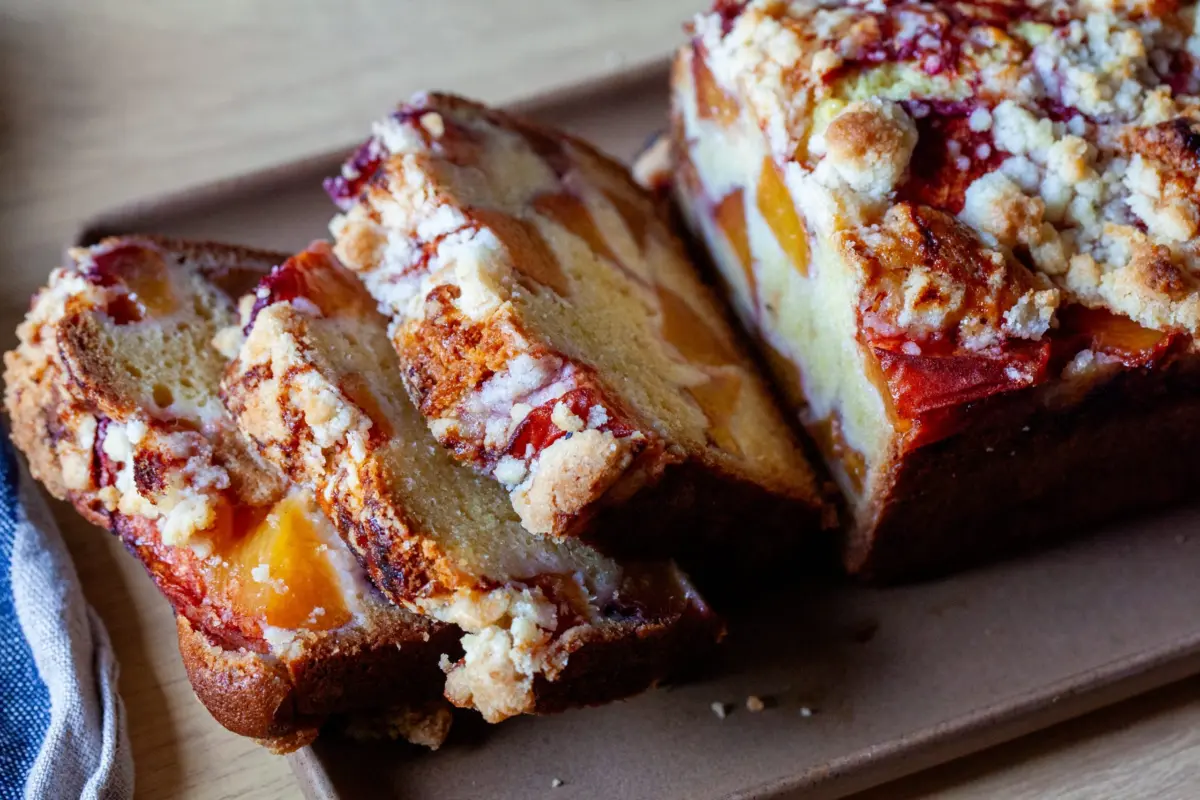
When asked how long it takes to achieve perfection in baking, the only honest answer is often the simplest: as much time as it requires. For many culinary creators, the desire to adjust expectations, settle for "close enough," or cultivate a sense of detachment when a project proves stubborn remains an elusive ideal. Human nature, however, tends to wire individuals for persistence, leading some to chase a single recipe through years of iterative adjustments, kitchen experiments, and countless surrendered peaches.

For one dedicated baker, that relentless pursuit has finally culminated in the realization of the ultimate Peach Cobbler Loaf. Spanning a staggering six summers of trial and error, the journey to finalize this exact recipe exacted a heavy toll on the local produce market, with an untold number of peaches falling short of expectations. Each successive stone fruit season brought a fresh round of tinkering, meticulous note-taking, and repeated conclusions that the latest iteration simply missed the mark.
The technical hurdles were numerous and frustrating. Diced peaches routinely baked down into bland, uninspired pockets within the crumb, while thinly sliced fruit seemed to disappear into the batter entirely. Attempts to infuse the batter with warm spices often resulted in a visually drab, beige loaf that lacked the vibrant, distinct punch of flavor required to anchor the dish. Time and again, the creator found themselves at a stubborn culinary impasse, ultimately folding their cards and shelving the project until the next harvest cycle rolled around.

The prolonged timeline was a byproduct of uncompromising standards. The vision demanded a cake that captured the rustic, comforting essence of a traditional southern cobbler while adapting seamlessly to the structured format of a classic loaf pan. Achieving this balance meant refusing to compromise on the structural integrity of the cake, the distinct texture of the fruit, the rich buttery crunch of a proper streusel topping, and the harmonious integration of fresh lemon and dairy elements to cut through the sweetness.
Although the debut arrives as the fleeting weeks of peach season draw rapidly to a close, the finished bake remains entirely indifferent to the calendar. Fully realized and thoroughly tested, the recipe is finally ready for the public, offering a rewarding payoff for anyone willing to invest the time in its creation.

Peach Cobbler Loaf
Crucial to the success of the bake is the exact dimensions of the loaf pan. The batter expands to fill every available millimeter before the baking process is complete, and rich fruit juices have a tendency to trickle over the edges. To mitigate any oven mess, placing the loaf pan on a larger rimmed baking sheet is strongly advised. The ideal pan holds approximately six liquid cups, or 1,420 milliliters, measuring eight by four inches at the bottom and nine by five inches at the top. Bakers utilizing smaller pans are encouraged to siphon off a muffin cup or two of batter and bake them separately rather than risk an overflow.
The preparation begins by preheating the oven to 375 degrees Fahrenheit, equivalent to 190 degrees Celsius. A standard loaf pan should be lined with parchment paper, extending the sheets up two opposing sides to act as convenient handles later, while any exposed metal surfaces receive a light coating of nonstick spray. As a safety precaution, positioning the pan on a larger baking sheet before it goes into the oven catches any bubbling juices.

The cake foundation starts by finely grating fresh lemon zest into a large mixing bowl, where it waits to infuse the surrounding fats. In a separate medium bowl, peach wedges are tossed with the freshly squeezed juice of half a lemon, a dash of cinnamon, and one tablespoon of brown sugar, ensuring every piece is evenly coated before being set aside.
The wet ingredients come together in the large bowl containing the lemon zest. Six tablespoons of melted butter are combined with one-third cup of granulated sugar and an additional one-third cup of brown sugar, whisked thoroughly until unified. Yogurt or sour cream is then incorporated, followed by whole eggs beaten until smooth. Leavening agents, including baking powder and baking soda, along with a pinch of salt, are sprinkled directly across the surface of the wet mixture and thoroughly whisked, with a few extra rotations to guarantee even distribution. Finally, one and a third cups of flour are folded in just until the dry traces disappear.

The accompanying streusel topping is assembled in a small bowl by melting two tablespoons of butter and stirring in two tablespoons of granulated sugar, a pinch of salt, and a quarter cup of flour until a crumbly texture forms.
Assembly requires a deliberate layering process. Half of the rich cake batter is poured into the prepared loaf pan and smoothed into an even layer. Half of the macerated peaches are arranged across the batter in a single, cohesive layer. The remaining batter is spooned gently over the fruit and spread out evenly, followed by the second half of the peaches arranged neatly on top. Any flavorful juices that have collected in the bottom of the peach bowl are then poured directly over the fruit. The entire arrangement is crowned with an even scattering of the prepared streusel.

Baking takes between 60 and 70 minutes. Doneness is verified by inserting a tester into the center of the cake, as well as probing a few times directly beneath the top peach layer where unbaked batter frequently hides. A clean withdrawal signals that the loaf is finished, though an additional five minutes may occasionally be required depending on the oven. Once removed from the heat, the pan rests on a wire cooling rack.
Serving the cake involves running a sharp knife along any unlined edges of the pan, then utilizing the extended parchment paper wings to lift the entire loaf out smoothly before slicing it into thick, generous portions.

While the cake delivers exceptional flavor on its first day out of the oven, it develops an even deeper complexity by the second and third days. Storage is best handled right in the pan at room temperature, left unwrapped to preserve the crisp integrity of the streusel topping. Placing the pan inside a dormant microwave or a cold oven acts as a makeshift bread box, protecting the texture from ambient kitchen humidity until the final slice is enjoyed.