
This story was produced by Drilled, a global multimedia reporting project focused on climate accountability, and is co-published with Grist.
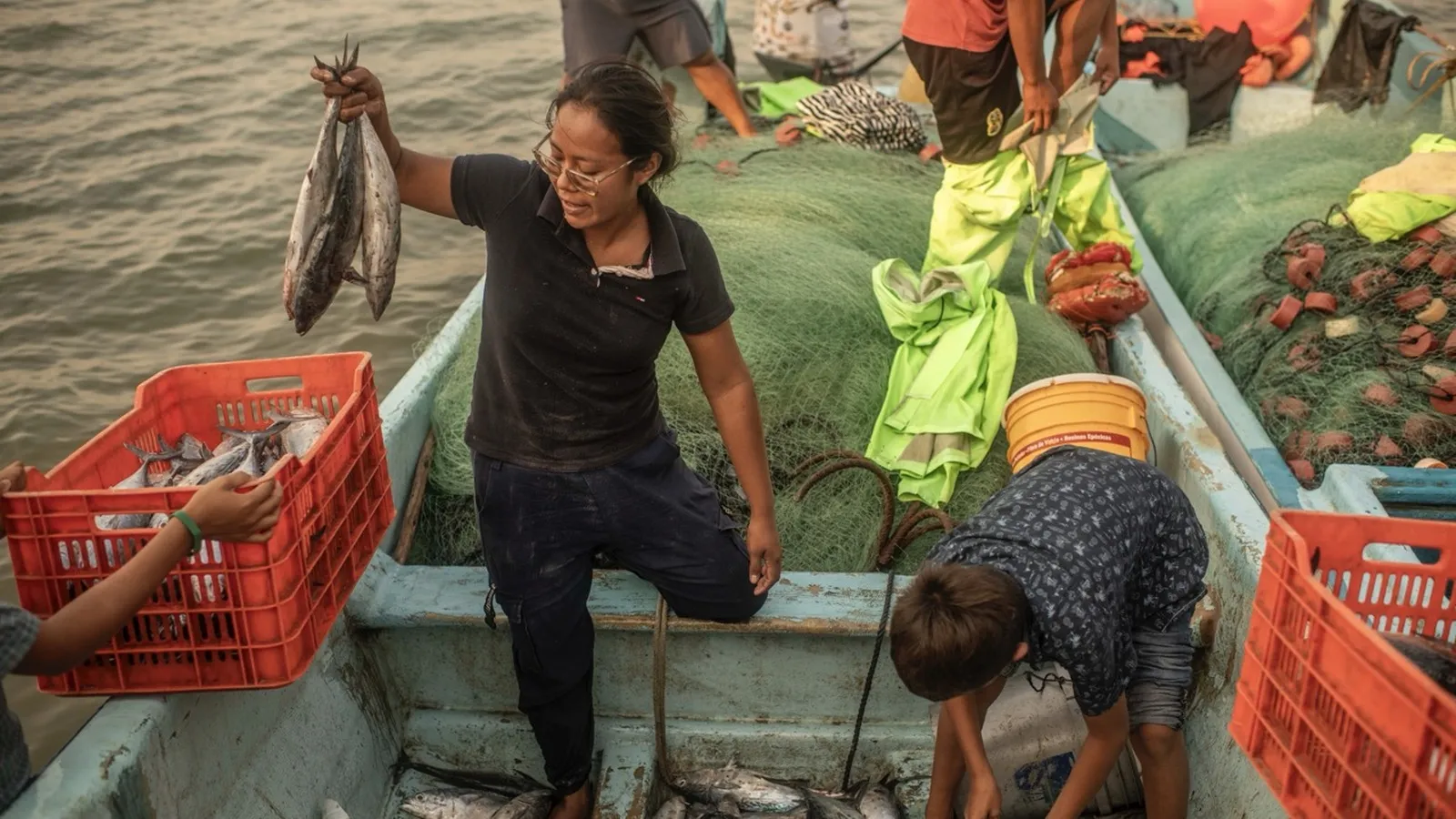
It is 3 a.m., and the beach in El Bosque, located in southeast Mexico, hums with small talk and laughter as Viviana Velázquez eases out of her hammock and dashes to the shoreline to greet a boat returning with the night’s catch. Velázquez, 38, and her 13-year-old daughter, Marlene, help the tired fishermen unload the ice boxes and heave a plastic crate full of bonito to the cooperative to be weighed.
The captain pays Velázquez for her help in fish. She saves a couple to fry for breakfast, cashes in the rest for 50 pesos—the equivalent of about $3—and heads back to her hammock, where some friends are eating pastries while catching up on the past week’s dramas.
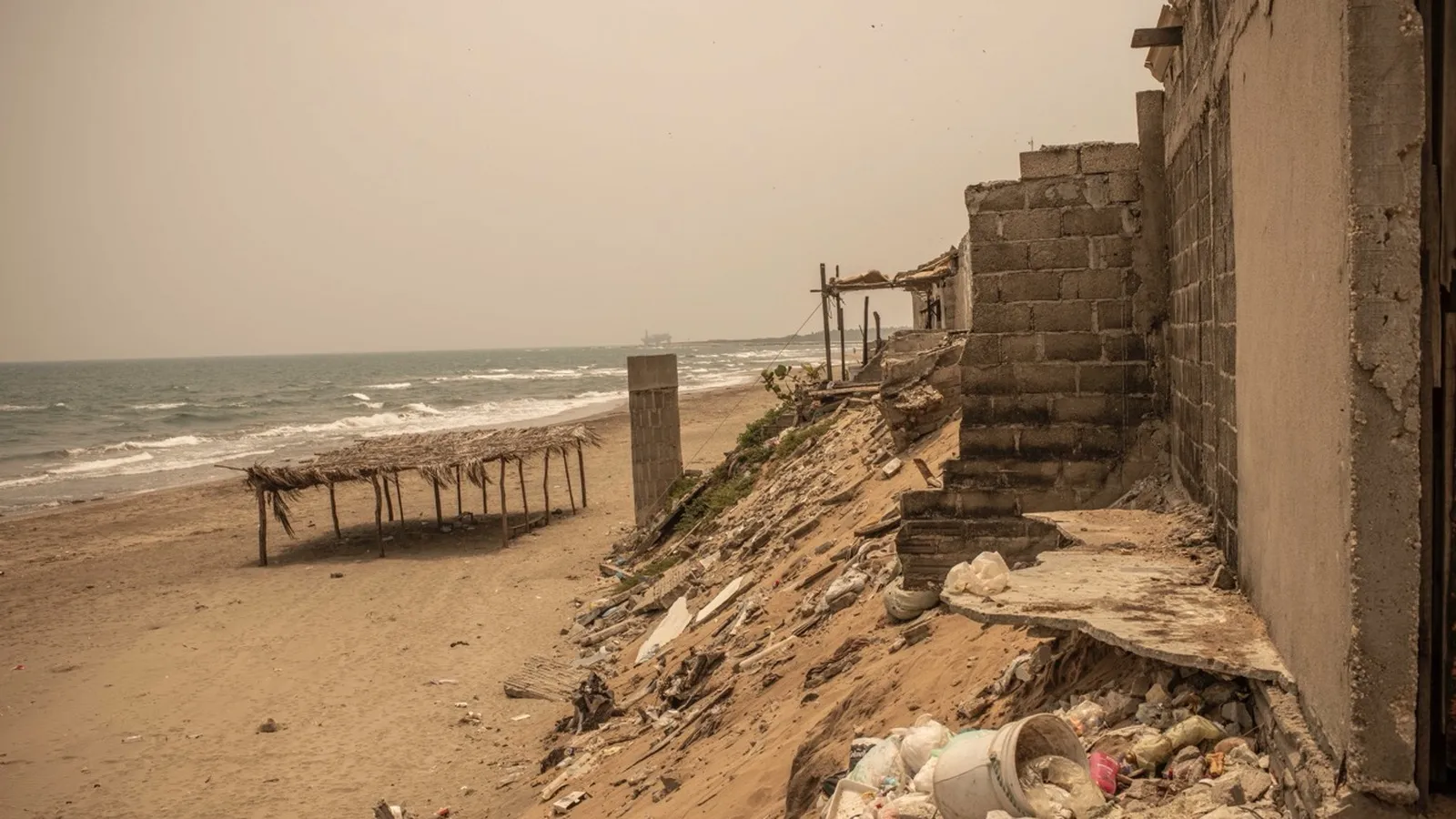
This work is known locally as garrulear. For decades, it was an important source of income, food, and social bonding for women in El Bosque, a small fishing community in the state of Tabasco situated on a narrow peninsula sandwiched between the Gulf of Mexico and the Usumacinta River. It is one of the things that Velázquez misses most since sea level rise forced residents to leave their homes behind.
“In El Bosque I would garrulear every day, but then the sea took everything,” said Velázquez, settling back into a hammock during a rare visit. “Now I’m stuck inside most of the time; it’s too far to come here often.”
El Bosque became the first community in Mexico to be officially recognized as displaced by climate change in 2023. By then, coastal erosion and flooding from recurring storm surges had already damaged or swept away more than half of the hundred or so homes in the area. Following a high-profile media campaign and a series of administrative claims by a coalition of environmental justice organizations working alongside local residents, then-President Andrés Manuel López Obrador pledged to relocate the population.
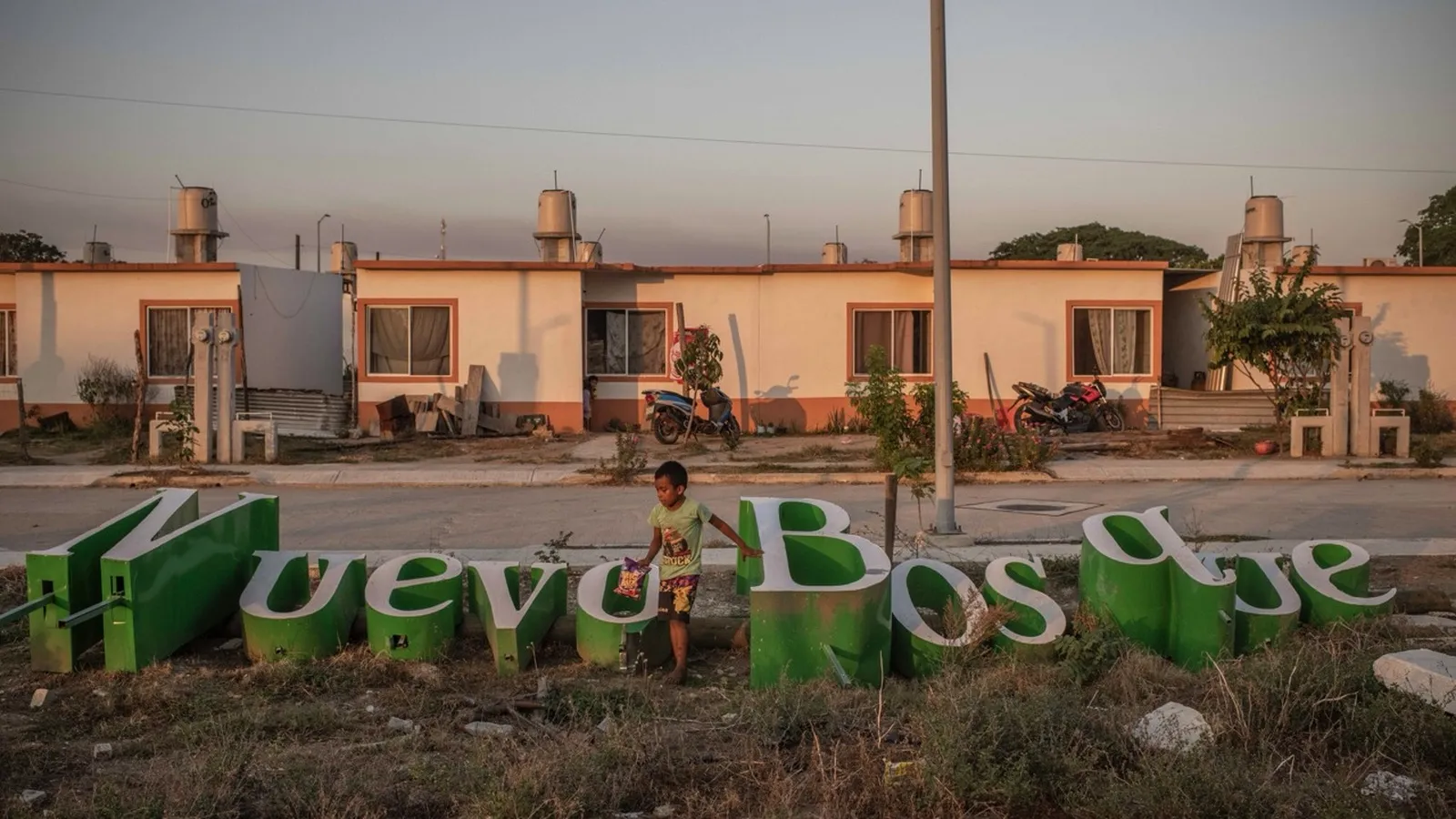
In November 2024, a new neighborhood called Nuevo Bosque—or New Forest—was inaugurated 7.5 miles inland on the outskirts of the city of Frontera. Fifty-one families received identical, purpose-built row houses in the new settlement.
While the El Bosque relocation was initially hailed as a major victory for residents and a rare success story for government-led climate adaptation, the reality has proven far more complex. Two years on, the community is struggling to adapt to deep economic, social, and cultural losses stemming from their separation from the sea. Meanwhile, residents who were excluded from the relocation process still do not know why they were left behind.
Velázquez was among the fortunate few to be rehoused, but she does not feel settled in her new environment. “I am trying to adapt to my new life, but I can’t sleep, I cry all the time, my heart beats a thousand times a minute,” she told Drilled. “We’re constantly worrying about money. I eat and eat and eat to calm my nerves. I’ve put on 29 pounds.”
“We are grateful, but I am still grieving,” she added. “I miss everything about El Bosque: the cool breeze, my friends, our whole life.”
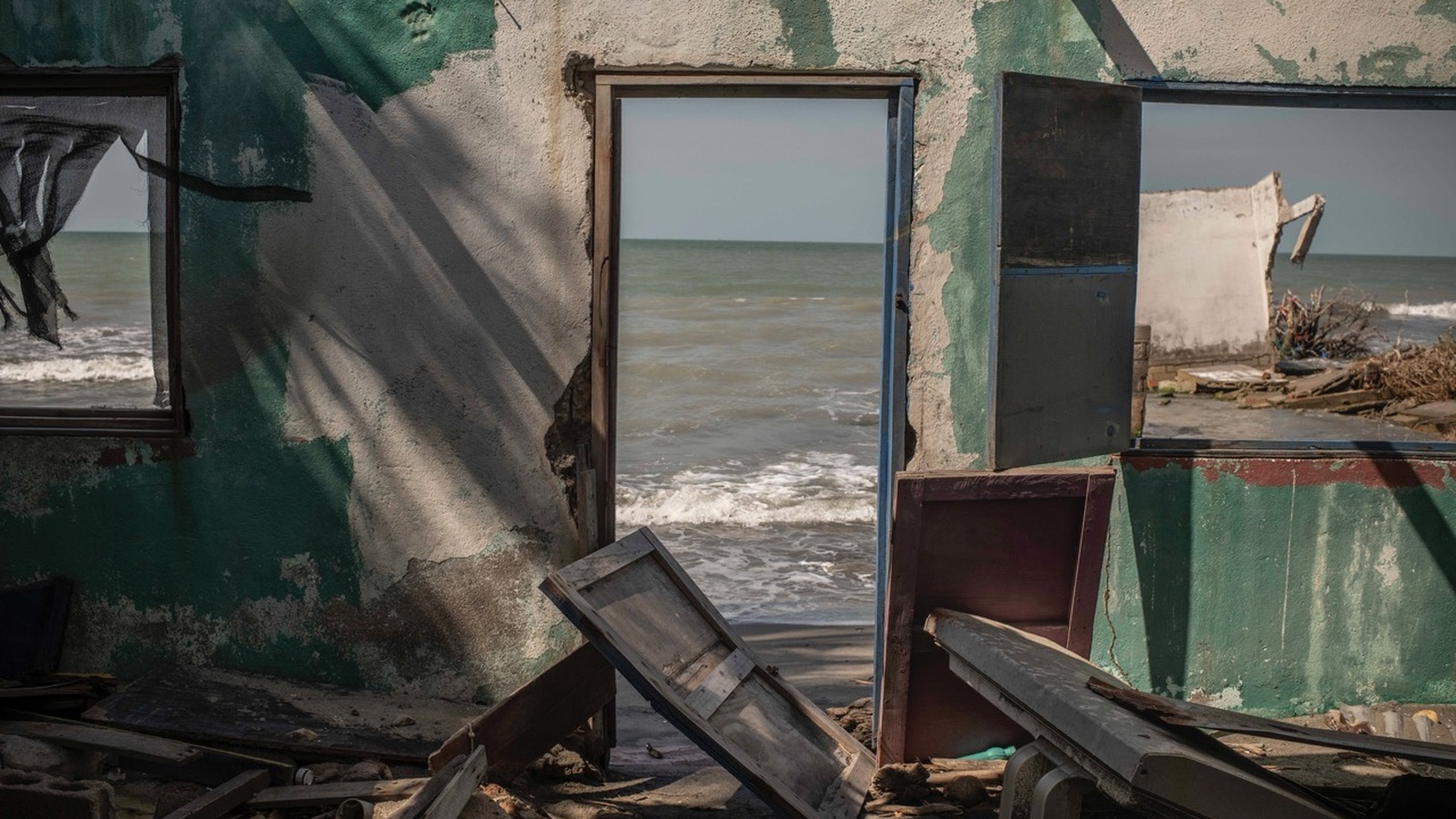
For the people of El Bosque, fishing was never merely an occupation; it was the bedrock of their individual identities and communal life. Residents initially hoped to be relocated closer to the coast so they could continue fishing daily, but authorities ruled out that option, warning that any coastal site would likely be flooded out again within a few years. In contrast, the inland location of Nuevo Bosque is projected to remain safe from flooding for roughly three decades.
Yet, the emotional and financial toll of the move remains acute. A taxi ride from Nuevo Bosque back to El Bosque costs 240 pesos—around $14—making it prohibitively expensive for Velázquez and her neighbors to return more than once a week during the height of the fishing season. Even these precious visits are temporary.
“At the rate things are going, a few sandy islands are all that will soon be left of El Bosque,” said Lilia Gama, an ecologist and coastal erosion expert from the Juárez Autonomous University of Tabasco. “The river and the sea will likely join up within a decade, and the entire community will be under water.”
According to Gama, while natural hydrological dynamics mean the river and sea in El Bosque would have eventually converged, climate change has severely accelerated the timeline.
Global sea level rise is driven primarily by planetary heating from greenhouse gas emissions released by burning fossil fuels. Melting ice caps, ice sheets, and glaciers increase the total volume of the oceans, while thermal expansion from warmer waters causes seas to rise further and supercharges storms. Powerful tidal waves, storm surges, and extreme sea-level events that historically occurred only once a century could become annual phenomena by 2100, according to the United Nations.
Globally, the rate of sea level rise has more than doubled over the past three decades. The Intergovernmental Panel on Climate Change projects that seas will rise an additional 15 to 30 centimeters—roughly 4 to 12 inches—on average by 2050, threatening nearly a billion people living in low-lying coastal zones.
In Tabasco, home to 2.5 million people, modeling by Climate Central suggests that up to half the state could become uninhabitable or highly vulnerable by the end of the century.
Under international law, states have a duty to protect their communities and uphold human rights, which includes transitioning away from fossil fuels and implementing proactive climate adaptation measures to minimize harm.
“If displacement cannot be prevented, communities have the right to be consulted, the right to information, and to provide input so they co-shape the decision on how and where they will be relocated,” said Veronika Fikfak, a professor of international human rights law at University College London.
From El Bosque to Nuevo Bosque
El Bosque was founded in the early 1980s by landless families from the neighboring state of Veracruz who saw an opportunity to build a stable livelihood. At the time, the peninsula was thick with mangroves and dense vegetation, inspiring the name El Bosque, meaning “the forest.”
Velázquez was just six months old when her family arrived. While they did not achieve wealth, they built a sustainable life. Fish were abundant, supplying markets in Mexico City and local restaurants as El Bosque grew into a popular destination for regional tourists seeking crab tamales, ceviche, and fish empanadas.
Velázquez eventually married a local fisherman, Javier Rodriguez, and the couple raised two children there.
In February 2022, a severe storm drove the sea into their home, prompting the family to relocate to another house slightly further inland. When that home flooded in November 2022, they were evacuated to Frontera. By then, an entire row of houses was completely submerged, and the local kindergarten and primary school had been abandoned.
Before the final evacuation, “the children were crying all the time, scared by the sound of the waves crashing into the house,” Velázquez recalled. Seeking to maintain their livelihood, the family returned to El Bosque, living in a makeshift shelter constructed from sticks and metal sheeting even after storms severed the electricity. “I couldn’t bear to leave.”
The family finally departed for good on New Year’s Eve 2024, one month after receiving the keys to their home in Nuevo Bosque.
Nuevo Bosque comprises four rows of identical, single-story, two-bedroom houses featuring front and back yards that are too small to accommodate the chickens and ducks many residents previously raised. A playground, a basketball court, and a few benches serve as the town’s primary gathering spaces.
The community was inaugurated without running water or a functioning primary school. A narrow, static laminate trailer stationed at the entrance currently operates as a makeshift classroom. Lacking indoor plumbing, children must run home when they need a restroom.
During a late May visit by Drilled, students spent the morning sweeping rainwater from an overnight storm out of the trailer. With no air conditioning and only four fans—one of them broken—the interior quickly became stifling. Although Tabasco has always been hot and humid, intensifying heat driven by climate change recently prompted the state education department to order schools to close by 11:30 a.m. for the remainder of the term.
“The kids get irritable and sleepy. It’s so hot, it’s hard even for me,” said teacher Isabel Mayo Cerino. “This was supposedly a planned relocation, and yet nobody thought about education. A community without a school isn’t a proper community.”
Although state education officials have promised to construct a proper facility once suitable land is secured, children in the community have lacked adequate schooling for nearly six years, ever since a tidal wave flooded their old school in late 2020. Natali Segura, 28, eventually transferred her 11-year-old son to a school in Frontera because he was falling behind in basic literacy. “The kids lost 5 or 6 years of school,” Segura said. “They are so behind.”
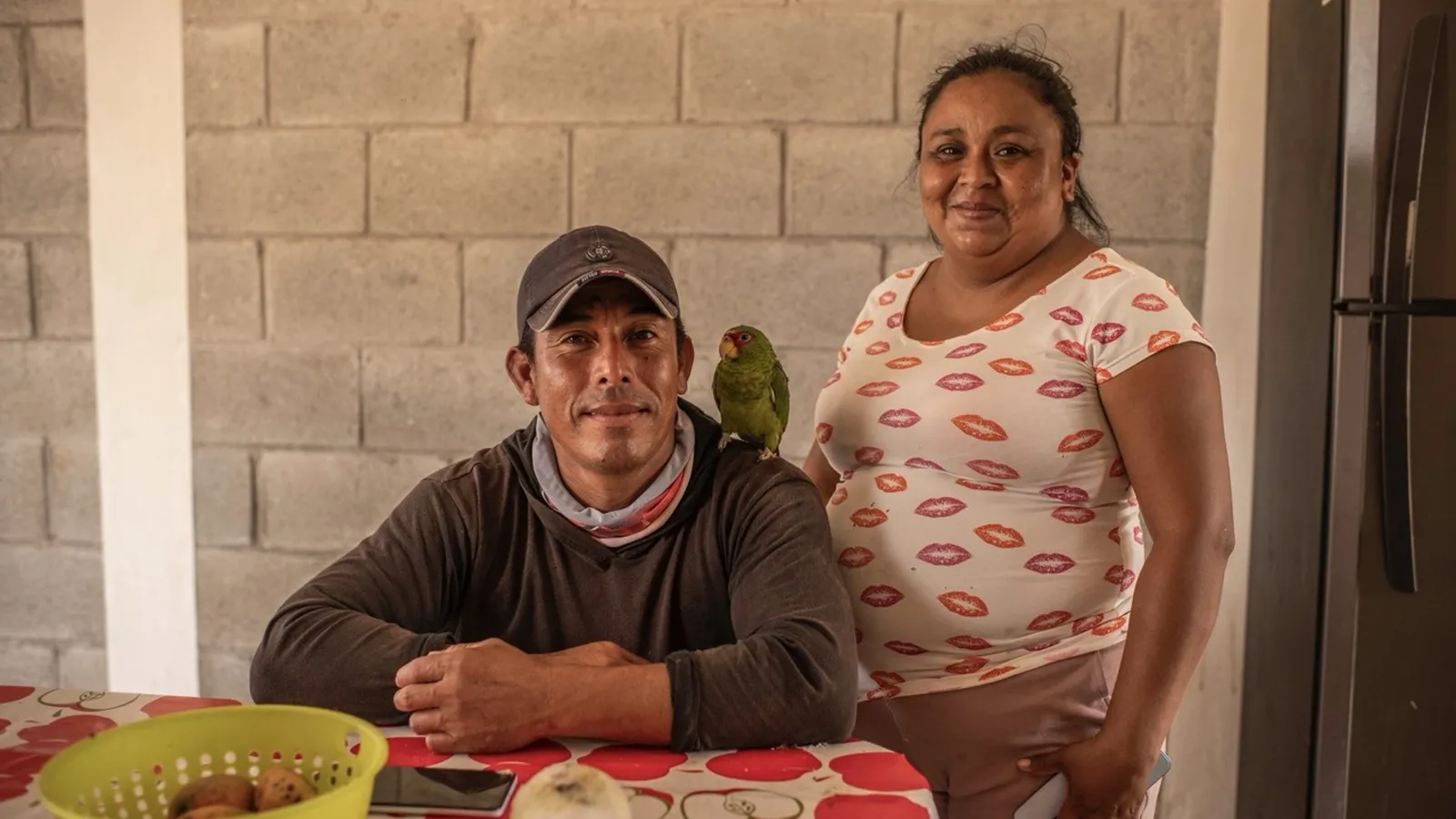
While residents express relief at escaping the immediate threat of rising seas—and appreciate the proximity to city amenities like a hospital and reliable internet service—many report feeling isolated and experiencing declining health. Velázquez and several other residents noted significant weight gain since moving inland, a consequence of a more sedentary lifestyle and a shift away from a fish-based diet toward readily available fast food and sugary drinks.
At the same time, household finances are tighter, leaving mothers uncertain about how they will afford their next meals.
“It might look like we’re better off in these new houses, but we’re not,” said Áurea Sánchez, 44, who spends hours each day praying at her evangelical church for the community. “No one was rich in El Bosque, but no one ever went hungry. Now, life is more precarious. We’re fishers, we can’t change overnight.”
In 2024, Sánchez and her eldest daughter, Yesenia, testified alongside hundreds of frontline community members from Latin America and the Caribbean at a landmark Inter-American Court of Human Rights (IACHR) hearing on climate displacement in Manaus, Brazil. “I realized that we’re not alone, that we have rights, and that many communities are suffering because we haven’t looked after what God gave us,” Sánchez told Drilled.
El Bosque has emerged as an emblematic case of climate displacement, helping clarify international legal standards and spurring policy discussions in Mexico. The community was explicitly cited in a historic advisory opinion published by the IACHR in May 2025.
“States are obligated to adopt measures to prevent […] migration and forced displacement resulting directly and indirectly from disasters and other impacts of climate change,” the IACHR opinion stated, affirming that governments across the Americas have a binding legal duty to develop and finance public policies on climate adaptation and displacement.
Where Oil Production and Displacement Converge
International climate debates frequently center on the dichotomy between nations historically responsible for emissions and those bearing the worst impacts. Mexico occupies a complex position in both categories.
As one of the top 20 historical contributors to greenhouse gas emissions, Mexico shares international obligations under the Paris Agreement to transition away from fossil fuels. Yet, according to the International Energy Agency, the country remains the world’s 11th-largest oil producer while facing severe climate vulnerability. World Bank modeling indicates that climate drivers like sea level rise, drought, extreme heat, and desertification could internally displace at least 3 million people in Mexico by 2050.
This paradox is sharply visible in Tabasco, a major oil-producing state and the home of former President Andrés Manuel López Obrador, whose 2018–2024 administration oversaw a slowdown in Mexico’s renewable energy transition.
Fossil fuel infrastructure—including refineries, pipelines, roads, and worker housing—sprawls across Tabasco’s eroding coastline. Industrial operations and climate-driven sea level rise compound environmental risks, exposing communities to toxic pollution during extraction and refining, as well as global heating when the fuels are burned.
Pemex, Mexico’s national oil company founded in 1938, stands as Latin America’s largest corporate polluter and one of the world’s most indebted energy firms. Operating installations in 80 percent of Tabasco’s municipalities, Pemex completed the Dos Bocas oil refinery in 2022 just 60 miles west of El Bosque, immediately adjacent to a school in the Lázaro Cárdenas del Río neighborhood, widely known as La Petrolera due to the high concentration of oil workers living there.
The refinery has experienced floods, fatal fires, and major oil leaks, accompanied by spikes in acute respiratory illness, panic attacks, headaches, and vomiting among residents. Many homes in the neighborhood now sit empty, abandoned by families fleeing industrial pollution and safety risks.
Cindy Barjau rushed her daughter to a Pemex-operated local hospital two years ago after the child collapsed from inhaling refinery fumes. “Children can’t play outside anymore; we keep our windows shut,” Barjau said. “It’s inhumane. Our quality of life has gone. We want to leave, too, but where would we go?”
While Pemex has acknowledged air quality concerns, it maintains that nearby communities face no risk. Independent assessment remains difficult because the government has classified its air monitoring data as secret until 2030. Furthermore, documents obtained by local media indicate that construction on the refinery began before environmental impact assessments and drainage systems were finalized.
Following a March fire that killed five workers, President Claudia Sheinbaum requested that Pemex assist in relocating the local school, where enrollment has plummeted.
A 2025 Amnesty International study revealed that approximately 2 billion people worldwide live within 3 miles of operational oil, gas, and coal projects, transforming surrounding areas into industrial sacrifice zones.
“The fossil fuel industry impacts people’s bodies, their health, their land, and the environment, polluting the surroundings and compromising the ability to sustain life in the short and medium term—and the long term, due to its climate impacts,” said Juan Manuel Orozco, a project officer at the nonprofit Conexiones Climáticas. “In the southeast of Mexico, the situation is particularly dramatic. It’s as if all the monsters of our times have converged here.”
International Law Advances
In July 2025, a historic advisory opinion from the International Court of Justice (ICJ) affirmed that all states possess a legal duty to enact rapid and sustained reductions in greenhouse gas emissions and regulate private corporations. The continued expansion of fossil fuels, the court noted, constitutes a legal wrong under customary international law that can trigger obligations to provide full reparations.
These legal developments, combined with the visibility of the El Bosque case, have generated political momentum in Mexico, leading to increased climate ambition under President Claudia Sheinbaum, who took office in 2024.
Under its Paris Agreement commitments, Mexico submitted an updated Nationally Determined Contribution in 2025 containing its first explicit greenhouse gas reduction targets. However, independent analysts at Climate Action Tracker note that planned fossil fuel expansion and the timeline for renewable energy adoption remain insufficient.
The IACHR and ICJ opinions underscore that governments must safeguard human rights against climate harms and institute adaptation measures, such as coastal restoration, flood walls, and water systems, to prevent predictable displacement. Where harm is unavoidable, legal frameworks increasingly point toward obligations regarding loss and damage, including financial compensation.
Mexico’s updated climate plan acknowledges for the first time that climate change causes loss and damage requiring community reparations. Simultaneously, the country faces domestic legal challenges regarding its regulatory oversight of polluting industries and preparedness for climate impacts.
Loss and Damage
The precise legal obligations of states concerning sea level rise, lost livelihoods, and displacement continue to evolve, with El Bosque serving as a critical testing ground. Mexico currently lacks a comprehensive national climate adaptation plan detailing how communities will be prepared for and protected against climate breakdown.
In El Bosque, legal advocates argue the state failed to implement basic adaptation measures, such as mangrove restoration, that could have slowed coastal erosion. Nora Cabrera, founder of the Mexico City-based law firm Nuestro Futuro, which represents El Bosque residents, noted that the relocation process ultimately diminished living standards.
“The community has been made more vulnerable by the relocation—a level of regression that speaks to the process of climate injustice,” Cabrera said. “The El Bosque case is clearly one of loss and damage, because conditions for adaptation were never created. This amounts to an omission on the part of the Mexican state regarding its citizens.”
The first home in El Bosque completely destroyed by the waves belonged to fisherman Pablo Cardoza, who lived on the seafront with his wife and three children. After a 2019 storm surge flooded his home with seawater and debris, Cardoza relocated his family to a rental in Frontera and transitioned to open-water line fishing, spending multiple nights at sea targeting sea bream, amberjack, and red snapper.
While open-water fishing yields more consistent catches, Cardoza struggles to pay monthly rent as fish stocks decline due to ocean warming, acidification, and pollution from offshore oil platforms.
When the government organized the relocation census, 51 families were selected to receive new homes. However, criteria for inclusion or exclusion were never made public, leaving residents like Cardoza without an explanation for why they were left out.
“I missed some meetings because I was out at sea, but it feels really unfair. We were the first to lose our home and livelihoods,” Cardoza said. “I haven’t given up. I hope one day they correct this injustice.”
In July, Nuestro Futuro filed a lawsuit on behalf of Cardoza and six other un-relocated El Bosque residents. Cabrera noted that the case could reach the Mexican Supreme Court, potentially establishing binding precedents regarding state obligations to climate-displaced populations.
As federal officials draft a national policy on climate displacement to alleviate urban pressures in cities like Mexico City, Monterrey, and Guadalajara, experts emphasize the need for relocations to be planned as a last resort rather than an administrative afterthought.
In September, the federal government acknowledged that most states and municipalities rely on risk data that is three to four years old, prompting new allocations to update risk atlases for earthquakes, hurricanes, and sea level rise, according to Laura Velázquez, Mexico’s national coordinator for civil protection.
As climate impacts accelerate beyond historical models, affected residents emphasize the broader significance of their struggle.
“It’s too late for us, but we need a law or a policy to help others,” said Sánchez, the Nuevo Bosque resident who testified in Brazil. “We were the first, but we won’t be the last.”