
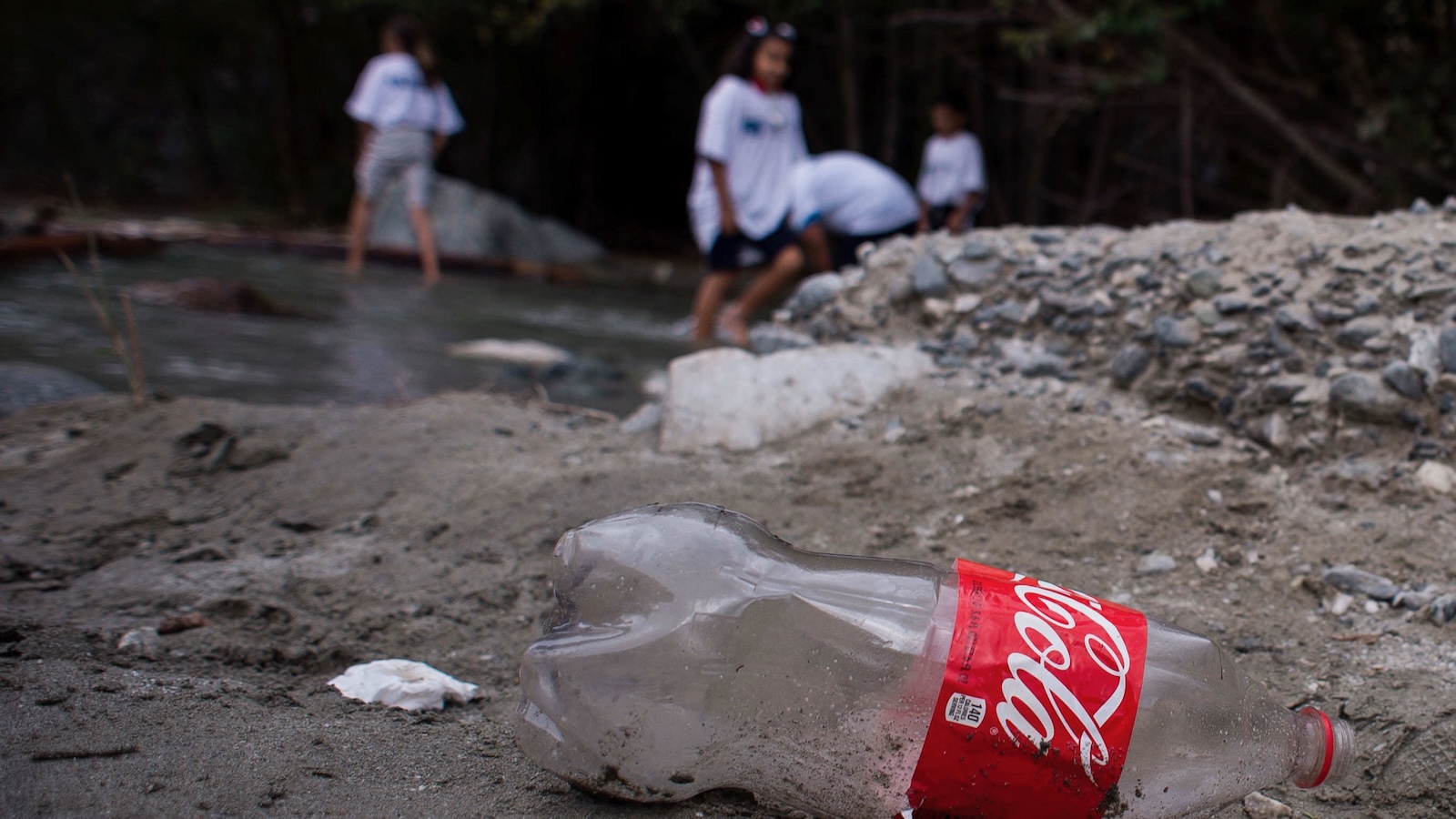
Plastic pollution blights the streets, beaches, parks, and lawns of Baltimore and communities across the globe. A significant amount of that persistent litter bears the circular red-and-blue Pepsi logo or the flowing white script of Coca-Cola’s branding, serving as a constant, visible reminder of the modern convenience economy’s environmental toll.
Yet, legally speaking, none of that rubbish is Pepsi’s fault. Nor is it Coke’s.
That is what a Baltimore city circuit court judge ruled this summer following a high-stakes legal battle in which the city and county of Baltimore sought millions of dollars from PepsiCo, Coca-Cola, and other major consumer goods corporations to clean up mounting plastic pollution. Companies “conducting lawful activities,” wrote Judge Audrey J.S. Carrión, referring to the manufacture and sale of single-use plastics, “should not be held liable under public nuisance claims because others are misusing the products in an unlawful manner.”
In other words, according to this prevailing judicial interpretation, plastic pollution is fundamentally a problem of consumer behavior, not corporate irresponsibility. As far as state public nuisance law is concerned, a manufacturer’s legal liability ends at the point of sale.
Similar reasoning has already scuttled a public nuisance lawsuit that the state of New York filed against PepsiCo and Frito-Lay, and the same fundamental hurdle has arisen in similar litigation stretching from Missouri to California. As environmental advocates, local governments, and state attorneys general continue to develop and test this legal theory, those mounting setbacks raise a fundamental question: When does a company’s responsibility for its products actually end? And can public nuisance laws ever succeed in making major corporate polluters pay for the waste they generate?
The legal concept of public nuisance is far from new, dating back centuries to 13th-century English common law. Traditionally, it applied to violations of rights shared broadly by the general public, such as free access to public roads, clean water, or unpolluted air. However, since the 1970s, plaintiffs and creative legal teams have increasingly tried to apply that ancient idea to modern manufacturers whose mass-produced products allegedly jeopardize public health, safety, and access to a clean environment.
These lawsuits, however, have a mixed record of success, according to legal experts. Cases targeting opioid manufacturers, e-cigarette companies, and even the landmark litigation against Big Tobacco have sometimes resulted in favorable outcomes, but mostly by securing massive out-of-court settlements rather than because judges definitively ruled in favor of expansive public nuisance arguments on their merits.
Cases that have actually proceeded to trial or substantive hearings, meanwhile, have routinely struggled to convince skeptical judges of “causation,” or the core legal idea that corporate defendants are substantially and directly responsible for violating a public right merely by selling a legal product. Judges remain deeply wary of extending corporate liability far past the lawful sale of commercial goods, particularly when those products are not ultimately used as intended by the manufacturer. If a doctor or patient diverts prescription opioids to the black market, for instance, are the pharmaceutical manufacturers legally responsible for the resulting public health crisis?
This is essentially the philosophical and legal barrier that Judge Carrión articulated in the Baltimore case. It also closely echoes skeptical questioning from Justice Stephen Lindley last month as he heard oral arguments in the appeal of New York’s high-profile plastics lawsuit against Pepsi.
“If [Pepsi] has to pay for the cleanup when somebody else is littering, … it’s not going to be sustainable,” Justice Lindley told the plaintiff’s lawyers from the bench. He appeared visibly sympathetic to PepsiCo attorney Andrew Tulumello’s argument that the state faced a massive causation hurdle, noting that Pepsi “is not encouraging people to throw stuff in the litter.”
According to Albert Lin, co-director of the California Environmental Law and Policy Center at the University of California, Davis, there are three basic, non-negotiable elements required to mount a successful public-nuisance lawsuit. The first is demonstrating a “substantial interference with a public right.” The second is causation, which requires robustly linking a corporate defendant’s specific actions to that community-wide interference. The third element, Lin noted, is establishing negligence, intent, or other tortious conduct inherent in the defendant’s commercial activities.
To get around the restrictive point-of-sale argument that has stymied cases in Maryland and New York, environmental groups and municipal governments are trying to tightly weave together causation and corporate conduct. Plastics companies, they argue in briefs across the country, are directly responsible for the ubiquitous pollution because they allegedly knew for decades that their actions and marketing decisions would inevitably harm public rights. Consequently, courts will have to pay close attention to the legal concept of “foreseeability”—specifically, whether it was entirely foreseeable to manufacturers that single-use plastic containers would routinely end up as environmental litter.
As Timothy Lytton, a professor at the Georgia State University College of Law, put it, manufacturers allegedly acted “in a way that foreseeably increases the risk of misuse.” The word “foreseeable,” for instance, appears 22 times in Baltimore’s original complaint.
Plaintiffs argue they have substantial evidence to support the claim that widespread plastic pollution was entirely foreseeable. At least some major packaging and petrochemical manufacturers have known for decades that the mass production of single-use plastics would inevitably contribute to severe environmental pollution, and that municipal recycling systems would be fundamentally incapable of managing the massive volume of waste. Furthermore, these lawsuits increasingly cite microplastics contamination as a core component of the alleged public nuisance. An investigative report published recently by the Los Angeles Times revealed that industry scientists have known since at least the 1970s that microscopic plastic particles could lodge and persist in human bodies.
That troubling historical record heavily informs the framing offered by advocates like Scott Hochberg, general counsel and litigation director for the nonprofit Earth Island Institute.
“Companies induced consumers to purchase these products while knowing the likelihood that they would end up as trash,” Hochberg said. “And that’s exactly what happened.”
Whether this strategic framing ultimately succeeds in the courtroom may depend heavily on the specific jurisdiction. In addition to the strict causation requirements inherent in public-nuisance lawsuits, Lin pointed out that some states maintain a much higher legal standard for demonstrating that defendants retained effective “control” over their products at the exact moment the nuisance occurred. New York and Maryland are two such states with stringent control hurdles. California, on the other hand, does not share this rigid requirement, and state and federal courts there have so far proven notably more receptive to plastics-related public nuisance suits.
Judge Richard Seeborg of the U.S. District Court for the Northern District of California, who is overseeing two separate lawsuits targeting Exxon Mobil Corp., allowed one major case brought by the Sierra Club to proceed forward to trial, though he has not yet ruled on a separate, high-profile lawsuit brought by the state’s attorney general.

However, even in legally hospitable California, surviving an early defense challenge is no guarantee of ultimate success. A federal judge previously allowed Earth Island Institute’s public-nuisance claim—which rested in part on allegedly misleading recycling labels—to proceed against 10 major food and beverage companies, but the claim was ultimately rejected earlier this year via summary judgment. Earth Island has indicated it plans to appeal the decision.
Representatives for PepsiCo, Coca-Cola, and Exxon Mobil did not respond to requests for comment regarding the ongoing litigation.
Lin emphasized that it is still very early days for this specific legal theory in the context of plastics, and early courtroom rejections do not necessarily signal a permanently losing strategy for environmental advocates. He noted, however, that the courts have shown significant institutional skepticism toward public nuisance claims in ongoing climate change litigation. Furthermore, a major case being heard by the U.S. Supreme Court this term could make it significantly more difficult for cities and states to bring such sprawling claims in the future.
Lin added that in broader climate lawsuits, plaintiffs have increasingly leaned more heavily on fossil fuel companies’ allegedly deceptive conduct, invoking consumer protection and false advertising statutes that can sometimes be easier to substantiate than traditional public nuisance claims. Plastics plaintiffs could potentially pursue a similar strategic pivot, potentially winning financial damages from courts, though they are unlikely to secure sweeping judicial orders requiring companies to physically clean up decades of accumulated environmental pollution.
At the same time, public nuisance laws are beginning to face fresh legislative constraints at the state level. Last year, Montana enacted a first-of-its-kind law explicitly preempting state and local public-nuisance lawsuits based on “lawful activities,” while states like Kansas and Utah have since enacted their own similar restrictions. All three state laws are closely connected to model legislation drafted by the American Legislative Exchange Council, a conservative policy organization that brings together state lawmakers and private-sector members to develop business-friendly model policies.
Whatever their ultimate outcome inside the courtroom, Lytton observed that high-profile plastics lawsuits can still achieve victories in other critical ways—by unearthing long-hidden internal corporate documents, for example, and pushing the plastic crisis much higher on the public-policy agenda. They also provide an essential platform for plaintiffs to forcefully challenge and refute the plastics industry’s dominant consumer-responsibility narrative.
“When you file a lawsuit, what you’re doing is you’re telling a story—often about some sort of structural or corporate wrongdoing,” Lytton said. “When you talk about tobacco, it’s not just about smokers. Or opioids, it’s not just about users. It’s about the companies and their design and marketing decisions. And so the framing that goes on in these [lawsuits] is moving the discussion of plastics away from ‘litterbugs’ and toward corporate responsibility.”