
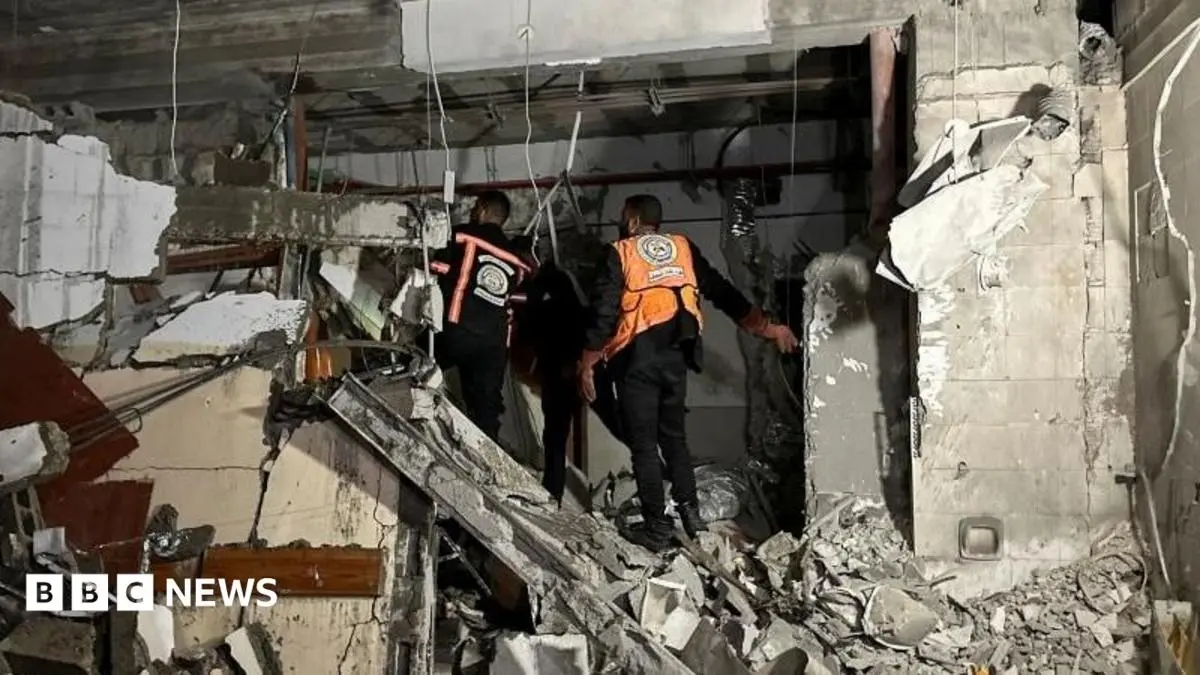
At least five Palestinians have been killed and twenty others injured after an Israeli airstrike struck a building within the Nasser Hospital complex in southern Gaza, according to official accounts provided to the BBC by a spokesman for the Hamas-run Civil Defence agency. The early Thursday morning attack on the facility—which stands as the largest operational hospital in the southern region of the enclave—has once again brought the targeting of medical infrastructure to the forefront of the ongoing conflict.
Eyewitnesses at the scene reported that the attack was executed by a single warplane that flew briefly over the area before firing a single missile into the medical complex. The projectile hit a building that houses critical care facilities, specifically containing the hospital’s surgical wards and intensive care units. Among those confirmed killed in the early morning bombardment was a practicing surgeon, underscoring the immediate lethal toll on healthcare personnel working inside the facility.
The casualty figures from the strike reflected initial confusion in the immediate aftermath of the explosion. Prior to the Civil Defence official’s update to the BBC, spokesperson Mahmoud Basal had informed the news agency AFP that six people were confirmed dead. Rescue and body recovery efforts were launched immediately following the blast by the Gaza Civil Defence, an organization that operates under the jurisdiction of the Hamas-run interior ministry. The agency’s emergency response work on the ground has received ongoing operational support from the International Committee of the Red Cross (ICRC).
Physical evidence of the strike’s impact was documented in video footage recorded and circulated by local activists. The footage captured scenes of heavy destruction inside the targeted building, with dense, thick smoke filling the corridors and rooms on the second floor. Medical equipment, clinical supplies, and hospital beds were seen scattered amidst piles of concrete debris caused by the force of the blast.
The structural severity of the damage was further detailed by the director of the Nasser Medical Complex, who spoke to reporters in the hours following the attack. The director confirmed that the facility had been struck in a direct vertical hit, which resulted in extensive destruction across both the intensive care units and the surgical departments. These affected departments provided vital care for both male and female patients requiring urgent surgical intervention and critical life support.
The Israeli military issued an official statement acknowledging the airstrike, asserting that its forces were targeting military targets embedded within the complex. According to the Israeli military, the strike was directed at a senior Hamas member as well as additional militants who were reportedly utilizing the hospital structure as an active command center for planning and carrying out military and terrorist operations.
In a joint statement released shortly after the attack, the Israel Defense Forces (IDF) and the Israel Security Agency (ISA) expressed strong condemnation regarding what they characterized as Hamas’s deliberate operational strategy. The security bodies accused the armed group of systematically exploiting civilian and medical infrastructure for military purposes, using vulnerable facilities to shelter combatants and command structures.
Addressing concerns regarding civilian casualties, the joint IDF and ISA statement maintained that specific measures were implemented prior to executing the operation to limit harm to non-combatants. The Israeli security forces stated that operational steps included the careful deployment of precision-guided munitions as well as the use of real-time aerial surveillance to monitor the targeted building before the missile was launched.
Alongside official statements, claims circulated by local activists suggested that the strike may have specifically targeted a senior Hamas security official who was allegedly hiding inside the hospital building at the time of the attack. These reports align with the broader narrative put forward by Israeli security officials regarding the presence of high-level militant figures inside the facility.
The attack on Nasser Hospital highlights the severe legal and operational tensions surrounding healthcare facilities in the Gaza Strip. Under international humanitarian law, hospitals and medical infrastructure are granted explicit protected status, which prohibits them from being targeted during armed conflict. Despite these established legal protections, medical facilities across Gaza have been repeatedly struck, damaged, or surrounded during the course of the war.
The Israeli government has repeatedly defended its military actions against healthcare centers by accusing Hamas of stripping these facilities of their protected status under international law. Israel maintains that Hamas, which continues to retain its weapons stockpiles and maintain security control across the Gaza Strip, routinely uses medical complexes to conceal military assets. According to Israeli officials, the group regularly operates command and control rooms within hospitals and stores weapons inside medical facilities. Hamas has repeatedly denied all accusations that it uses healthcare infrastructure for military operations or that it maintains combat positions inside medical facilities.
Navigating the details of the incident remains complex due to significant reporting limitations on the ground. The BBC, along with other international news organizations, remains prevented by Israel from entering the Gaza Strip to report independently from inside the territory. As a result, news organizations are unable to independently verify the precise details, sequence of events, or full extent of casualties associated with the strike on Nasser Hospital, relying instead on reported accounts from eyewitnesses, local health authorities, civil defence workers, and military spokespersons.
Thursday’s attack marks another violent chapter in the history of Nasser Hospital during this war. As the largest medical facility in southern Gaza, the hospital serves as a critical healthcare hub for the region’s population. However, it has previously suffered catastrophic damage. In August 2025, the hospital was hit by a double Israeli strike that resulted in the deaths of at least 20 people, including medical workers and journalists who were present at the complex to cover ongoing events.
The latest strike also reflects the volatility of the broader security environment across Gaza, where military actions have persisted despite a ceasefire agreement reached in October of last year. In the period following that October agreement, the localized cessation of hostilities has repeatedly broken down, with both Israel and Hamas accusing each other of violating the terms of the truce.
The loss of life resulting from ongoing hostilities has continued to accumulate rapidly since the agreement was signed. Data from Gaza’s Hamas-run health ministry indicates that more than 1,600 people have been killed in the enclave since the October ceasefire came into effect. The statistical reporting provided by the Gaza health ministry regarding casualty figures is considered reliable by the United Nations and is regularly utilized by international bodies to assess the human toll of the conflict.
The broader war was initiated following the Hamas-led attack on southern Israel on October 7, 2023. During that initial assault, approximately 1,200 people were killed, mostly civilians, and 251 individuals were captured and taken into Gaza as hostages. In the military operations launched by Israel following the October 7 attack, the scale of destruction and mortality in Gaza has reached extraordinary levels. According to the health ministry in Gaza, more than 74,645 people have been killed across the enclave since the war began.
Compounding the violence of military strikes, the broader humanitarian situation facing the civilian population in Gaza has continued to deteriorate rapidly. The hardship has been sharply intensified by recent adverse weather conditions, including severe winter storms and heavy rains across the enclave. The rainfall has led to extensive flooding in informal camps and displacement sites, submerging tens of thousands of temporary tents that house displaced families who have been forced from their homes over the course of the conflict.