
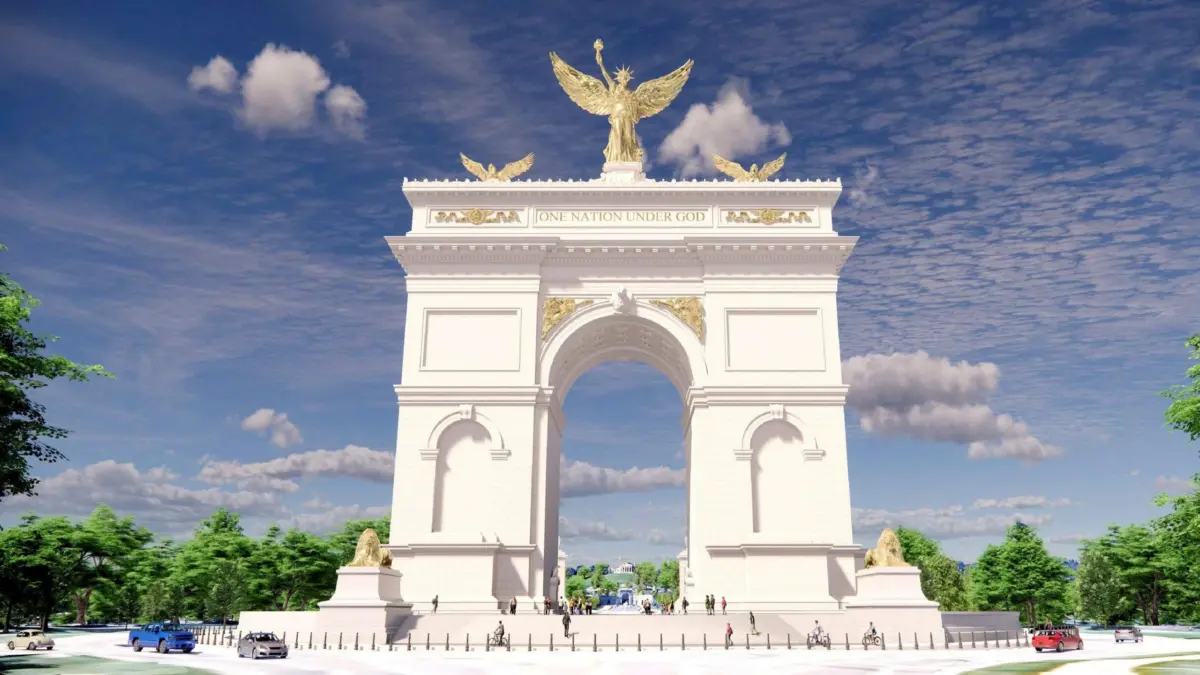
Members of one of America’s most prominent political dynasties have stepped directly into a high-profile legal battle over the visual and historical landscape of the nation’s capital. Nine members of the Kennedy family have formally moved to intervene in federal court to block the construction of a massive 250-foot triumphal arch championed by President Donald Trump. The proposed structure, slated for erection at the gateway to Arlington National Cemetery, has drawn fierce opposition from historic preservationists, local government officials, veteran organizations, and now the descendants of President John F. Kennedy and Senator Robert F. Kennedy.
The legal action targets a project that opponents contend would permanently alter the solemn aesthetic and visual integrity of the national cemetery in Virginia, as well as the carefully preserved sightlines connecting major monuments across the Potomac River. According to court filings submitted by the Kennedy family, the sheer scale of the 76-meter-tall monument would cast long shadows across the grounds and directly sever historical sightlines to the grave of President John F. Kennedy, where an eternal flame has burned since his assassination, alongside the final resting places of hundreds of thousands of American military service members.
The family’s legal intervention comes on the heels of a rapid sequence of events in Washington. Just last week, the National Capital Planning Commission voted to approve the construction plan, clearing a major regulatory hurdle for the administration’s ambitious architectural project. However, the momentum was abruptly slowed when U.S. District Judge Tanya Chutkan granted a temporary 14-day pause on all pre-construction and development activities. The court-ordered stay was designed to allow the federal judiciary time to evaluate multiple emergency lawsuits seeking a preliminary injunction before ground can be broken at the historic site.
In entering the ongoing litigation, the Kennedy family joined a consolidated federal lawsuit originally initiated by the Commonwealth of Virginia and the District of Columbia. Their motion to intervene aligns their legal resources with parallel complaints brought by conservation societies and veteran advocacy groups. The collective suit names federal entities, arguing that administrative officials moved forward with project authorizations without securing the requisite statutory mandates from the United States Congress. Specifically, the plaintiffs contend that the National Park Service and the Department of the Interior granted formal authorization for the project on November 5, 2026, bypassing required legislative oversight and public consultation procedures governing federal parklands and national monuments.
The nine family members participating in the lawsuit represent a broad coalition of the extended Kennedy family. The group includes seven children of the late Senator Robert F. Kennedy and Ethel Kennedy, as well as their grandson, former Democratic Congressman Joe Kennedy III, and Edward Kennedy Jr., the son of the late long-serving Massachusetts Senator Edward M. Kennedy. The plaintiffs argue in their filing that the erection of the arch would constitute a permanent denigration of the sacred space and that the family and the public would never again be able to experience or appreciate the memorial sites as originally envisioned and intended.

Notably absent from the legal filing is Robert F. Kennedy Jr., who serves in President Trump’s administration as the Secretary of the Department of Health and Human Services. The split underscores the complex political dynamics surrounding the project, as most of his siblings and extended family members have united against the administration’s monument plan in federal court.
The White House responded firmly to the family’s entry into the lawsuit, defending the proposed monument as a fitting tribute to the nation’s military heritage and a centerpiece for upcoming national commemorations. White House spokesman Davis R. Ingle expressed disappointment with the legal challenge, framing the arch as a unifying landmark intended to honor American sacrifice. In an official statement provided to the BBC, Ingle stated that it was unfortunate to see members of the Kennedy family aligning themselves with litigation against a structure designed to honor the nation’s fallen heroes resting in Arlington National Cemetery. He emphasized the administration’s stance that the judiciary should not be abused to politicize a monument created to foster national unity, adding that the administration remains confident it will be fully vindicated in court as the legal proceedings move forward.
The controversial monument, informally dubbed by critics and commentators as the "Arc de Trump," represents a key component of the president’s broader initiative to reshape the architectural character of the capital city. The project was conceived as a monumental gesture to mark the upcoming 250th anniversary of the founding of the United States. Designed as an imposing white arch topped with gilded statues, including a winged figure, the structure is intended to serve as a dramatic grand entrance along the historical axis leading into Arlington National Cemetery.
However, the proposed physical placement of the arch has drawn intense scrutiny from urban planners, historians, and legal experts. Spatial maps and project renderings show the 250-foot structure positioned just south of the Potomac River at the Virginia terminus of the Arlington Memorial Bridge. This precise location places the arch directly within the prominent visual corridor that aligns the Lincoln Memorial, the Washington Monument, and the White House on the East Coast side of the river with the elevated terrain of Arlington National Cemetery to the west.
Preservationists and the Kennedy family argue that placing a massive 76-meter structure at this exact junction disrupts one of the most carefully preserved urban visual corridors in North America. The Memorial Bridge was specifically engineered in the early 20th century to symbolically link the North and the South, creating a seamless visual and physical line between the Lincoln Memorial and the historic grounds of Arlington. The Kennedy grave site, located on the sloping hills of the cemetery below Arlington House, was deliberately aligned with this monumental axis when President Kennedy was interred there in November 1963.
According to the complaint filed by the family, the physical footprint and height of the proposed arch would irreparably sever this historical visual continuity. The plaintiffs state that the construction would fundamentally alter the reverent atmosphere that millions of annual visitors experience when visiting the national cemetery, casting direct physical shadows over adjacent burial plots and forever obstructing the clear vista looking out over the capital skyline from the Kennedy gravesite.

The legal battle over the arch is not the first time President Trump has clashed with the Kennedy family or historic preservation entities over capital landmarks and presidential naming rights. Last year, the president initiated a separate controversy by placing his own name on the facade of the John F. Kennedy Center for the Performing Arts, a national cultural institution established by Congress as a living memorial to the 35th president. Trump’s name remained emblazoned on the exterior of the building for six months before administrative and legal reviews deemed the addition unauthorized under federal law, prompting its removal.
The dispute currently before Judge Chutkan highlights broader constitutional and statutory questions regarding executive authority over federal land, national parks, and historic preservation. Under federal statutes governing the nation’s capital, major additions to the memorial landscape typically require rigorous multi-agency review and explicit authorization from Congress, particularly when proposed structures impact designated historic districts or federal parklands managed by the Department of the Interior.
The state of Virginia and the District of Columbia have asserted in their underlying filings that the federal government skirted these mandatory statutory checks when the National Park Service granted its approval in late 2026. The plaintiffs contend that without explicit congressional action, administrative approvals for a structure of such magnitude are legally invalid.
With Judge Chutkan’s 14-day administrative stay currently in effect, both sides are preparing for high-stakes evidentiary hearings in federal district court. The court will consider whether to grant a preliminary injunction that would indefinitely bar any land clearance, engineering, or construction work while the full legal merits of the case are adjudicated. For the Kennedy family, the lawsuit represents an urgent effort to safeguard a national sanctuary and preserve the visual legacy of their family patriarch, while the White House continues to assert its legal right to construct a new symbol for the nation’s capital.