
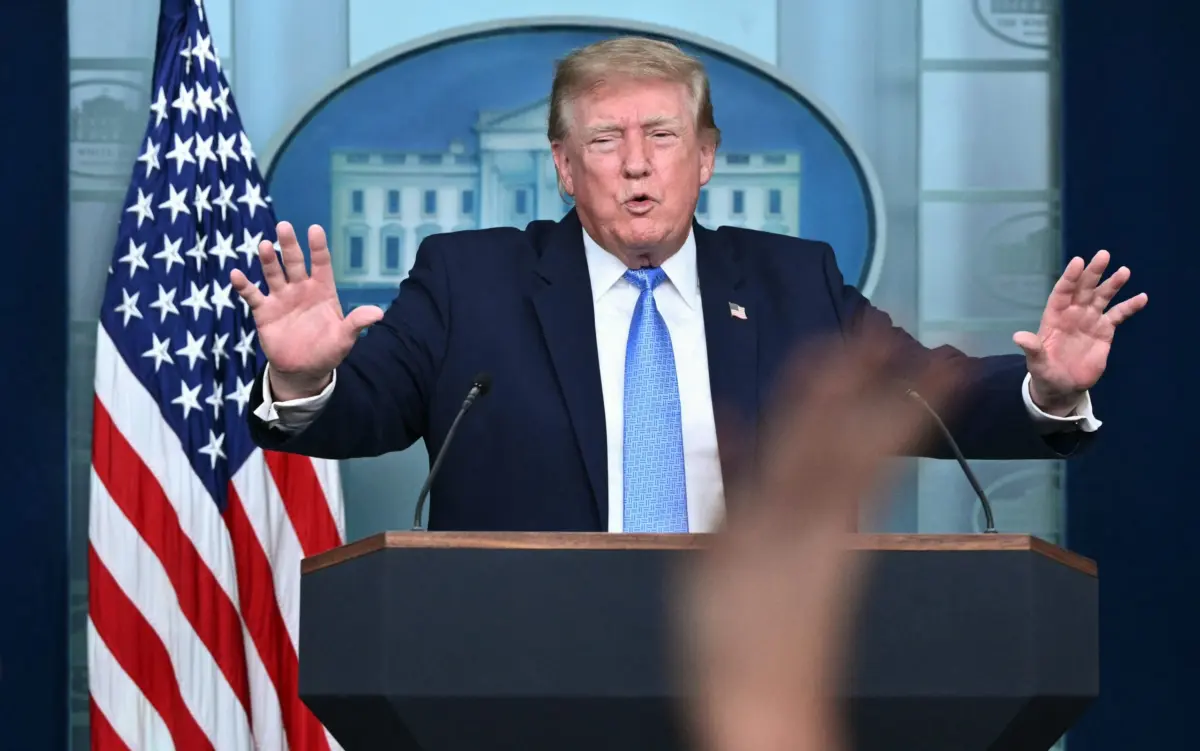
United States President Donald Trump has signaled that he considers the military campaign against Iran by the US and Israel to be "effectively" at an end, following a high-level meeting with diplomatic mediators from Qatar. The announcement, delivered during an unexpected briefing at the White House on Monday, highlighted both Washington’s insistence that Iran’s conventional military strength has been broken and the growing diplomatic pressure from Gulf allies seeking an end to full-scale hostilities.
Addressing reporters, Trump reiterated his administration’s stance that American and Israeli forces have neutralized Iran’s primary defense capabilities. However, rather than declaring a formal, total conclusion to all operational measures, the president stated that Washington would maintain a posture focused on enforcing a strict containment strategy. This stance, he explained, comes at the explicit request of neighboring Middle Eastern nations who remain concerned about broader regional stability.
"Iran, militarily, is effectively over. We’re just keeping it the status quo," Trump said during the briefing. "We’re doing that really at the behest of countries that are their neighbours."
According to the president, maintaining this "status quo" means continuing an extensive maritime economic embargo aimed at isolating Tehran, alongside newly expanded interdiction efforts across land and alternative sea routes.
The ‘Status Quo’ Strategy and Task Force Iron Gate
Clarifying what the continued American presence and containment strategy would look like in practice, President Trump emphasized that the U.S. has no immediate intention of dismantling its heavy military monitoring and maritime enforcement mechanisms. Central to this strategy is the ongoing naval deployment encircling Iranian maritime access points, alongside a newly established task force designated to sever Iran’s alternative trade routes.
Trump detailed that the current operational posture relies heavily on the enforcement of Task Force Iron Gate, a recently announced coalition initiative engineered to cut off Iranian overland trade and shut down commercial transit networks across the Caspian Sea. Combined with maritime interdiction, the measure is intended to maintain severe pressure on Tehran without necessitating large-scale aerial bomb runs or direct land engagements.
"Much was discussed with respect to the Islamic Republic of Iran," Trump said, reflecting on his consultations with regional partners. "Most importantly, Qatar, Saudi Arabia, UAE, Bahrain, Kuwait and others would prefer the status quo, that we remain as is — in other words, a continuation of the greatest naval blockade in the history of our country. Probably in the history of the world."
Despite describing Iran’s military capacity as largely dismantled, Trump declined to commit to a formal, long-term ceasefire or permanent peace accord. When pressed in the White House briefing room on why his administration would not simply declare a definitive end to the conflict and withdraw, Trump framed the continued blockade as an essential security umbrella for regional allies who remain vulnerable to potential lingering threats.
"We have some great allies there, and we have to make sure they’re not hurt, and they would be hurt," Trump explained. "They are right now a lot safer than they were six months ago because Iran’s been very much decapitated. But there’s still the bully of the Middle East a little bit."
The president stressed his preference for a durable, structural resolution over an immediate, temporary truce that could allow Tehran to rebuild its forces. Nevertheless, he issued a stark warning that American military action could resume at a moment’s notice should conditions change.
"I don’t guarantee anything," Trump stated. "But if we do have to go back in, we are locked and loaded and ready to go."
Qatari Mediation and the Push for a Diplomatic Framework
Trump’s public assessment followed high-stakes diplomatic consultations held earlier at the White House, where he and Vice President JD Vance hosted Qatari Prime Minister Sheikh Mohammed bin Abdulrahman bin Jassim Al Thani. Sheikh Mohammed, who also serves as Qatar’s foreign minister, has long played a central role as a key diplomatic bridge between Washington and Tehran, leveraging Doha’s unique positioning to facilitate negotiations throughout the course of the war.
During the closed-door meeting, the Qatari Prime Minister reportedly presented the Trump administration with a two-day framework proposal drafted by Iranian officials intended to serve as a roadmap toward ending the conflict.
Following the meeting, Sheikh Mohammed expressed cautious optimism regarding the direction of the talks, taking to social media to state that he was "grateful for the positive discussions on reaching a deal and bringing peace to the region."
Despite Qatar’s push for a structured path toward a permanent resolution, it remains uncertain whether Trump’s recent statements signal a fundamental operational pivot in the overall U.S. defense posture or simply reflect a temporary pause in direct offensive strikes.
Tehran Rejects U.S. Claims and Demands Full Blockade Lift
In Tehran, high-ranking Iranian officials swiftly dismissed Trump’s public characterization of the conflict, framing his declarations as political maneuvering intended to mask American strategic missteps. Throughout the nearly nine-month conflict, both Washington and Tehran have repeatedly asserted victory, offering starkly contrasting narratives of the war’s progress and impact.
Responding directly to the White House briefing, Mohsen Rezaei, Secretary of Iran’s Supreme National Security Council, took to social media to push back against Trump’s statements and reject the premise of ongoing informal understandings.
"The war on Iran has already wrecked the US government. But Washington flails like a desperate gambler," Rezaei wrote. "FOLD YOUR HAND. STOP manufacturing FAKE NEWS about imaginary talks."
Simultaneously, Iranian President Masoud Pezeshkian offered official commentary carried by Iran’s state-aligned Tasnim News Agency, shedding light on the internal perspective of Iran’s leadership. Pezeshkian stated that Supreme Leader Mojtaba Khamenei had expressed a clear desire to resolve the ongoing crisis, describing the current standoff as an unsustainable state of "neither war nor peace."
Pezeshkian reiterated that while Tehran remains open to engaging in legitimate diplomatic channels to achieve a lasting resolution, it would not accept terms dictated under duress or threat of continued economic blockades.
"We will not surrender to force and bullying," Pezeshkian affirmed, emphasizing Iran’s insistence on equitable terms.
Iranian leadership has laid out a specific framework of seven core conditions that Washington must satisfy to achieve a formal termination of the war. Chief among these demands are the immediate lifting of the U.S. naval blockade, the provision of financial reparations for physical and economic damage inflicted during the war, a complete termination of economic sanctions against Iran, and a broad cessation of offensive military operations across all regional theaters, including campaign fronts in Lebanon and Gaza.
A Regional War with Global Consequences
The diplomatic maneuvering comes after nearly nine months of continuous military escalation that has fundamentally disrupted global commerce and reshaped the security geography of the Middle East. Since hostilities officially erupted on February 28, the fighting rapidly expanded beyond the borders of Iran and Israel, drawing in multiple regional actors and critical global maritime corridors.
In the immediate aftermath of the initial U.S. and Israeli military campaign, Iran implemented retaliatory measures by taking steps to close the Strait of Hormuz. The strategic waterway, through which a major portion of the world’s petroleum, liquid natural gas, and essential agricultural fertilizers pass, became a primary focal point of global economic anxiety as commercial shipping ground to a near-total halt.
To counter American and Israeli strikes, Iranian forces launched sustained series of missile and long-range drone attacks across neighboring Gulf states. Iranian strikes repeatedly targeted military installations hosting American personnel and infrastructure in Qatar, Bahrain, Kuwait, and the United Arab Emirates, heightening security alarms across the Gulf Cooperation Council.
The primary conflict between the U.S., Israel, and Iran also reactivated parallel operational fronts across the region. In the Arabian Peninsula, Saudi Arabia found itself drawn back into active fighting with the Iran-backed Houthi movement. Concurrently, northern front engagements saw Israeli forces launch ground operations and establish an occupation within southern Lebanon, accompanied by heavy bombardment campaigns aimed at neutralizing regional partner networks.
Sporadic Warfare, Nuclear Disputes, and the Road Ahead
As the war approached its ninth month, the intensity of direct American military strikes against Iranian targets transitioned from high-frequency offensive campaigns to more sporadic, targeted operations interspersed with brief lulls in active combat.
Even as diplomatic channels opened via Qatari mediation, localized engagements persisted. In the days preceding the White House meeting, the Trump administration confirmed that U.S. forces had executed what it categorized as "minor strikes" targeting positions on Iran’s strategic Qeshm Island, located near the narrowest point of the Strait of Hormuz.
In parallel with ongoing military interdiction, the U.S. government escalated its intelligence pressure against Tehran’s strategic infrastructure. The administration publicly announced a $20 million financial reward for critical actionable intelligence regarding Iran’s nuclear program, specifically targeting detailed information on nuclear enrichment facilities, high-tech hardware, research equipment, and key personnel involved in nuclear developments.
The status of Iran’s nuclear program remains one of the most disputed elements of the conflict. Following an earlier military campaign known as the Twelve-Day War in June 2025, President Trump asserted that American and allied forces had completely obliterated Iran’s uranium enrichment infrastructure. However, in the months leading up to and throughout the current conflict, the imperative to eliminate Iran’s nuclear capacity was once again cited by Washington as a primary justification for ongoing military operations.
For its part, Tehran has consistently rejected allegations that it is developing non-civilian nuclear capacity. Iranian officials maintain that the nation’s nuclear research and uranium enrichment infrastructure are strictly dedicated to civilian power generation, scientific development, and medical research applications.
With Washington maintaining its naval blockade and Task Force Iron Gate operations, and Tehran refusing to yield to unilateral pressure while insisting on its seven preconditions, the confrontation remains balanced precariously between active hostilities and a fragile, heavily militarized containment framework.