
A catastrophic wave of violence swept through the central district of Krakow on Saturday, leaving six people dead and several others injured after a gunman opened fire in Poland’s second-largest city. The deadly assault in one of the nation’s premier cultural and historic centers quickly escalated into a national security emergency, with law enforcement agencies and emergency medical services securing the area while criminal investigators scrambled to establish the full scope of the tragedy. Hours after the initial rampage in the city center was contained by police, Polish Prime Minister Donald Tusk delivered a grave update to the nation, revealing that law enforcement officers conducting a search of the suspect’s home had discovered three additional bodies inside the residence. The grim finding raised the total number of fatalities connected to the perpetrator to nine, marking one of the most severe public violence incidents in the country’s recent history.
The perpetrator, identified by law enforcement authorities as a 25-year-old Polish citizen, was officially described by Poland’s Interior Minister as having been motivated and inspired by radical far-right ideologies. Police officials further confirmed that the suspect carried out the shooting spree utilizing military-grade weapons, a factor that significantly contributed to the rapid and devastating lethal outcome in the crowded urban setting. As details regarding the suspect’s political orientation and high-powered weaponry emerged, senior government officials, local administrators, and counterterrorism specialists began confronting the horrific reality of a targeted, ideologically driven mass casualty event unfolding in the heart of a major European urban center.
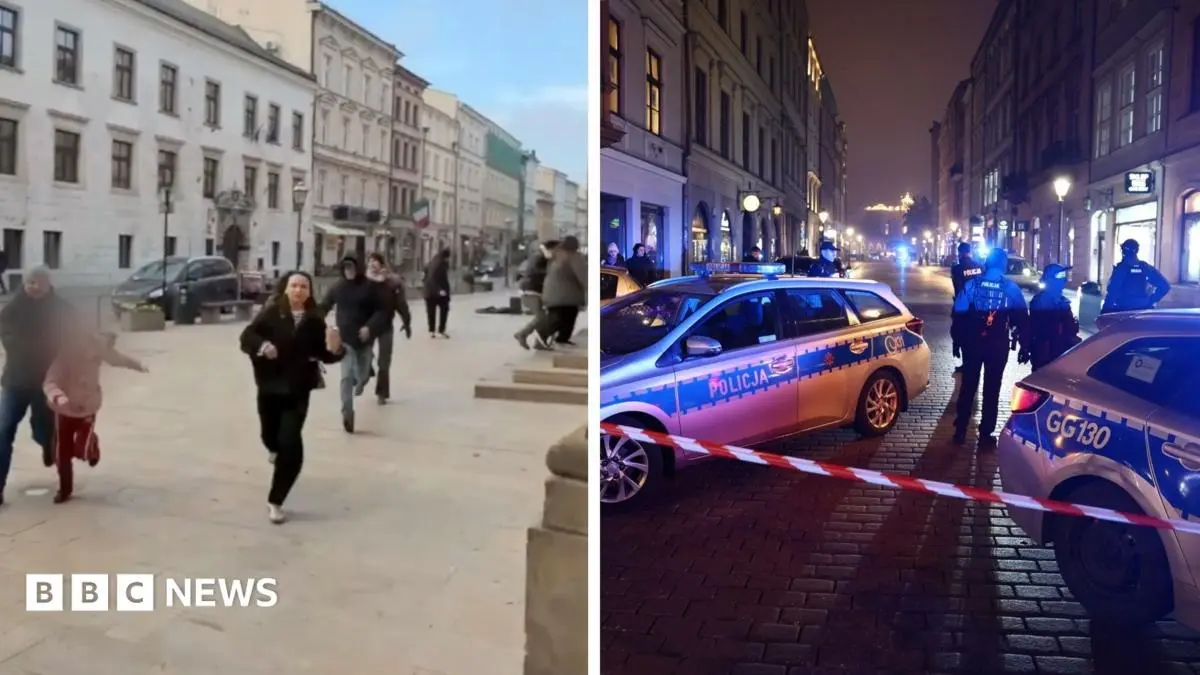
The violence began on Saturday within the historic core of central Krakow, provoking immediate terror among local residents, workers, and visitors who populated the surrounding streets and public spaces. The city’s famous main market square, a renowned focal point of public life, civic culture, and tourism, was suddenly transformed into an active crime scene as rapid gunfire echoed across the plaza. Eyewitness reports and digital recordings emerging from the scene documented the raw panic that spread through the public as civilians fled for safety in every direction, attempting to take cover behind nearby structures while assisting others away from the danger zone.
Visual evidence of the tragedy was quickly recorded by onlookers and local surveillance systems, providing key evidentiary details into the sequence of events as they unfolded during the attack. Video footage authenticated by BBC Verify offers a clear and harrowing depiction of the immediate chaos in the city center during the shooter’s rampage. In the verified footage, approximately a dozen people can be seen running frantically for safety into two separate nearby buildings as gunshots reverberated through the area. Moments after the group of civilians scrambled into the structures, a black passenger vehicle with its front window rolled open was captured driving past the buildings, followed closely by a police patrol car in immediate and rapid pursuit.
Another verified video clip analyzed following the outbreak of violence captured the specific moment gunshots resonated across Krakow’s main market square. The audio and visual recordings illustrate the sudden transition from a normal Saturday afternoon into a high-intensity crisis, with members of the public dropping to the ground, seeking shelter behind stone columns and outdoor fixtures, or fleeing into surrounding alleyways to escape the incoming fire. These authenticated recordings have formed a central component of the ongoing police investigation, helping forensic analysts establish a precise timeline of the suspect’s movements through central Krakow while documenting the rapid tactical intervention of local law enforcement officers who moved to intercept the vehicle and suppress the threat.
Following the initial containment of the attack in the city center, top members of the Polish government moved swiftly to inform the public and outline the preliminary findings of the security apparatus. Poland’s Interior Minister publicly confirmed that the suspect was a 25-year-old Polish national whose actions were driven by far-right ideological beliefs. The Interior Minister specifically emphasized that the suspect deployed military weapons during the assault, underscoring the extreme danger posed by the capability and nature of the armaments involved. Law enforcement leadership noted that the use of military-grade firepower made the assault uniquely lethal, allowing the attacker to inflict heavy casualties within moments of opening fire in the market square.
The full scale of the disaster expanded significantly several hours later when Prime Minister Donald Tusk issued a formal statement addressing the progress of the law enforcement response. Prime Minister Tusk revealed that police units executing a search warrant at the 25-year-old suspect’s home address discovered three additional bodies inside the residential property. Tusk reported that the suspect’s home remained an active crime scene under intense forensic examination, with specialized investigative teams working meticulously to gather physical evidence, secure the premises, and determine the exact identities of the three victims found indoors, as well as the timeline and circumstances surrounding their deaths.
The discovery of additional fatalities inside the suspect’s residence has fundamentally shifted the nature of the criminal investigation, expanding it from a public mass shooting into a multi-location homicide inquiry. Law enforcement officials, forensic pathologists, and crime scene technicians are continuing to conduct a comprehensive sweep of the suspect’s residence, searching for additional physical evidence, ammunition stockpiles, potential explosives, and digital devices. Investigators are prioritizing the recovery of computers, mobile phones, and online accounts to analyze the suspect’s communications, digital footprint, and path to radicalization, aiming to ascertain whether he acted entirely alone or had direct contact with extremist networks.
In central Krakow, emergency medical services worked continuously throughout Saturday to stabilize and transport the several individuals who sustained injuries during the shooting. Hospitals across the region were placed on high alert to receive victims suffering from gunshot wounds and trauma suffered during the chaotic evacuation of the market square. Medical staff have been working around the clock to provide critical treatment to the wounded, while municipal authorities have mobilized mental health professionals and crisis response teams to assist traumatized survivors, eyewitnesses, and family members affected by the tragedy.
The city of Krakow, long recognized as a historic cultural center and one of Central Europe’s most popular urban destinations, remains in a state of profound shock as details of the violence continue to unfold. The main market square, typically defined by bustling pedestrian movement and public gatherings, was cordoned off by law enforcement officers to preserve critical physical evidence. Forensic teams placed markers across the cobblestone plaza to trace bullet casings, structural damage, and discarded personal items, while detectives initiated extensive interviews with shop owners, employees, and bystanders who witnessed the shooter or recorded initial footage of the attack.
The suspect’s use of military weapons in a major public venue has initiated urgent debates among national security experts and law enforcement authorities in Poland. While officials have not yet publicly specified the exact classification or origin of the military armaments deployed by the 25-year-old gunman, the presence of such weaponry has raised grave concerns regarding illegal arms trafficking and security monitoring. Authorities are actively investigating how the suspect obtained military-grade hardware and whether any security protocols were breached leading up to Saturday’s violent assault.
The explicit connection to far-right ideology has also placed heightened focus on the threat of extreme political radicalization within the country. Security agencies are analyzing the suspect’s background to identify any manifestos, online postings, or affiliations with organized extremist groups that may have inspired the attack. The combination of extremist ideology and access to high-powered military arms presents a severe threat model, prompting calls from public figures and civil rights observers for enhanced counterterrorism measures and proactive intervention strategies targeting extremist radicalization.
As the forensic search at the suspect’s residential property continues under the close supervision of law enforcement and the office of Prime Minister Donald Tusk, the nation continues to monitor developments while offering support to the affected families. Polish leadership has committed all necessary state resources to ensure a complete, transparent, and thorough investigation into the full extent of the perpetrator’s actions. The tragedy has cast a heavy shadow over Poland’s second-largest city, as emergency personnel, forensic investigators, and law enforcement agencies work through the night to provide answers, secure the region, and deliver justice following a day of catastrophic violence.