
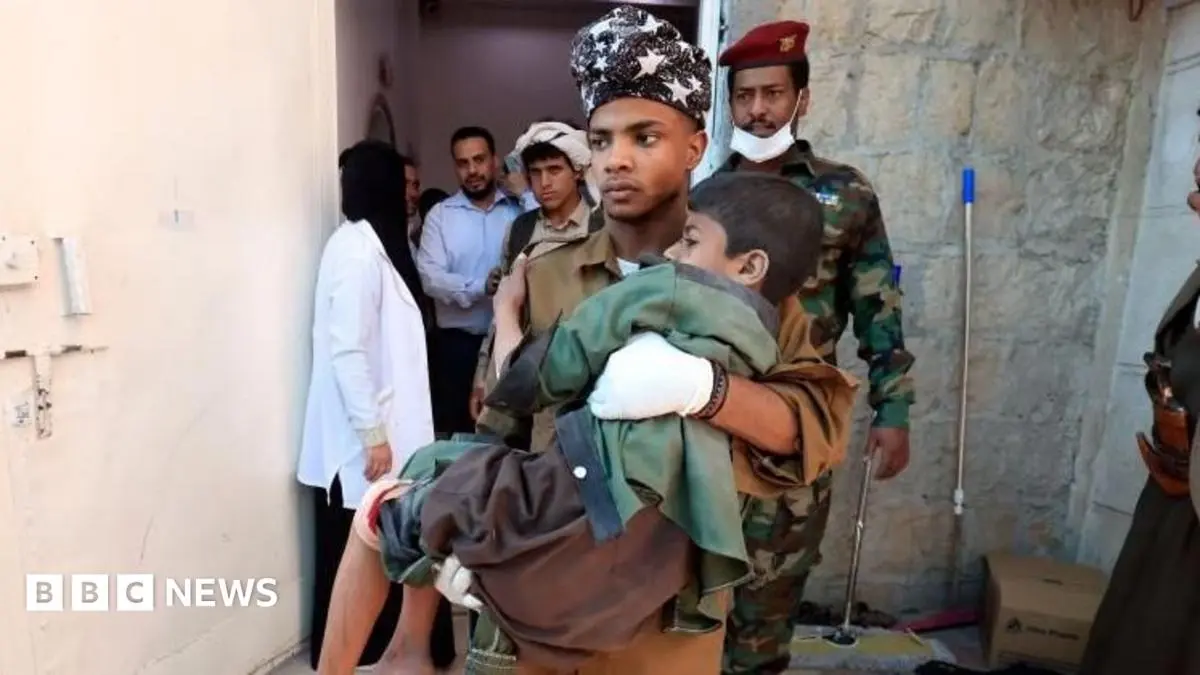
Media outlets aligned with the Houthi movement in Yemen report that at least 33 people, including women and children, have been killed following a series of air strikes attributed to Saudi Arabia. The devastating strikes targeted al-Shariyah, a town situated to the east of the Yemeni capital, Sanaa, marking one of the most lethal incidents since major fighting recently flared up across the country.
The initial toll was reported by Houthi-affiliated media, with the Houthi-run Saba news agency confirming that the aerial bombardment took place on Saturday. According to Saba news agency, in addition to the 33 confirmed fatalities, at least 39 people sustained injuries of varying severity during the attack. The Saudi-led coalition, which backs Yemen’s internationally recognized government in its prolonged campaign against the Houthis, has not issued any formal comment or response regarding the strikes in al-Shariyah.
Graphic live video footage broadcast by Al Masirah—a television network operated by the Houthi movement—offered a grim window into the immediate aftermath of the strike. Broadcasts from the scene in al-Shariyah showed frantic rescue workers and local residents sifting through shattered concrete and twisted metal to pull victims from the smoking rubble of several collapsed structures. Among those recovered from the ruins of the shattered residential buildings were the bodies of young children. Additional television reports displayed numerous injured individuals, covered in dust and blood, being rushed to nearby medical facilities on stretchers as emergency teams worked desperately to manage the sudden influx of casualties.
The deadly strike on al-Shariyah occurred against the backdrop of rapidly rising cross-border military activity between the warring factions. Just hours prior to the air strikes that devastated the town east of Sanaa, the Saudi-led coalition announced that its air defense systems had successfully intercepted a missile launched toward the Saudi capital of Riyadh. The interception highlighted the ongoing direct aerial exchanges between Houthi forces and Saudi Arabia, underscoring the immediate vulnerability of key urban centers on both sides of the border.
The attack on al-Shariyah also followed closely on the heels of another mass-casualty event in Yemen’s ongoing violence. On Friday, an attack struck a busy market in Taiz province, an area that has emerged as a central focal point of the recent resurgence in heavy ground fighting. The strike on the Taiz market reportedly resulted in the deaths of at least 30 people, triggering immediate and conflicting accusations from both sides of the divide. Houthi officials accused the Saudi-led coalition of executing an air strike on the market, while forces supporting Yemen’s internationally recognized government countered by asserting that the Houthis were responsible for firing a destructive missile into the crowded commercial site.
Responding to the recent sequence of strikes and the mounting civilian death toll, high-ranking Houthi official Mahdi al-Mashat issued a public statement condemning the attacks. Promising that the actions of their opponents would not go unanswered, al-Mashat explicitly vowed that the Houthi movement would take revenge for the latest strikes in Yemen, signaling that further military escalation and retaliatory actions are imminent.
The latest wave of bloodshed reflects a disastrous unraveling of relative stability in a conflict that has spanned more than a decade. The Saudi-led coalition originally entered the Yemeni conflict to conduct military operations aimed at suppressing the Houthis and reinstating Yemen’s internationally recognized government. For several years, the high-intensity war had entered a largely dormant phase, marked by decreased broad-scale offensives and fragile diplomatic understandings. However, this period of relative calm deteriorated sharply, with the broader violence reigniting as a direct consequence of the escalating regional Iran war.
The collapse of the fragile truce began when Saudi Arabia executed air strikes against the international airport in Sanaa—a key strategic facility under Houthi control. The primary objective of the Saudi strike on the Sanaa airport was to block an Iranian aircraft from landing at the site, reflecting deep-seated concerns over direct supply lines and regional alliances between Tehran and the Houthi movement.
The targeted strike on the airport promptly triggered a chain reaction of reciprocal military measures. In response to the action at Sanaa airport, the Tehran-backed Houthis launched retaliatory attacks against Saudi infrastructure, targeting Abha airport located inside Saudi Arabia. Following the strikes on Abha airport, Houthi forces expanded their campaign to maritime targets, launching attacks against Saudi vessels navigating the Red Sea off the Yemeni coastline. The Red Sea maritime corridor had become increasingly vital for Saudi Arabia as an alternative oil export route designed to bypass the strategic vulnerability of the Strait of Hormuz. By targeting shipping lanes off Yemen’s coast, the Houthis effectively extended the conflict into critical international economic channels.
These sequential tit-for-tat escalations dismantled the remaining elements of the cease-fire, leading to a complete resumption of major combat operations across Yemen. Ground forces aligned with the Saudi-backed recognized government and Houthi fighters have re-engaged in heavy combat across multiple battlefronts, effectively ending years of relative quiescence and plunging civilian populations back into intense warfare.
Throughout the course of the broader multi-year conflict, the tactical pattern of engagement has largely relied on heavy aerial bombardment by the Saudi-led coalition juxtaposed against long-range projectile attacks by the Houthis. Coalition forces have regularly carried out targeted air strikes aimed at neutralizing Houthi military positions, command structures, and logistical hubs throughout Houthi-controlled territories, including Sanaa and surrounding provinces. Conversely, the Houthi movement has continuously utilized ballistic missiles and specialized weaponry to target strategic locations deep inside Saudi Arabian territory, focusing their strikes on civilian airports, military installations, and vital economic targets such as oil production and processing facilities.
The human consequences of this renewed cycle of violence have drawn profound concern from international observers and humanitarian organizations. According to figures provided by the United Nations, more than 1,600 people have been killed since active fighting reignited across Yemen. Furthermore, the United Nations reports that the renewed hostilies have forcibly displaced more than 300,000 people from their homes, worsening an already severe internal displacement crisis and overwhelming regional relief efforts.
The destruction observed in al-Shariyah represents the acute danger faced by civilians residing near target zones or strategic regions in Yemen. As rescue teams continue clearing ruined structures in al-Shariyah and medical staff care for the 39 injured victims reported by Saba news agency, the prospect of immediate de-escalation appears remote.
With Saudi Arabia maintaining its coalition operations and keeping silence on specific strike incidents like Saturday’s attack, and with Houthi leadership under Mahdi al-Mashat formally committing to swift retaliation, the cycle of strike and counter-strike shows every indication of worsening. The convergence of regional geopolitical clashes, local front-line battles such as those in Taiz province, and mutual cross-border strikes continues to inflict a heavy toll on Yemeni civilians, who remain caught in the center of the reignited war.