
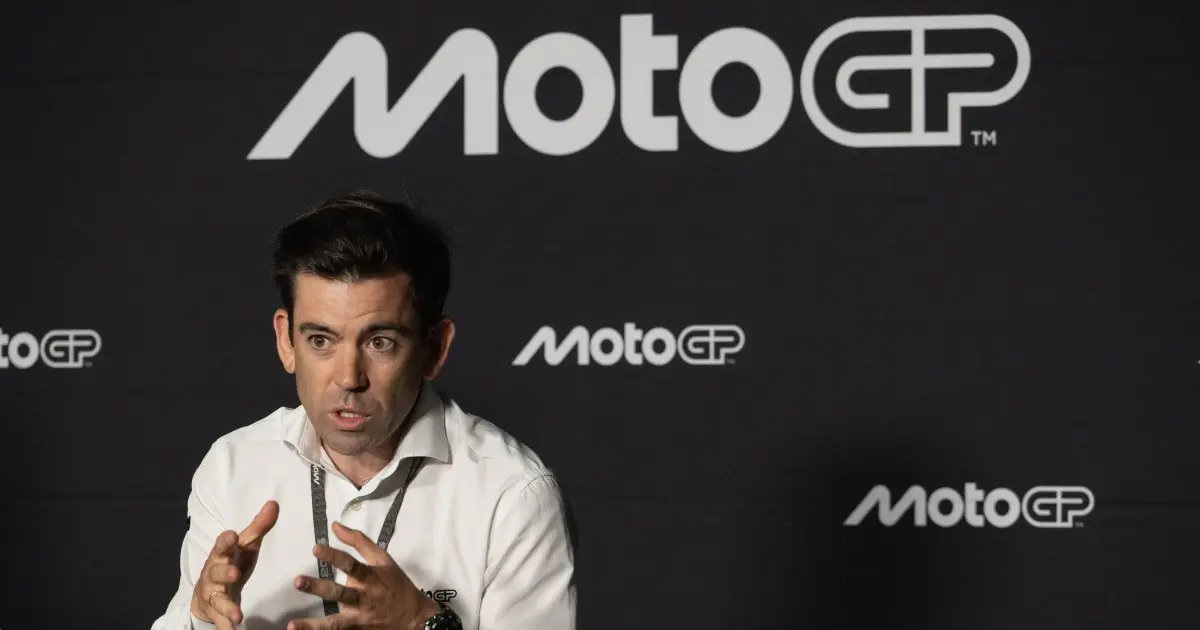
MotoGP deputy chief Carlos Ezpeleta has strongly defended the championship’s decision to proceed with the Qatar Grand Prix, maintaining that organizers made the correct call despite widespread rider anxieties regarding security in the Gulf region. The event, held at the Lusail International Circuit, took place against the backdrop of heightened geopolitical instability driven by the ongoing United States-Israel war on Iran.
Speaking in an interview with the Reuters news agency, Ezpeleta acknowledged that while it was entirely natural for riders to express deep concerns about traveling to the Middle East during a period of conflict, the series management was confident in the comprehensive security assessments that allowed the race weekend to go ahead. However, Ezpeleta admitted that the sudden, late withdrawal of Japanese manufacturing giant Yamaha from the event came as a genuine surprise to series organizers.
The decision to hold the race—which took place from November 6 to 8 after being rescheduled from its original April date—was built upon rigorous intelligence gathering. Ezpeleta revealed that MotoGP based its operational directives on official communications provided directly by the Qatari government, alongside detailed assessments from foreign embassies that maintain a significant diplomatic and logistical presence within the MotoGP paddock.
"We can unequivocally say that it was the right decision," Ezpeleta told Reuters, reflecting on the logistical and security hurdles overcome to stage the event. "Obviously, it was normal that the riders showed their concerns, and I think that we mitigated those and confronted them to the best that we possibly could."
Addressing the intense public discussion and paddock apprehension leading up to the race, Ezpeleta stressed the importance of relying on verified official intelligence rather than external commentary. He noted that unverified reports created substantial anxiety among teams and competitors in the weeks leading up to the Grand Prix.
"It’s just important in today’s day and age to follow official information and real intelligence versus speculation in the media and disinformation, which I think ultimately was what brought a lot of noise around the event itself," Ezpeleta explained.
The Qatar Grand Prix had initially been scheduled as an early-season fixture in April, but regional conflict prompted organizers to postpone the race to November. Ezpeleta clarified that safety remained the primary prerequisite for holding the event and emphasized that MotoGP management would not have hesitated to alter plans again had regional threats escalated. If security conditions in Qatar had deteriorated, the event would have been cancelled or postponed a second time. However, conditions stabilized significantly during June and July, allowing organizers to accelerate operational planning for the November race weekend.
The decision to proceed in Qatar occurred while neighboring sports properties faced severe disruptions. Across the border in Saudi Arabia, a wide array of high-profile international sporting events—spanning professional football, tennis, golf, and cycling—were cancelled or postponed following escalation in regional hostilities. Notably, the 2027 Dakar Rally was moved out of Saudi Arabia after attacks launched by Yemen’s Houthis targeted Riyadh’s international airport, resulting in at least 12 fatalities and injuring more than 300 people.
Despite these severe disruptions in nearby Saudi Arabia, Ezpeleta noted that Qatar had not experienced the same direct impact or threat profile as its Gulf neighbors, allowing MotoGP to safely conduct its event at Lusail once security protocols were thoroughly vetted.
Yamaha Withdrawal Surprised MotoGP
While MotoGP management remained firm in its decision to run the Grand Prix, the grid was significantly altered by the unexpected absence of Yamaha. The Japanese manufacturer announced its withdrawal from the Qatar Grand Prix shortly before the event, citing strict "company-wide travel restrictions" implemented for its staff regarding travel to the Middle East.

Yamaha’s decision resulted in the complete absence of both its factory team, Monster Energy Yamaha, and its satellite partner, Prima Pramac Racing. Their non-attendance removed four bikes from the grid, shrinking the premier class field down to just 18 riders for the weekend’s sessions and races.
Ezpeleta expressed clear surprise at Yamaha’s stance, pointing out that series organizers had provided exhaustive security briefings and directly addressed all safety queries raised by the manufacturer prior to their decision.
"I can say that the decision surprised us, given the level of detail that was put into the assessment and all the planning," Ezpeleta said. "All the questions that Yamaha had were answered."
Despite the friction caused by the last-minute pullout, Ezpeleta struck a diplomatic tone regarding the long-standing relationship between the series rights holder and the manufacturer, acknowledging the weight of the choice Yamaha faced.
"Ultimately, Yamaha is a great partner of the championship historically, and I’m sure they will continue to be," Ezpeleta added. "We understand that it wasn’t a decision that was taken easily from their side, but it is a decision that was surprising to us for sure."
Intriguingly, Yamaha’s corporate travel ban was not applied uniformly across all motorcycle racing categories in Qatar. While the premier MotoGP class teams were pulled from the event, Yamaha’s Moto2 squad did make the trip to the Lusail International Circuit. The decision to allow the Moto2 team to compete was heavily influenced by the championship standings, as Yamaha rider Izan Guevara was embroiled in a tight title battle, sitting second in the Moto2 world championship. However, Guevara’s race weekend ended in frustration when he suffered a technical failure during the race and failed to finish.
MotoGP Leaves Sanctions to FIM
Yamaha’s decision to boycott the Qatar Grand Prix has created regulatory and contractual complications within the sport. MotoGP officials previously noted that failing to participate in a scheduled World Championship event carries distinct sporting implications, but Ezpeleta made it clear that sanctioning authority rests outside the commercial rights holder’s direct domain.
When asked about potential penalties or disciplinary measures facing Yamaha, Ezpeleta declined to speculate on specific consequences, drawing a clear line between commercial obligations and governing body regulations.
"We just said that we would manage any contractual matters with Yamaha directly and any sporting conversations would be handled by FIM," Ezpeleta stated, referring to the International Motorcycling Federation, which serves as the global governing body for motorcycle racing.
Under the framework governing MotoGP, participating teams enter into binding agreements to field their entries at every round on the official calendar. Ezpeleta underscored the critical nature of these commitments to the overall health, credibility, and commercial integrity of the World Championship.

"We continue to say that it’s a disappointment because I think one of the strengths of MotoGP as a championship is that all the riders, all the teams are committed for the full season," Ezpeleta said. "I would say as a rights holder that the teams are committed and obliged to show up at all the events and all races."
Neither Yamaha nor the FIM responded to requests for comment regarding prospective sporting penalties, contractual discussions, or the broader fallout from the manufacturer’s absence in Qatar.
Improving Communication and Historical Lessons
The dispute surrounding the Qatar Grand Prix has highlighted internal friction between series management, manufacturers, and competitors during times of crisis. Ezpeleta acknowledged that the situation exposed gaps in how information is relayed across the paddock, pledging that MotoGP management will work to establish clearer, more proactive lines of communication with teams and riders moving forward.
"We have to proactively push to improve communication, especially with the teams and the riders because they are obviously the most important part of the championship," Ezpeleta admitted.
Reflecting on his decades at the helm of the sport, Ezpeleta noted that navigating external crises and paddock skepticism is not unprecedented for MotoGP management. He drew a direct historical parallel between the recent events in Qatar and the controversial 2011 Japanese Grand Prix at Motegi, which took place in the aftermath of the devastating Fukushima nuclear disaster.
During the 2011 season, several top riders and teams expressed intense reluctance to travel to Japan due to radiation fears, sparking months of heated debate and intense media scrutiny before the event ultimately went ahead safely.
"We’ve been managing the sport for 35 years and we’ve had situations like this before," Ezpeleta remarked, recalling the Japanese Grand Prix crisis. "There was a lot of controversy at the time, as was now with Qatar, guided by misinformation and speculation, rather than facts. We continue to say that this was the right decision."
On the track at Lusail, the reduced 18-rider field delivered pivotal results for the 2026 MotoGP World Championship. Aprilia Racing’s Italian rider Marco Bezzecchi mastered the conditions to secure victory in the main Grand Prix race on Sunday. However, Ducati’s Marc Marquez emerged as the weekend’s chief beneficiary in the championship standings. After winning Saturday’s sprint race, Marquez secured a second-place finish behind Bezzecchi in the main feature, extending his lead at the top of the standings to a formidable 60 points with just two rounds remaining in the season.