
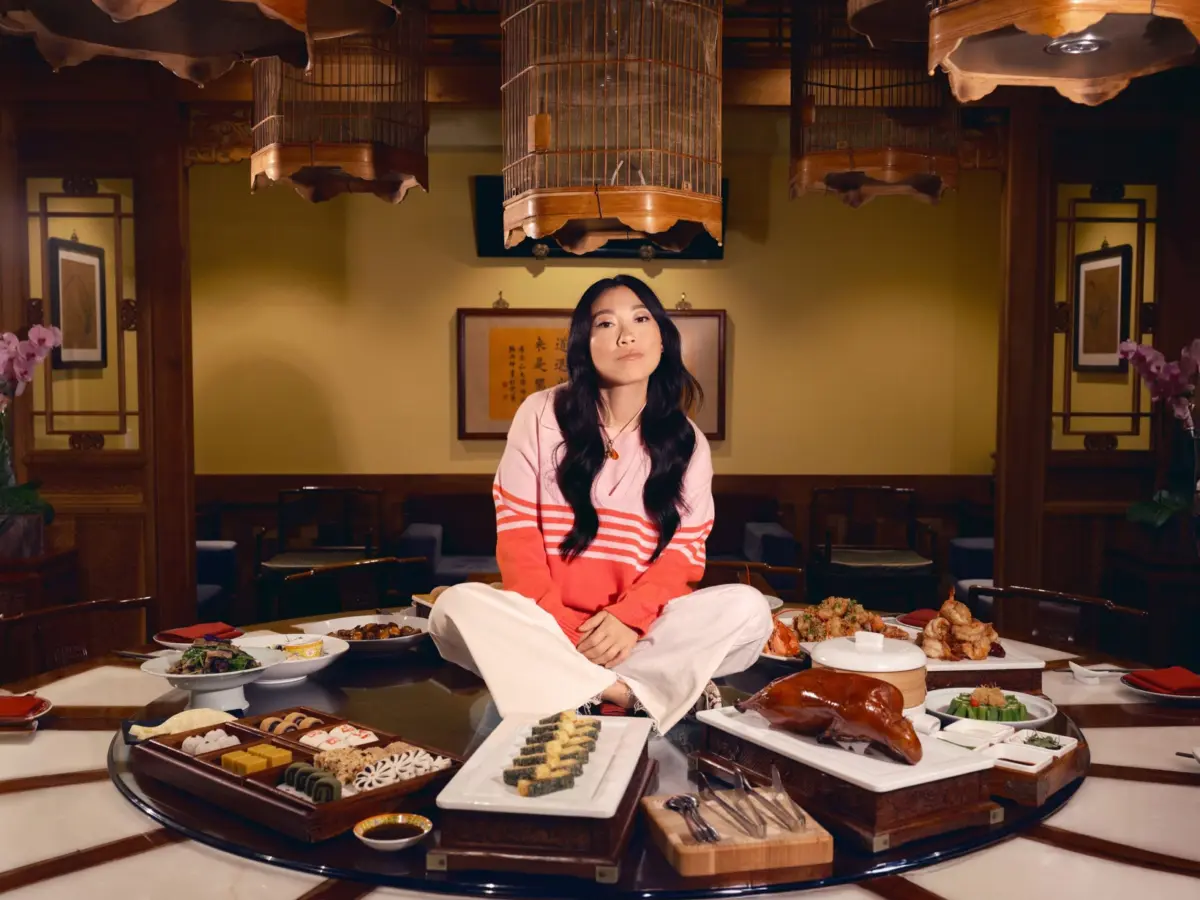
In her pristine Los Angeles kitchen, Nora Lum—the actor, comedian, and rapper better known to the world as Awkwafina—is standing over a stove with two burners and losing the immediate battle with both. Ramen boils furiously on one burner, while Spam sizzles and pops with aggressive violence over the other. Surveying this domestic spectacle over FaceTime, her nonagenarian grandmother, Powah, cackles and tells her, with characteristic and loving bluntness, that it looks like absolute garbage.
This chaotic yet affectionate scene serves as the cold open for Lum’s new Apple TV docuseries, Awkwafina: The Unlikely Cook.
“Food is so important to being Asian,” she announces directly to the camera, capturing a sentiment that resonates deeply across cultures and generations. “You can’t talk about being Asian without food being the thread that pulls it all together.” But what happens when, much like the 38-year-old Lum, you possess a skill set that prevents you from even successfully steaming an egg?
Family history complicates the answer further. Raised in Forest Hills, New York, the actor has considerable Queens credentials—after all, her semi-autobiographical Comedy Central hit was titled Awkwafina Is Nora From Queens—but her lineage also includes genuine local restaurant royalty.
In 1952, her great-grandfather, Jimmy Lum, opened the family’s landmark Chinese restaurant in Flushing, making it one of the earliest dining establishments in the neighborhood at the time. “If you lived in New York, not just Queens, at a certain era, almost 10 out of 10 times, you remember Lum’s,” she recalls. When food-world historians and long-time New York residents are asked about the legendary spot, they respond immediately with vivid memories of the classic pupu platter, the iconic lobster egg rolls, and the glitzy, neon-lit interior decor that defined a bygone era of Chinese-American dining in New York City.
Lum, who is half Korean, previously explored her mother’s roots on an episode of No Taste Like Home With Antoni Porowski, but she admits to knowing relatively little firsthand about her father’s family restaurant, which permanently closed its doors long before she was born. “When they talk about it, it’s like they’re talking about a long-lost family member,” she says, reflecting on the mythical status the restaurant holds within her family lore.
The new Apple TV docuseries follows Lum as she travels across the country to meet, learn from, and cook alongside various Asian American chefs and restaurateurs. Many of them share a background remarkably similar to her own—they are second- or third-generation restaurant kids who initially stepped away from the family business before ultimately finding their way back to the culinary world on their own terms.
“A lot of their families did not want them to go into the industry. They’re subverting the stereotype in a way,” she says, highlighting culinary figures like Cory Ng and Zhan Chen of New York City’s Potluck Club, who generously step in to help her resurrect Lum’s for a special, one-night-only pop-up event during the filming of the series.

“I always dreamed of [being] the intrepid restaurant worker,” Lum confesses, reflecting on a romanticized notion of kitchen life. Yet, her actual family upbringing fostered an entirely different attitude toward cooking and domestic labor. “Whether it was dishes or cooking, no one trusted me with it. I convinced myself that I’m just not a cook.”
Zigzagging across the country for the show thoroughly challenged and ultimately changed that perception. Her journey took her from blowing up a duck at Mister Jiu’s in San Francisco to aggressively manning the wok at the prestigious Culinary Institute of America in New York. She also embarked on a barbecue road trip through Texas with her friend and fellow comedian Jimmy O. Yang.
During their Lone Star State excursion, the duo stopped by Curry Boys BBQ in San Antonio, where traditional Texas brisket is served atop a comforting bowl of green Thai curry, followed by a visit to Eaker Barbecue in Fredericksburg to sample bulgogi-infused sausage. “Seeing Asian people in this environment that’s so Texas, where the two cultures are very different,” she notes, profoundly broadened her perspective on how modern chefs layer disparate cultural influences into their craft without ever making it feel like a compromise.
Much of the inherent pleasure of the show stems from watching Lum genuinely encounter new culinary experiences with wide-eyed curiosity. During a whole-hog barbecue segment set in Hawaii, local chef Mark Noguchi informs her that they will be utilizing an imu, a traditional underground pit oven. Lum lights up instantly, not missing a single beat before asking with characteristic deadpan humor, “Like the bird?”
Her lack of formal culinary knowledge is frequently played for laughs, yet it simultaneously serves as the unexpected source of the show’s underlying tenderness and emotional core. Lum proves entirely game for almost anything thrown her way, even when she is completely in the dark about what is happening around her. “It’s like one of those school nightmares where you hadn’t completed the class and then you’re just walking in for the test,” she explains.
Naturally, things go wrong along the way, and Lum is frequently put through the culinary wringer. The docuseries does not attempt to spare her from the awkwardness or physical discomfort of the kitchen, but what ultimately surprised her most was how surprisingly gentle cooking for professional chefs turned out to be. “I’ll cook for a chef any day,” she says with a laugh. “With my family, I’ll order out.”
Lately, she has been spending her downtime perfecting her Bolognese sauce, though she is careful not to oversell the television show as a tidy narrative of complete personal transformation.
“As much as it was a journey of food and collective Asian culture, it was also self-discovery,” she says, pausing before catching herself with a characteristically self-deprecating chuckle. “Probably in a narcissistic way—there’s still a question mark as to what it all means.”