
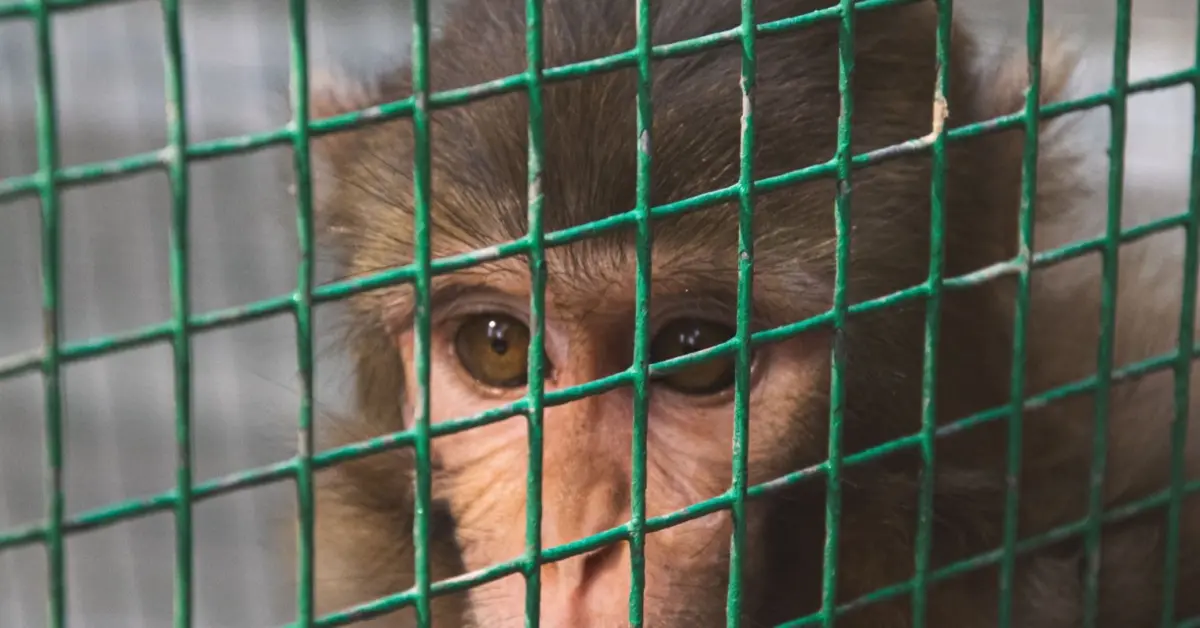
For the vast majority of the public, what happens inside a research laboratory remains entirely hidden behind locked doors, institutional walls, and bureaucratic secrecy. It is a world where medical progress is debated in abstract policy terms, far removed from the daily reality of the living creatures housed inside. Driven by a desire to uncover the truth about how these animals are treated and how humans adapt to working in such an environment, award-winning writer and investigator Lindsay Oliver made the decision to go undercover.
Her gripping new book, Marshmallows Are Their Favorite: Undercover at a Primate Lab, pulls back the curtain on this secretive world. Oliver offers a unique, deeply personal story that sheds light on the nonhuman residents living in cages and the everyday human workers tasked with managing them.
In a revealing interview with Marc Bekoff, Oliver discusses the motivations behind her undercover operation, the surreal environment of the laboratory workplace, and her hopes for how the public will react to her groundbreaking account.
Why Write About the Primates?
When asked why she wrote Marshmallows Are Their Favorite and how she settled on its eye-catching title, Oliver points directly to a sense of moral obligation toward the animals she encountered.
"Honestly, I wrote this book because I owe it to the monkeys," Oliver explains. "When I first walked into that facility and saw cages lining the cinderblock walls, with monkeys watching me through the bars, I knew almost immediately that I needed to write about it. Most people will never be allowed inside a primate lab, and I felt a heavy responsibility to tell these stories."
The title itself carries a deeper, individualized meaning that challenges the sterile terminology often used by research institutions. "We all have favorites, and a favorite is personal. That is part of why I landed on Marshmallows Are Their Favorite," Oliver notes. "It tells you there is an individual there with preferences, opinions, and things they look forward to. I wanted readers to see the monkeys as individuals before they even opened the book."
A Journey from Aspiring Veterinarian to Undercover Investigator
Oliver’s path to the primate lab traces back to her childhood dreams. Like many young animal lovers, she originally aspired to become a veterinarian. However, her first exposure to animal testing in college presented a stark ethical dilemma that altered the course of her life.
"Ironically, college was my first exposure to animal testing and what would have been required of me to be a vet," she says. "For the kid who walked out of a high school science class to protest dissecting a frog, this presented a fairly significant problem."
Unable to reconcile the requirements of modern veterinary medicine with her own ethical boundaries, Oliver walked away from that career path and instead chose to become an undercover animal cruelty investigator. Her assignment inside the primate lab marked her very first lab case, thrusting her into an environment where she would form deep and unexpected connections with the animals behind bars.
Reaching Beyond Traditional Audiences
When considering who she hopes will read the book, Oliver rejects the notion of a narrow target demographic. While "everyone" might sound like an ambitious answer, she believes it is precisely what the animals deserve.
"I really want to reach people who would never assume that a book about a primate lab is for them," Oliver explains. She points out that readers can pick up the book for various reasons, whether drawn in by the undercover element, the covert cameras, the double life, the high-stakes close calls, or the surprising relationships she built with her coworkers.
Crucially, Oliver also hopes the book reaches individuals who currently work inside research facilities—particularly those who feel internally conflicted or who have been told by superiors that caring too much about the animals makes them bad at their jobs. To counter that narrative, she emphasizes that empathy is not a professional flaw. Furthermore, she wrote the book with readers in mind who might initially find the subject matter too emotionally difficult to confront.
The Surreal Normalcy of the Laboratory Workplace
One of the most striking elements of Oliver’s account is the exploration of what happens when a deeply troubling practice becomes entirely ordinary. Situated in the middle of a typical American town, the facility she investigated could exist almost anywhere. A Target sits on one corner, a Starbucks on another, and nearby, thousands of monkeys remain locked inside cages.
Within its walls, the lab functions first and foremost as a workplace. People clock in, complain about their work schedules, gossip, flirt, and plan their weekends while, mere feet away, monkeys scream and pound on the walls of their enclosures. What felt surreal and shocking to an undercover investigator was simply treated as "just another Tuesday" by veteran employees.
This profound disconnection is sustained, in part, by systemic language that reduces sentient beings to numbers and "subjects." Yet, Oliver discovered that these animals are highly intelligent, sensitive creatures with distinct personalities, intense fears, and strong opinions. She recalls an individual named Bo, who eagerly ate almost everything handed to him—except for pretzels, which he would throw to the ground as if personally offended by their presence. It is through these small, intimate moments that the true nature of the animals emerges, irrevocably changing those who witness them.
At the same time, the human employees proved to be far more complex than Oliver initially anticipated. Expecting a staff entirely comfortable with the suffering around them, she instead found workers who cared deeply about the animals, quietly finding small ways to improve their daily lives while visibly struggling with the mental toll of their job requirements.
An Insiders Perspective on Undercover Operations
Addressing how her book differs from other literature on animal experimentation, Oliver notes that while many existing texts analyze the issue through the lenses of science, ethics, or policy, her work invites readers directly through the employee entrance.
Rather than presenting an objective academic report, Oliver shares a lived narrative. She became the inexperienced new technician, learned the daily routines, wore hidden cameras, made friends, and constantly tried to help the monkeys without exposing her true identity. Readers experience the facility alongside her, from the initial hiring process through her final shift.
"Facts can show the scale and systemic impact of an industry," Oliver says. "I wanted this book to show what it feels like to be inside one."
Challenging the Narrative on Medical Progress
Looking toward the broader cultural and scientific landscape, Oliver remains hopeful that increased public awareness will prompt a critical re-evaluation of animal research. Having witnessed firsthand the realities of a primate lab, she emphasizes that the impact goes far beyond the immediate welfare of the animals.
While the public has long been told that animal experimentation is a necessary evil that drives life-saving medical progress, Oliver points out a widening gap between that narrative and official data. She highlights the U.S. Food and Drug Administration’s own 2025 roadmap for reducing animal testing, which states that over 90 percent of drugs that appear safe and effective in animal trials ultimately fail to receive FDA approval in humans, predominantly due to issues involving safety or efficacy.
"That number doesn’t fit the narrative we’ve been sold," Oliver notes, adding that institutional inertia continues to drive practices that are both harmful to animals and inefficient for human medicine.
With scientific advancements now allowing regulatory bodies like the FDA and the National Institutes of Health to prioritize modern technologies built around human biology, the primary challenge lies in translating progressive policy into everyday practice. Ultimately, Oliver hopes that introducing readers to the individual monkeys inside these facilities will provide the necessary catalyst for meaningful change.