
The stock market has a persistent habit of surprising even the most seasoned observers. As years pass, market indices continue to reach unprecedented heights, prompting a familiar mix of awe and anxiety. When markets crash, investors panic over shrinking retirement portfolios. Yet, when equities surge to record-breaking valuations, anxiety often returns in a different form, driven by the fear that an inevitable, catastrophic crash is looming just around the corner. Today, that pervasive market anxiety is heavily fueled by the unprecedented frenzy surrounding Artificial Intelligence.
For those who have managed to tune out the daily market drama and focus on everyday life, the detachment is commendable. However, understanding the current financial landscape requires looking at the broader trajectory of the AI boom, market psychology, and historical context. Investors increasingly worry that while artificial intelligence is unquestionably a monumental technological breakthrough, the financial mania surrounding it is moving too fast and scaling too high. This has sparked widespread comparisons to the dot-com bubble of the early 2000s—a market cycle that heavily influenced the early career of prominent financial commentators before the subsequent crash nearly derailed their professional standing and immigration status.

As financial analysts and early retirement advocates field a rising tide of questions regarding the current investment cycle, public discourse has turned toward examining whether the AI bubble poses a genuine threat to long-term financial security. Financial commentators have taken to public speaking circuits, including recent presentations at Camp FI Midwest and upcoming appearances at national financial literacy conferences, to unpack the psychology of market booms and busts.
Reflecting on more than two decades of retirement, financial observers frequently encounter anxious inquiries from peers asking how anyone can remain comfortable and sleep soundly given the state of the modern world. Turn on the news on any given day, and the catalog of global anxieties is staggering: geopolitical instability involving prominent world leaders, persistent inflation eroding purchasing power, towering national deficits, and the constant threat of international conflicts spilling over into broader devastation.

Yet, human anxieties are remarkably cyclical. Looking back two decades to 2006, the worries dominating public discourse were strikingly similar, albeit with different actors and buzzwords. Back then, markets fretted over different geopolitical flashpoints, national debt, and inflation. Investors worried about a severely overvalued stock market driven not by artificial intelligence, but by a runaway housing bubble. Rather than AI threatening to displace human workers, the prevailing anxiety centered on white-collar and manufacturing jobs being outsourced overseas. There was even widespread panic over "Peak Oil," with doomsayers warning that fossil fuel consumption was outstripping supply and threatening global collapse—an outcome that was ultimately upended by technological shifts in energy production.
Despite the profound anxieties of 2006, the subsequent decades witnessed the Great Financial Crisis—a historic market downturn triggered by housing market irrational exuberance and excessive financial leverage. Yet, when viewed through the lens of a twenty-year horizon, even the most severe financial crash in generations appears as a temporary dip within a much larger upward trend. Long-term market charts demonstrate that capital deployed in broad index funds during periods of peak anxiety still grew exponentially over the long run, weathering subsequent shocks such as the 2020 pandemic crash.

Parallel to the financial markets, global living standards made remarkable strides over the same twenty-year period. The proportion of the global population living in extreme poverty dropped significantly, while infant mortality rates were cut in half. Clean energy transitioned from a fringe concept to a dominant economic force, driven by dramatic cost reductions in solar technology and the rapid adoption of electric vehicles worldwide.
Examining this historical persistence raises a fundamental economic question: Is the current era truly different? Skeptics point to expanding national debts, towering valuations tied to AI, and theoretical concerns regarding superintelligent technology spiraling out of control. Financial media outlets thrive on amplifying these existential fears, yet they routinely overlook a foundational economic truth: real prosperity is not derived from abstract figures flickering across financial terminals and stock exchanges. True prosperity originates from productivity.

The core principle governing long-term economic health remains remarkably resilient across generations. Capitalism is inherently volatile, prone to cyclical waves of euphoria and panic. Beneath the surface turbulence, however, real people perform tangible work and develop genuine innovations. Financial systems and economic economies are fundamentally human inventions; if a financial architecture collapses due to shifting market sentiment, society has repeatedly demonstrated the capacity to recalibrate the system and resume productive labor.
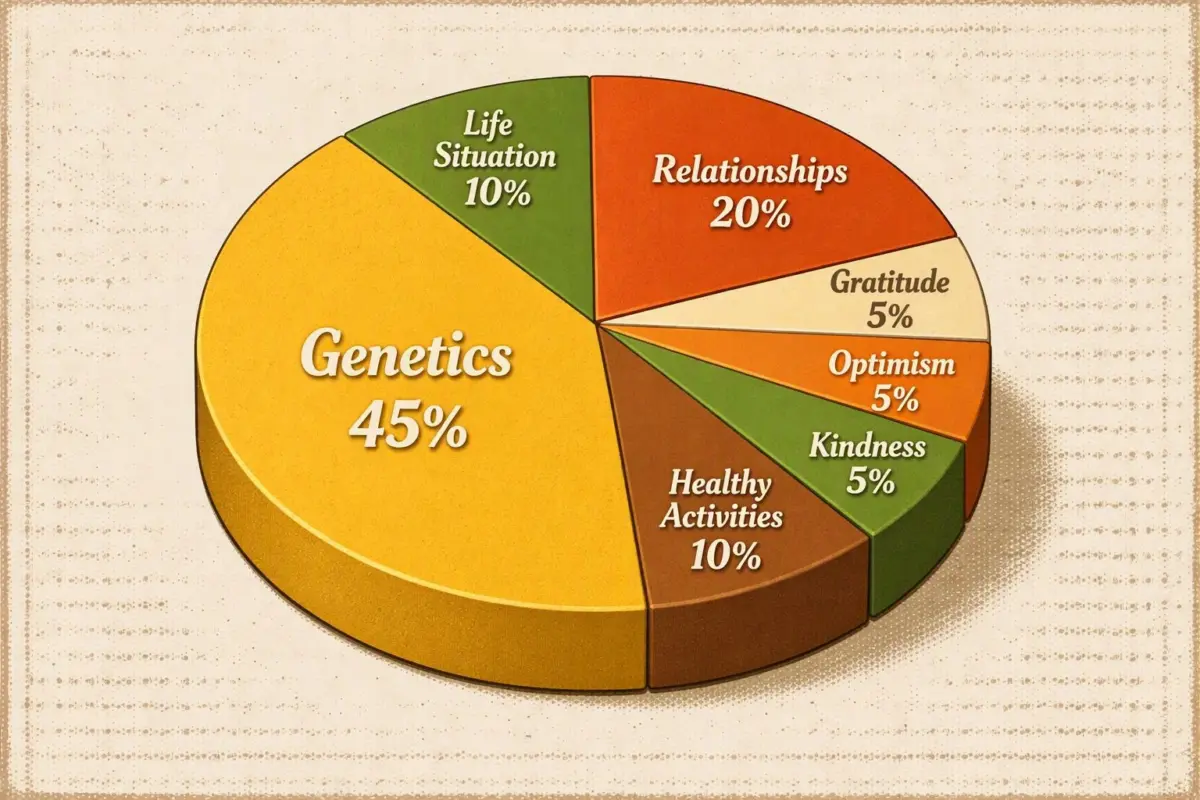
Standard of living, economic growth, and the feasibility of early retirement are all inextricably linked to high productivity rather than speculative market valuations. Furthermore, once basic human needs and modern standards of living are met, additional wealth ceases to be the primary driver of life satisfaction. Psychological research and long-term observational data suggest that human happiness is anchored largely by internal factors, strong interpersonal relationships, gratitude, optimism, and active engagement with the physical world.

Despite these reassuring realities, background fear remains a pervasive element of modern life. Evolutionary biology designed human beings as sophisticated danger-detection mechanisms. This survival trait protected early humans from immediate physical threats, but in a modern environment largely devoid of those immediate dangers, the human mind frequently continues scanning for things to worry about, shifting the goalposts of anxiety from physical survival to financial security, social standing, and microscopic lifestyle comparisons.
Combatting this innate tendency toward fear requires self-awareness and rational inquiry. Tracing anxieties back to their roots—whether influenced by childhood environments, familial scarcity mentalities, or past trauma—allows individuals to distinguish between historical conditioning and objective present-day reality. By identifying specific fears and examining worst-case scenarios rationally, individuals often realize that catastrophic outcomes are statistically improbable. Action consistently cures fear by transforming the unfamiliar into the manageable, fostering a deep sense of resilience.

Another crucial step in mitigating financial anxiety involves auditing one’s daily mental diet. Modern media consumption frequently relies on sensationalism, bombarding audiences with hand-picked narratives designed to provoke alarm. Stepping away from perpetual news cycles and redirecting energy toward tangible, positive behaviors—such as physical movement, outdoor activity, and constructive problem-solving—helps realign human biology with its natural state. Surrounding oneself with optimistic, forward-thinking peers further reinforces a balanced mindset.
Approaching major life transitions and technological shifts through the framework of experimentation can fundamentally alter one’s perspective. Whether evaluating a minor lifestyle change or a major milestone like early retirement, treating life choices as experiments removes the paralyzing weight of perfection and dread.

This experimental mindset applies directly to the current artificial intelligence landscape. Rather than succumbing to doomsday narratives, framing AI as a transformative technological tool provides a clearer lens for evaluation. Observers with backgrounds in technology and economics frequently view artificial intelligence not as an existential threat, but as a cognitive amplifier—essentially serving as a cognitive nail gun designed to boost human efficiency and productivity.
Just like previous technological revolutions, AI will inevitably enhance productivity while simultaneously displacing certain administrative and entry-level roles, prompting a necessary economic transition. Historically, productivity gains lower the cost of goods and services while spawning entirely new industries, mirroring the transformative impact of the internet and mobile computing. While the financial rewards of these transitions often concentrate among capital owners and shareholders—including everyday investors holding broad market index funds—the overarching trajectory remains consistent with past waves of innovation.

Ultimately, artificial intelligence represents another opportunity for individuals to make deliberate choices. Rather than yielding to speculative fear, recognizing anxiety as an internal psychological response allows people to focus on continuous learning, personal agency, and constructive engagement with the world. As many long-term financial independence advocates observe, everything worthwhile on the other side of life—including financial security and personal fulfillment—lies waiting just beyond the threshold of fear.