
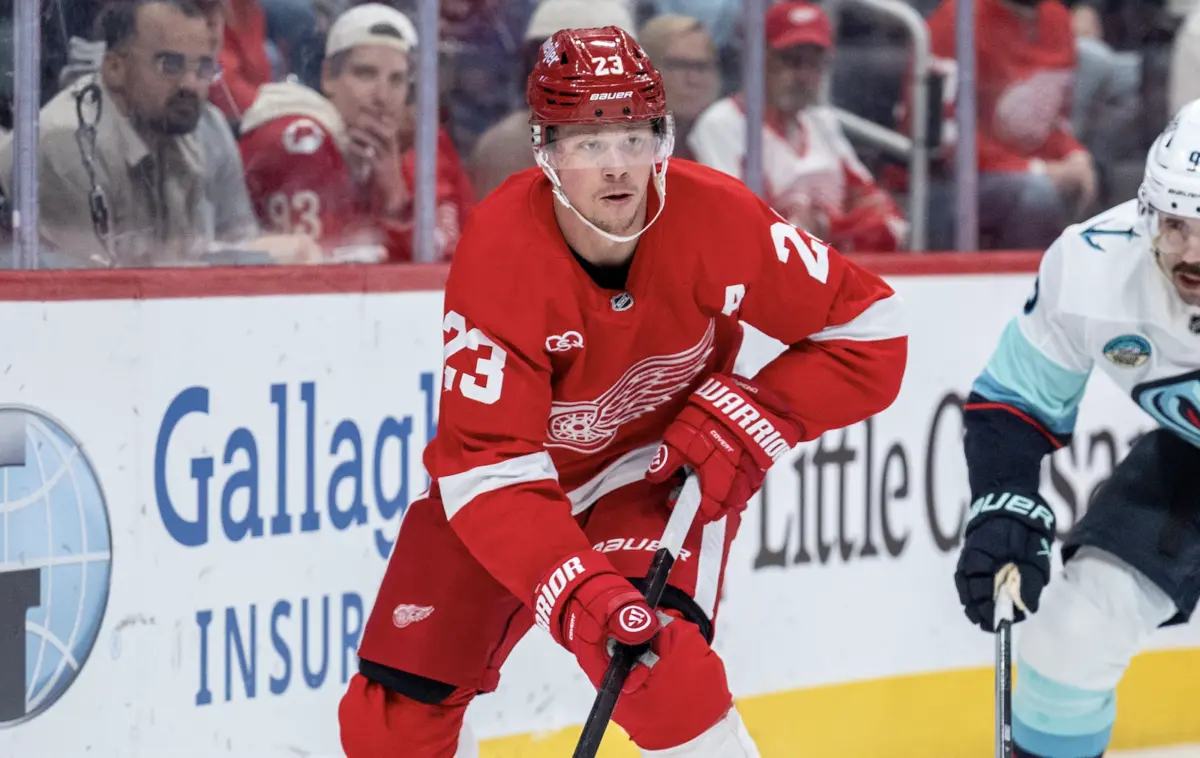
On a Tuesday night at Little Caesars Arena, Alex DeBrincat delivered another vintage performance, netting two goals and adding a primary assist as part of the Detroit Red Wings’ hard-fought 5-4 overtime loss to the New Jersey Devils. Yet, by the time the dust settled on the ice, the most rewarding development of his evening had nothing to do with the scoreboard tally in the extra frame, but rather what was happening in the background of the franchise.
Shortly after the final horn, news broke cementing DeBrincat’s immediate and long-term future in Hockeytown through a significant contract extension. At first glance, the deal has been overwhelmingly hailed across the hockey landscape as a major victory for the organization. After all, DeBrincat is a proven, elite offensive producer, and both the term and the financial figures appear entirely fair on paper given the current trajectory of the NHL’s salary cap.
However, beneath the initial wave of praise and the satisfaction of locking up a premier goal-scorer, a more complicated underlying question remains: Is this blockbuster deal genuinely in the best long-term interests of the Detroit Red Wings as they attempt to navigate a perpetually elusive path back to postseason contention?
Evaluating the Value: A Bargain for an Elite Scorer
It is practically impossible to deny that, purely from a transactional and asset-management perspective, this is a strong deal for the franchise. The max term of seven years does carry a measure of inherent risk, particularly for a player who will be approaching his 30s by the time the fresh agreement officially kicks in. Yet, when evaluated against the backdrop of an escalating salary cap, the Annual Average Value (AAV) looks like a distinct bargain for a player of DeBrincat’s caliber.
Since his arrival in Detroit ahead of the 2023-24 campaign, DeBrincat has firmly established himself among the league’s most reliable offensive contributors. Over that span, he ranks 17th in the entire National Hockey League with 111 goals, while also placing 33rd in total points with 230. By any statistical measure, this is an elite finisher. Securing his services for a cap hit of $13 million—which currently stands as the 11th-largest AAV in the league, though one that will rapidly lose its relative weight as the cap ceiling continues to rise—represents sharp operational work by interim general manager Shawn Horcoff.
For a fan base that has endured nearly a decade of prolonged frustration, this move offers tangible evidence that there is a steady hand at the wheel. DeBrincat is undeniably a high-level player, and securing a locally-born star who genuinely wants to represent the Winged Wheel is a clear win for morale. If the organization can successfully steer its way into a genuinely competitive state over the next few seasons, front office personnel will undoubtedly point to this transaction as a foundational pillar of a new era of Red Wings hockey.
The Bigger Picture: Empty Calories or Meaningful Wins?
The central dilemma, however, lies in how the broader hockey world perceives the team’s trajectory. Who is ultimately going to buy into the narrative of progress when the results on the ice continue to fall short of expectations?
The Red Wings have stumbled out of the gate once again to begin the new campaign. While DeBrincat’s early-season production—featuring four goals and eight points through his first six games—looks respectable on an individual scoresheet, critics could reasonably argue that these statistics have occasionally amounted to "empty-calorie" production in the context of the team’s broader struggles.
This situation bears a striking resemblance to the ongoing narrative surrounding team captain Dylan Larkin. Both are unquestionably very good, highly talented hockey players who, due to circumstances largely outside of their individual control, have simply not been able to single-handedly shift the fortunes of the franchise in the standings.
Since DeBrincat’s arrival in Hockeytown, the Red Wings have averaged a modest 89.5 standings points per 82-game schedule. While that represents an incremental improvement over the 75.3-point average recorded over the three years prior to his acquisition, it remains stubbornly short of the threshold required to crack the Eastern Conference playoff picture.

To even match that meager 89.5-point average moving forward, let alone exceed it and secure a wild-card or divisional berth, Detroit must immediately elevate its play to a 92-point pace for the remainder of the season. While that might not sound like an insurmountable mountain to climb, a 92-point finish merely mirrors last year’s output—a total that ultimately left the team out of the postseason party and stands as the franchise’s highest points accumulation since the 2015-16 campaign. Clearly, hitting that baseline has proven immensely difficult for this roster, and the challenge grows steeper with each passing day.
Competing Now Versus Planning for Tomorrow
Locking in a popular, productive player who embraces the market is an undeniable positive, but the contract must be scrutinized within the wider framework of Detroit’s overarching organizational goals. The leadership group clearly harbors ambitions of returning to the playoffs; yet, just last year in an Atlantic Division characterized by widespread turbulence, the Red Wings missed the cut line by a glaring margin of seven points.
DeBrincat will undoubtedly provide immense value, at least through the opening chapters of this new contract. The philosophical debate, however, centers on whether this is the right kind of value for a team in Detroit’s exact stage of development. Given the advancing age profiles of several core players who carry heavy workloads, management must decide whether they should aggressively chase short-term standings points or pivot toward a more patient, draft-centric rebuild philosophy.
It is entirely understandable why ownership witnessed the progression of the previous regime’s long-term blueprint and ultimately decided to alter course. Tear-down rebuilds are notoriously grueling, and their historical success rate plummets when an organization prematurely abandons the process, routing all its financial flexibility and roster opportunities toward a collection of unrestricted free agent mediocrities rather than organic drafting and development. Nearly every team that has hoisted the Stanley Cup in the modern salary-cap era has relied heavily on a foundation of elite high draft picks amassed through several consecutive years of intentional roster building.
This raises a provocative question: Could DeBrincat’s positive-value contract paradoxically act as a net negative when measured against the type of asset accumulation the Red Wings should arguably be prioritizing? An argument can be made that a player with his exceptional resume might have ultimately yielded far greater long-term value to the franchise as a high-yield trade chip at the deadline.
Perhaps interim general manager Shawn Horcoff wished to avoid entangling the organization in a second round of exhausting, high-stakes trade negotiations regarding another of the team’s primary offensive drivers. Yet, the massive prospect and draft-pick haul a player of DeBrincat’s caliber could command on the open market arguably holds significantly more long-term utility for a rebuilding squad than what a borderline-elite scorer can provide in the short-to-medium term.
Over the initial seasons of this new deal, DeBrincat’s undeniable skill will inevitably push Detroit’s standings points higher—precisely at a juncture when conventional wisdom suggests the front office should be maximizing its odds at securing high-end lottery selections.
The Illusion of Competitiveness
Ultimately, what the organization should be doing from a purely analytical standpoint often clashes with what ownership and management want to do. This contract successfully accomplishes the latter: it provides the fan base with an emotional lift, generates positive momentum, and forestalls the daunting prospect of plunging back into a turbulent, comprehensive rebuild, all in the hope that the team might miraculously sneak into the Stanley Cup Playoffs once or twice over the course of the next eight seasons.
Within hockey circles and local media rooms, the extension is being universally praised as a resounding win and precisely what the Red Wings needed. And, from a surface-level perspective, it certainly is not not that.
Yet, the disappointing result of Tuesday night’s overtime loss to the New Jersey Devils served as a poetic, almost uncanny encapsulation of what this strategy actually achieves in practice. All of DeBrincat’s offensive brilliance on the night amounted to nothing more than a single loser point secured during a regular-season campaign that already threatens to slip off the rails before the winter months truly set in. The performance created a fleeting illusion of competitiveness on a night where the Red Wings were otherwise pushed around by a middling opponent, leaving the fundamental questions about the franchise’s ultimate direction completely unanswered.