
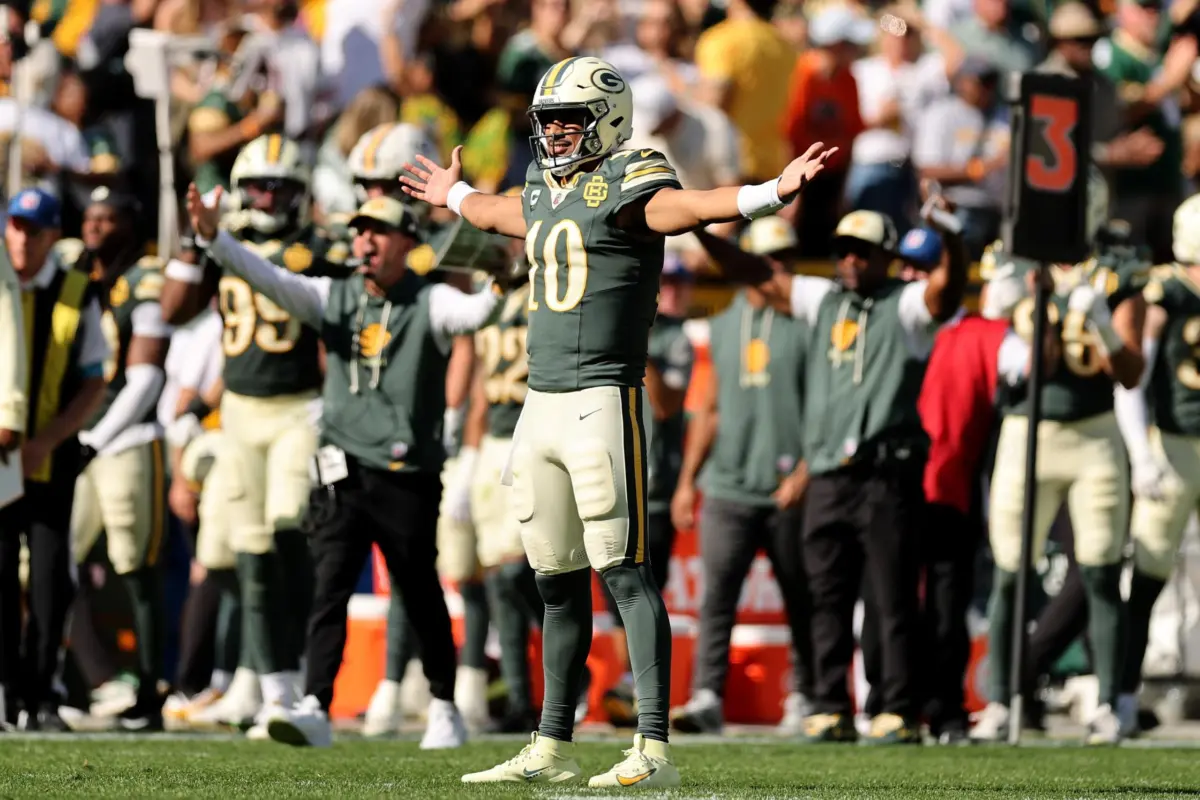
Through the first three weeks of the 2026 NFL season, the Green Bay Packers found themselves sitting at a disappointing 1-2 record, fresh off an embarrassing 35-14 primetime loss to the Atlanta Falcons. At that exact juncture, the glaring issues plaguing Matt LaFleur’s squad could not have been more obvious.
The primary culprit was the offensive line.
Quarterback Jordan Love had been under siege from literally the very first offensive snap of the season all the way through the conclusion of that Thursday Night Football blowout at home against Atlanta. Comprehensive charting data and performance metrics fully backed up the visual evidence. Through the first two weeks alone, Love had been pressured on an alarming 44.4% of his dropbacks, placing him behind only Bryce Young, Caleb Williams, and Deshaun Watson, according to Pro Football Focus tracking.
When facing that relentless heat during those initial weeks, Love completed just 36% of his passes for 300 yards, failing to throw a single touchdown while tossing a pair of interceptions.
A Mini-Bye Shakeup and Veteran Additions
That early offensive collapse forced the front office to take swift action. Coming out of that dismal Thursday-night defeat, the Packers entered a much-needed mini-bye week and aggressively worked to fortify the trenches. Green Bay added a trio of seasoned veterans to the roster: Laken Tomlinson, Mekhi Becton, and Kevin Zeitler, bringing vital experience into a room that desperately needed stability.
Tomlinson immediately stepped into the starting lineup for Green Bay’s Week 4 matchup against the Tampa Bay Buccaneers, earning the nod at left guard. While Tomlinson has been the only member of that veteran trio to see significant game action so far—with Becton remaining on the practice squad and Zeitler sitting behind Travis Glover on the depth chart during the Week 5 victory over the Chicago Bears—the offensive line has seemingly turned a massive corner.
Consider the stark contrast in the numbers. While Love ranked among the most pressured signal-callers in the entire National Football League through the first three weeks, the narrative completely shifted over the subsequent fortnight. According to Pro Football Focus, over Weeks 4 and 5, Love was pressured on just 13 of his 65 dropbacks, which translates to a mere 20%.
Out of the 34 quarterbacks who logged playing time across the league over Weeks 4 and 5, that represented the lowest pressure percentage rate in the entire NFL.
This dramatic improvement did not happen because head coach Matt LaFleur and offensive coordinator Adam Stenavich suddenly pivoted to a horizontal, dink-and-dunk passing game designed merely to get the ball out of Love’s hands instantly. Over this recent two-game stretch, Love has aggressively pushed the ball downfield, attempting 13 passes traveling 20 yards or more through the air. These deep route concepts inherently require extended time to develop and force the quarterback to hold the ball longer in the pocket.
In fact, only Jameis Winston has attempted more deep passes over that timeframe.
Deep Shots and Trust in the Pocket
To truly understand the newfound confidence in the protection, one only needs to look at the very first play the Packers ran against the Chicago Bears. Backed up deep in their own territory with Love lining up practically in the shadow of their own end zone and goalposts, LaFleur and Stenavich called a slow-developing flea-flicker that ultimately culminated in a screen pass to tight end Tucker Kraft.
Calling a high-risk, slow-developing trick play right at your own goal line demonstrates a distinct lack of hesitation regarding the integrity of the pass protection.
When offensive coordinator Adam Stenavich met with the local media in Green Bay to discuss the game plan, he highlighted how crucial the interior blocking was to opening up the playbook. The Packers first found the end zone against Chicago on a deep shot to wide receiver Christian Watson, which was brilliantly built off play-action mechanics. On that specific play, Tomlinson excelled on the interior, first providing critical help to center Sean Rhyan before sliding over to assist left tackle Jordan Morgan, allowing the pocket to hold up securely.
The Bears brought heavy pressure on that sequence, aggressively blitzing both Tyrique Stevenson and Jaylon Johnson off the edges. Yet, the revamped offensive line held its ground just long enough for Love to make the Chicago defense pay dearly for the blitz.
Love capitalized on the Bears defense once again later in the game on another vertical shot to Watson, who cleanly split two deep safeties. The route concept featured a trio of vertical routes attacking the left side of the formation, tasking linebacker D’Marco Jackson with the near-impossible assignment of trying to carry Watson’s vertical route while simultaneously aiding the Cover 2 safeties in the middle of the field as the receiver split them.
The quarterback, executing a quick play-action fake toss, diagnosed the coverage immediately and delivered an accurate strike downfield as the protection stood firm in front of him.
The Power of Play-Action
The implementation of play-action has clearly served as a catalyst for Green Bay’s offensive resurgence. All three of the aforementioned big plays featured distinct run-action elements—a flea-flicker, a standard run fake, and a fake toss on the third snap.
During the first three weeks of the season, Love and the Packers utilized play-action on just 18.8% of his dropbacks, ranking a lowly 35th out of 37 qualified passers. Only Jalen Hurts and Cooper Rush used play-action less frequently than Green Bay from Weeks 1 through 3, as charted by Pro Football Focus.
The transformation over the past two weeks has been staggering.
Love has utilized play-action on 30.6% of his dropbacks, vaulting him into 13th place in the league over that span. On those specific play-action designs, Love has completed 25 of 32 passes for 424 yards—an exceptional 78.1% completion rate—with three touchdowns and zero interceptions. Furthermore, he has averaged an elite 13.3 yards per attempt, trailing only Lamar Jackson over the last two weeks.
Against the Bears alone, a massive 41.2% of Green Bay’s passing plays featured play-action. In those situations, Love went 12-for-14 for 245 yards and a touchdown.
While these schematic adjustments have undoubtedly aided the offense, fundamental line play remains the bedrock of success. At times, an offense simply requires its blockers to win their individual matchups, and the quarterback needs to finally feel comfortable stepping up cleanly in the pocket.
Against Chicago, when the Bears ran a slow-developing defensive stunt, the offensive line picked it up seamlessly. Love sensed the pocket opening up, stepped forward with total confidence—a luxury that was entirely absent earlier in the year—and delivered an absolute heat-check throw into the end zone.
After enduring a turbulent and discouraging start to the 2026 campaign, the Green Bay Packers appear to have firmly found their footing, particularly along the offensive line. They have successfully identified passing concepts that mitigate the pass rush while unlocking explosive plays downfield, and crucially, they are identifying the best five linemen to protect Jordan Love.
An old adage in the National Football League dictates that a team discovers its glaring flaws in September, actively corrects them in October, and prepares itself for a grueling stretch run in November and December.
It certainly appears that the Green Bay Packers have already checked the first two items off that checklist.