
WINNIPEG — As the setting autumn sun poured its warm light through the high, arched windows of Shaarey Zedek Synagogue last Friday, Cantor Leslie Emery stepped forward to perform a ritual rich with history and reverence. Reaching out, she opened a pair of sliding brass doors at the front of the sanctuary to reveal six sacred scrolls, carefully preserved and wrapped in ornate coverings embroidered with traditional Hebrew letters.
Five of these venerable scrolls contain the complete Torah—the first five books of the Hebrew Bible—meticulously handwritten with quill and ink on fine parchment. Some of these fragile artifacts carry more than a century of history, bearing witness to generations of prayer, study, and community life. For the regular congregants of Shaarey Zedek, these scrolls are not merely historical relics; they are living texts read aloud multiple times a week during services.
“When we read the stories of the Bible, when we read the stories of the prophets, when we observe Jewish holidays, we’re actually recounting the history of our ancestors,” Cantor Emery reflected as the sanctuary filled with the soft murmurs of the gathering crowd.
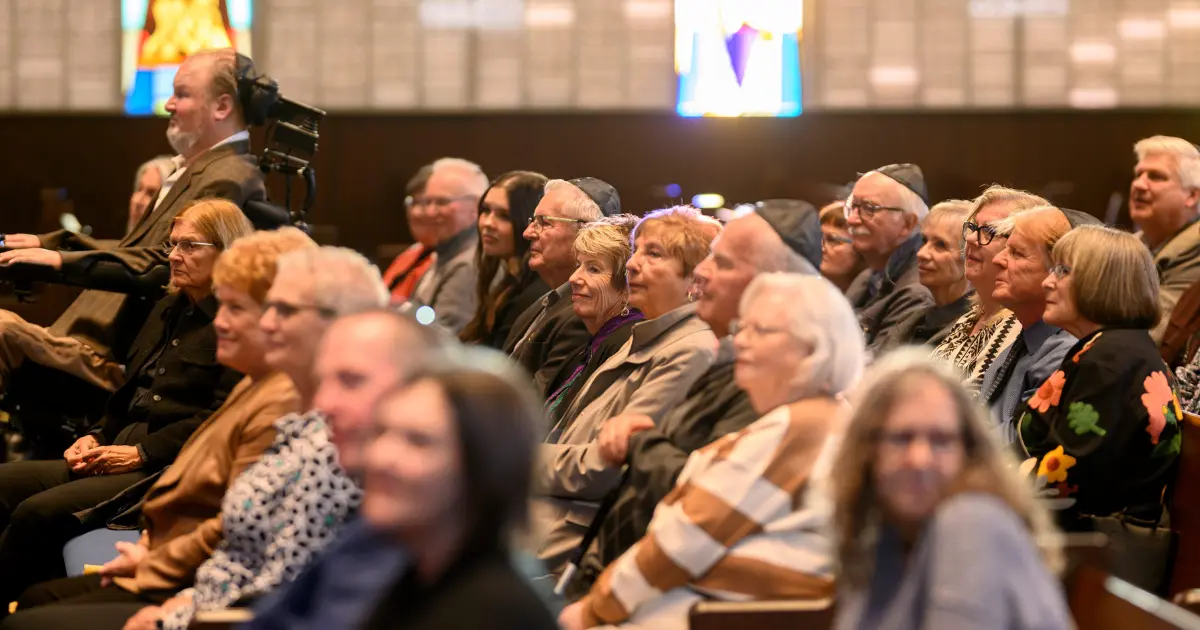
Every Friday evening, a rabbi and a cantor traditionally lead the congregation in a solemn yet joyful prayer service to welcome the arrival of the Sabbath. This particular Friday, however, was fundamentally different. The service served as the opening chapter of a deeply intentional interfaith exchange, bringing together two distinct religious communities that occupy the same geographical landscape in Winnipeg but rarely share sacred space in quite this manner.
Roughly half of the people gathered inside the sanctuary were members of the synagogue, while the other half came from across town as visitors. Twenty-five members of Charleswood United Church had crossed the threshold to join their Jewish neighbors for worship, a spiritual gathering that would naturally conclude with a shared meal of fellowship. The partnership is reciprocal; next month, a delegation of 25 members from Shaarey Zedek Synagogue will make the journey to Charleswood United to experience a Christian service and continue the dialogue.
The initiative is built on a foundation of mutual curiosity rather than proselytization. Organizers were quick to emphasize that the exchange is entirely free of hidden agendas or attempts to alter anyone’s religious convictions.
“We’re not walking into each other’s buildings trying to persuade one another to join our religion. That’s not what it’s about,” said Rabbi Carnie Rose. “We want to be in fellowship, sharing what makes us tick, what makes us feel, what makes us special and unique.”
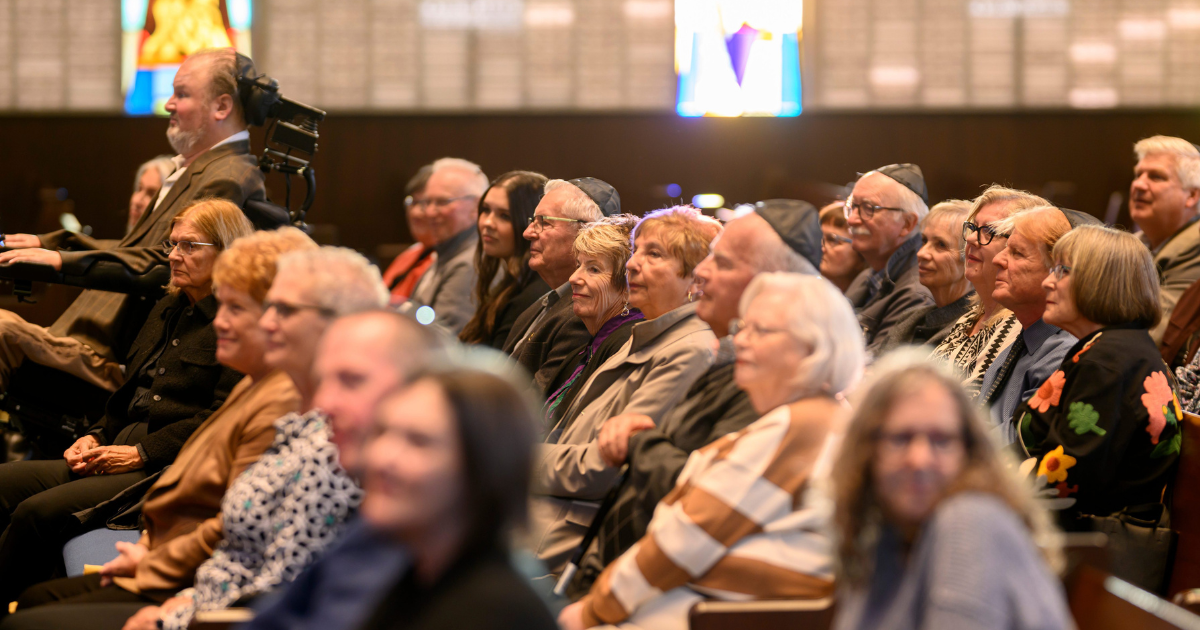
For the leadership of Charleswood United, the gathering was also an active step toward mending community relations and standing in solidarity with local Jewish residents during a complex social climate.
“We’re recognizing that there’s been some tensions and difficulties for the Jewish community in Winnipeg, and we want to be part of the resolution to that, to be neighbours and friends,” explained Rev. Michael Wilson of Charleswood United.
The decision by a United Church congregation to enter a synagogue for joint prayer arrives against a backdrop of broader denominational friction. In recent years, historic tensions have occasionally surfaced between the United Church of Canada and various national Jewish organizations. In December 2023, the United Church of Canada publicly characterized Israel’s military campaign in Gaza—launched in retaliation for the devastating October 7 Hamas attacks—as genocide, while simultaneously issuing a call for an immediate ceasefire. That position drew sharp criticism from groups such as the Centre for Israel and Jewish Affairs. Furthermore, the United Church has previously strained relations by supporting selective boycotts of goods produced within Israeli settlements situated in the West Bank.
Rev. Wilson acknowledged that he was fully aware of these broader geopolitical and institutional tensions, but he stressed that they were deliberately kept outside the doors of the sanctuary for this exchange. He noted that members within a denomination often hold diverse viewpoints, and local church members do not necessarily endorse every national policy stance taken by their church hierarchy.
“I don’t think our congregation is totally on board with some of the positions the United Church has taken, and in the United Church you’re allowed to do that,” Wilson said. Instead, he reiterated that the core focus of the evening remained fixed on the fundamental calling of being good neighbors within their shared home city of Winnipeg.
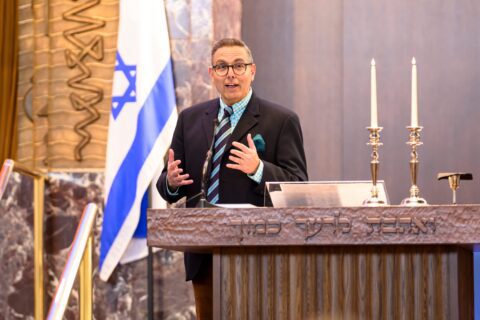
As the service prepared to commence, Cantor Emery drew attention to the front of the lectern, translating an inscription carved into the wood in Hebrew: “Love your neighbour as you love yourself.” She pointed out that these words carry an immediate, profound resonance for anyone grounded in the Christian scriptural tradition as well.
“I feel like I’m welcoming some neighbours into our sacred space today,” she told the assembly.
The evening quickly turned into an organic educational experience. During a preparatory moment before the prayers, a curious member of Charleswood United raised a hand to ask why the Hebrew language is read from right to left. Rabbi Rose offered a lighthearted reply, gesturing vertically to the air. “You think that’s difficult? I was a rabbi in Japan,” he quipped with a smile. “That’s a whole other story.”
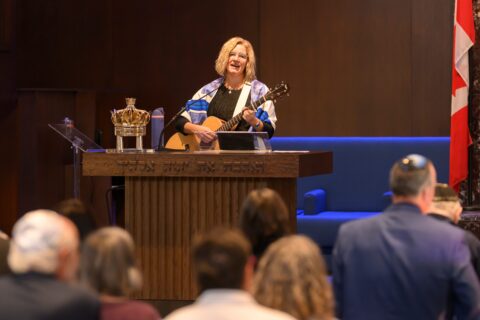
As Cantor Emery tuned her acoustic guitar, Rabbi Rose took a moment to explain the vital, central role that music plays within Jewish liturgical traditions. The cantor, he noted, functions as the spiritual minister of music, serving as the emotional heartbeat of the sanctuary.
“Much of what we do is singing, because we know that music moves the spirit and allows us to feel the presence of the divine in our lives,” the rabbi explained.
To ensure the visitors felt included in the musical elements of the liturgy, Cantor Emery encouraged them to sing along, directing their attention to a projection screen placed beside the traditional text. The screen displayed transliterations of the Hebrew words, making the prayers accessible to those unfamiliar with the alphabet or phonetics.
“Nobody in the history of Jewish tradition has ever been thrown out of synagogue for singing too loud or off key,” Rabbi Rose reassured the visitors with a warm grin. “Make a joyful noise unto the Lord. That’s what it’s all about.”
The prayer service officially opened with the Kaddish, a traditional mourner’s prayer recited in memory of those who have recently passed away. The congregation then flowed into hymns welcoming the arrival of the Sabbath, followed by the responsive reading of Psalms. Among the musical selections was at least one familiar melody composed by Canada’s most celebrated poetic bard, Leonard Cohen, providing a bridge of popular culture that resonated across both congregations.
Following the formal conclusion of the prayer service, the two groups transitioned to a social hall for a communal meal featuring roast chicken and seasonal vegetables. Over the plates of food, barriers dissolved as people mingled freely, discussing the commonalities and differences of their respective spiritual traditions, as well as the contemporary challenges facing modern religious institutions.
Conversations drifted across a wide array of topics. Attendees compared milestones, wondering aloud how a Jewish bar or bat mitzvah ceremony differs from the Christian tradition of confirmation. They explored theological symbolism, with one visitor asking about the precise meaning of the cup of wine used during Jewish rituals—clarifying that it traditionally symbolizes joy and celebration, rather than representing blood as it does in Christian communion services.
Inevitably, local culture and community life also entered the mix. Someone raised the question of the Winnipeg Blue Bombers football game happening that very evening, noting with amusement that observant Jewish fans would be unable to watch it live because the Sabbath had officially begun at sundown.
“Unless someone else turns on the TV and you just happen to walk through the room,” Rabbi Rose joked, drawing appreciative laughter from the tables.
Beneath the lighthearted banter, however, deeper institutional concerns emerged. Nancy Jeffries, a lifelong member of Charleswood United, shared anxieties common to many mainline churches regarding dwindling worship attendance and the relative scarcity of young families in the pews. “How do we make it relevant for parents and their children?” she asked, voicing a question that hangs heavy over contemporary religious leadership.
Paulie Rose, who is married to the rabbi, noted that these existential questions are hardly isolated to the Christian church. “It’s not just the Christian community asking those questions,” she observed.
The dialogue also touched on social evolution and inclusion. Karen Riddell shared the moving story of how Charleswood United navigated the deliberate process of becoming an officially affirming congregation for 2SLGBTQ+ individuals, noting with pride that every single member voted in favor of the policy—including lifelong congregants well into their eighties and nineties.
As the evening wound down, Rev. Wilson and Rabbi Rose explored how their respective traditions approach the reading and interpretation of sacred scriptures. Rabbi Rose explained that within Jewish scholarship, sacred texts are rarely read in isolation; they are traditionally studied alongside centuries of rabbinic commentary and debate, valuing multiple perspectives over a single dogmatic conclusion.
“We believe the Messiah is still on his way, and you believe he’s on his way back,” Rabbi Rose said, his face softening into a smile. Then, adopting a more reflective tone, he summed up the spirit of the evening: “It’s nice to talk about the things that are different. Not because they divide us, but because they’re interesting.”