
Rodents darting across bathroom tiles, water cascading through damaged ceilings, and radiators that fail in the dead of winter: for weeks, a steady stream of cellphone footage recorded by French pupils has circulated widely across social media networks. These videos, captured in hallways and classrooms from the suburbs of Paris to regional towns across the country, provide an unvarnished window into the deteriorating conditions found in many of France’s educational institutions.
At the Lycée Paul Éluard in the northern Paris suburb of Saint-Denis—a municipality that has become a central hub of the current wave of youth demonstrations—students have described conditions that make basic learning difficult. Vermin roam parts of the campus, and plumbing failures have left burst pipes a recurrent fixture of school life. Just a short distance away in Pantin, pupils have voiced frustration over sealed windows that could not be opened even as summer heatwaves pushed indoor temperatures beyond 40 degrees Celsius (104 degrees Fahrenheit).
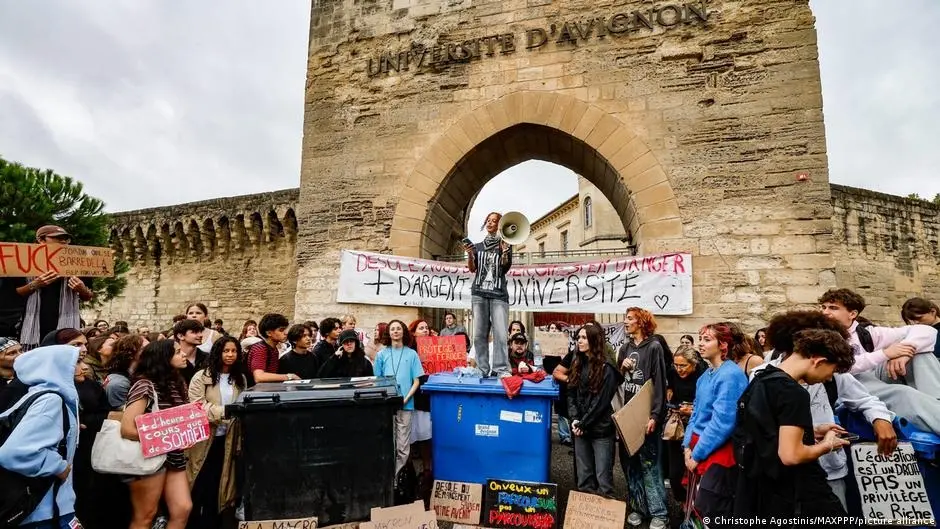
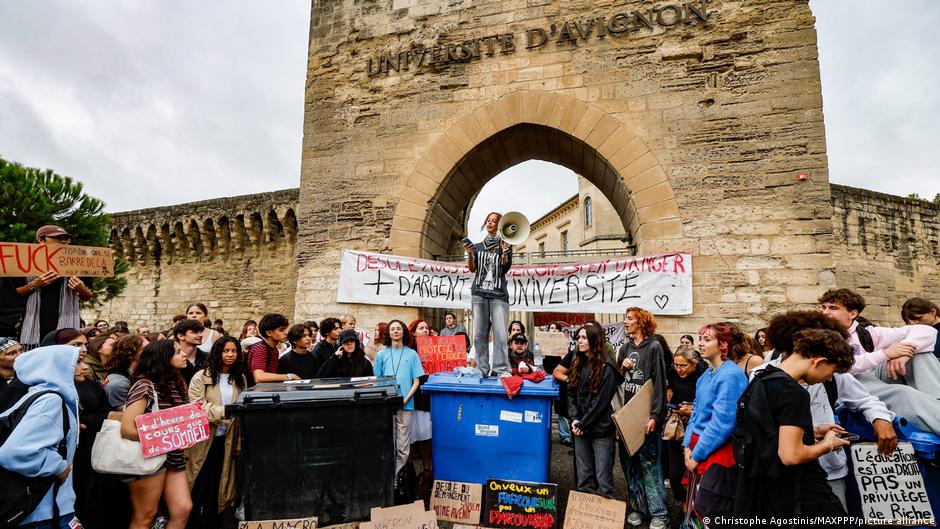
Beyond physical neglect, pupils across France report endemic classroom overcrowding and a relentless cycle of cancelled lessons, which leave large gaps in their weekly schedules. Rather than subsiding, the youth demonstrations that erupted in response to these conditions have continued to spread throughout the nation. High school blockades and street marches, which have now persisted for nearly two weeks, show little sign of abating as frustration spills beyond the school gates and into the national political debate.
Problems of Centralization
The visible decline of French school infrastructure presents a striking paradox. By European Union standards, France directs a considerable share of its financial resources toward public education, allocating roughly 6.7% of its gross domestic product to the sector. Yet this significant financial commitment has struggled to translate into well-maintained, comfortable, and functional learning environments on the ground.
Much of this dysfunction can be traced to the complex division of responsibilities that characterizes the French administrative apparatus. The central government in Paris retains authority over the hiring and remuneration of teachers, as well as the formulation of national curricula and academic standards. However, the physical upkeep, renovation, and construction of school facilities fall under the jurisdiction of three distinct tiers of local government.
Under this decentralized framework, France’s tens of thousands of individual municipalities are tasked with managing and maintaining elementary school properties. The broader departmental councils oversee lower secondary schools, known as collèges, which serve pupils aged 11 to 15. Regional councils, in turn, shoulder responsibility for upper secondary schools, or lycées, catering to students aged 15 to 18.
This tiered system creates substantial disparities across the country. Local authorities do not possess equal fiscal capacity, leaving their ability to finance major structural overhauls dependent on local revenue streams and municipal priorities. Furthermore, local administrations must manage the planning, bidding, and execution of modernization programs themselves, creating bureaucratic bottlenecks that often drag renovation timelines out over years. Compounding these hurdles, local authorities must dedicate more than two-thirds of their operational budgets to mandatory staffing expenditures and pension obligations, leaving little discretionary capital for brick-and-mortar structural investments.
Dilapidated Infrastructure
The backlog of overdue maintenance is substantial. More than 80% of elementary school structures across France are over half a century old, having been erected during postwar population booms. According to industry assessments, between 10% and 20% of all public school facilities are currently in urgent need of fundamental structural repairs.
Elected officials have made various attempts to tackle the infrastructure deficit. In Île-de-France, the densely populated administrative region surrounding Paris, regional authorities introduced an ambitious 10-year development and renovation program spanning from 2017 to 2027, backed by a €6.6 billion ($7.4 billion) budget.
Regional administrators maintain that substantial headway has been achieved under this investment plan, noting that two-thirds of upper secondary pupils in Île-de-France now attend classes in either newly built or thoroughly refurbished facilities. Nevertheless, fundamental structural gaps persist. Even when remediation teams succeed in eradicating persistent damp, scraping away mold, and repairing fractured roofs, relatively few older campuses receive adequate thermal insulation to guard against worsening summer temperatures. Adding to these challenges, recent unrest has seen several newly renovated or newly constructed sites suffer property damage during demonstrations.
Macron Tried in Vain to Address the Problem
Structural disparities also extend to how ongoing operational funds are allocated across different stages of the educational pathway. While France allocates substantial resources to upper secondary education, figures compiled by the Organization for Economic Cooperation and Development (OECD) demonstrate that per-pupil spending at the primary school level in France sits below the average of industrialized nations. Educational researchers repeatedly warn that this funding distribution is counterproductive, as early childhood and elementary schooling establish the foundational cognitive and social competencies necessary for later academic achievement.
Successive governments under French President Emmanuel Macron have sought to address this imbalance. Beginning in 2017, the administration introduced targeted measures to halve class sizes in the earliest grades of primary schools located in socially disadvantaged zones, creating roughly 16,000 additional teaching positions to facilitate smaller cohorts.

Faced with the current wave of youth unrest, the government has moved to announce short-term remedies. Education Minister Édouard Geffray outlined emergency plans to rapidly hire more than 3,000 replacement supply teachers to stem classroom disruption. In addition, the ministry intends to deploy administrative tracking software designed to pinpoint facilities facing severe operational distress.
These initiatives represent the executive branch’s initial formal response to the demands presented by protesting pupils. Over nearly two weeks of sustained demonstrations, students have demanded modernized secondary school facilities, a reliable network of substitute teaching staff, and an overarching expansion of state investment in public education.
Increasing Deficiencies
These infrastructure challenges are mirrored by broader concerns regarding student achievement. The latest results from the OECD’s Programme for International Student Assessment (PISA), published in September, underscore the systemic hurdles facing French classrooms. The evaluation revealed that more than one in three 15-year-old French students fail to meet basic competency thresholds in foundational mathematics.
Controversy has also surrounded structural overhauls introduced under Macron’s presidency, notably his flagship reform of the lycée curriculum. The overhaul dismantled the traditional system of academic tracks—which long steered students along predefined humanities, economic, or scientific concentrations—in favor of a modular model allowing teenagers to select distinct combinations of specialty subjects.
While promoted as a measure to expand student choice and individual autonomy, the modular framework has introduced severe logistical friction. Managing an array of customized subject pairings has complicated school timetables, leaving students with fragmented schedules, protracted midday gaps, and lengthened school days.
Similar strains are evident within the higher education system. At a university in Paris, an instructor reported conducting an academic seminar for 50 attendees in a room with inadequate seating, forcing students to forage for chairs in neighboring corridors or sit on the floor, while university management offered no immediate remedies.

Cancelled Lessons
On paper, French schoolchildren log an extensive number of instructional hours each school year relative to their peers throughout the European Union. In practice, however, these scheduled hours are frequently interrupted. Findings from the French Court of Accounts indicate that 9% of all scheduled lessons across state collèges were cancelled during the 2023–24 academic year. Further exacerbating the issue, findings from the 2024–25 school year suggest that merely 12% of classes cancelled on short notice are successfully covered by replacement educators.
A key factor behind these staffing strains is teacher compensation. OECD comparative data demonstrates that after 15 years on the job, lower secondary teachers in France take home roughly half the earnings of their professional counterparts in neighboring Germany, complicating recruitment and retention efforts across the system.
Broken Promises of Equality
These systemic strains have placed scrutiny on France’s foundational educational compact. The nation’s republican model of public schooling is designed to operate as an egalitarian engine, ensuring equal advancement for all children regardless of family background.
Yet empirical metrics show that academic performance in France remains heavily tethered to parental socioeconomic circumstances, diverging markedly from international peers. This disparity is visible in the distribution of instructional disruption: pupils enrolled in schools within economically marginalized communities bear a disproportionate burden of teacher absences and cancelled classes.
The state’s capacity to overhaul these deficits remains constrained by national fiscal pressures. While the draft national budget for 2027 allocates an additional €1.2 billion in funding for the Ministry of Education, it simultaneously incorporates reductions in total teaching positions, a policy rationalized by national projections of declining overall pupil enrollment.
Protests in the Run-Up to the Presidential Election
As the movement has gathered momentum, online platforms have expanded beyond footage of dilapidated school buildings to encompass scenes of street demonstrations and student actions. Marches have increasingly featured placards bearing broad political slogans that extend well beyond educational grievances. Reports and videos of flaming barricades and street altercations with riot forces have surfaced, accompanied by public criticism surrounding the heavy-handedness of crowd dispersal tactics. In Saint-Denis, local mayor Bally Bagayoko intervened directly during one demonstration, attempting to shield student protesters from advancing riot police.

The escalating mobilization has quickly become integrated into the broader political landscape. Members of the left-wing opposition party France Unbowed (LFI) have voiced public support for the students’ platform, with party lawmakers visiting high school picket lines and sharing footage of student demonstrations online. The government has condemned these actions, accusing LFI of deliberately seizing upon youth anger for partisan gain—a charge the party firmly disputes.
With France’s presidential election just six months away, what began as a grassroots outcry over cracked ceilings, unheated rooms, and missing teachers has expanded into a contentious political dispute over state spending, public institutions, and national priorities.