
In a significant development confronting Alberta’s legislative assembly, the province’s chief electoral officer has suggested that Alberta’s next provincial general election should either be conducted using existing electoral boundaries or be formally postponed. The recommendation, delivered by Chief Electoral Officer Gordon McClure in an official letter addressed to Legislative Assembly Speaker Ric McIver and circulated to all Members of the Legislative Assembly, underscores growing administrative concerns over whether Elections Alberta can properly prepare for the vote within the current statutory timeframe.
The letter, which was publicly released by the Official Opposition New Democratic Party, outlines the substantial logistical hurdles facing the independent electoral agency. McClure stressed that whether lawmakers choose to maintain the existing constituency maps or delay the voting date, Elections Alberta requires sufficient and predictable lead time to execute the upcoming provincial general election with complete integrity, robust administrative safeguards, and operational readiness. Under current provincial legislation, the next general election is scheduled to take place on October 18, 2027.
McClure’s intervention arrives at a sensitive moment, directly preceding the anticipated release of a highly contentious report detailing proposed revisions to Alberta’s electoral boundaries. The report, which has already been reviewed by an all-party legislative committee, is scheduled to be officially tabled in the Legislative Assembly on Monday. Anticipating intense political debate over the proposed redrawn map, the chief electoral officer cautioned that partisan disagreements and prolonged legislative wrangling could severely jeopardize the timeline required to implement new voting districts across the province.
Writing to Speaker McIver and all sitting MLAs, McClure urged lawmakers to give immediate weight to the operational realities of election administration as they debate the forthcoming boundary adjustments. He noted that a definitive, timely resolution regarding constituency lines, paired with an appropriate contingency strategy should extra time be needed, is essential to safeguarding the integrity and successful execution of the province’s next democratic contest. He emphasized that the process of implementing new electoral boundaries across Alberta is a complex undertaking that cannot be rushed without jeopardizing the thoroughness and reliability of election administration.
According to McClure, conducting a standard provincial general election typically demands up to 18 months of intensive advance preparation. This extended planning period is necessary for Elections Alberta to adjust voting districts, update voter registries, establish polling stations, train election workers, and deploy necessary administrative technology across dozens of constituencies. The chief electoral officer pointed out that the non-partisan agency’s operational capacity has already been severely stretched thin in recent months due to extraordinary administrative demands, including managing the provincial referendum on separation held earlier this month.
The strain on administrative resources is further compounded by the escalating political conflict surrounding the contents of the impending boundary report. The proposed constituency adjustments have already ignited fierce debates within the legislature ahead of the report’s formal tabling. Opposition leaders argue that the newly recommended maps threaten to distort democratic representation and alter the competitive balance of Alberta’s political landscape.

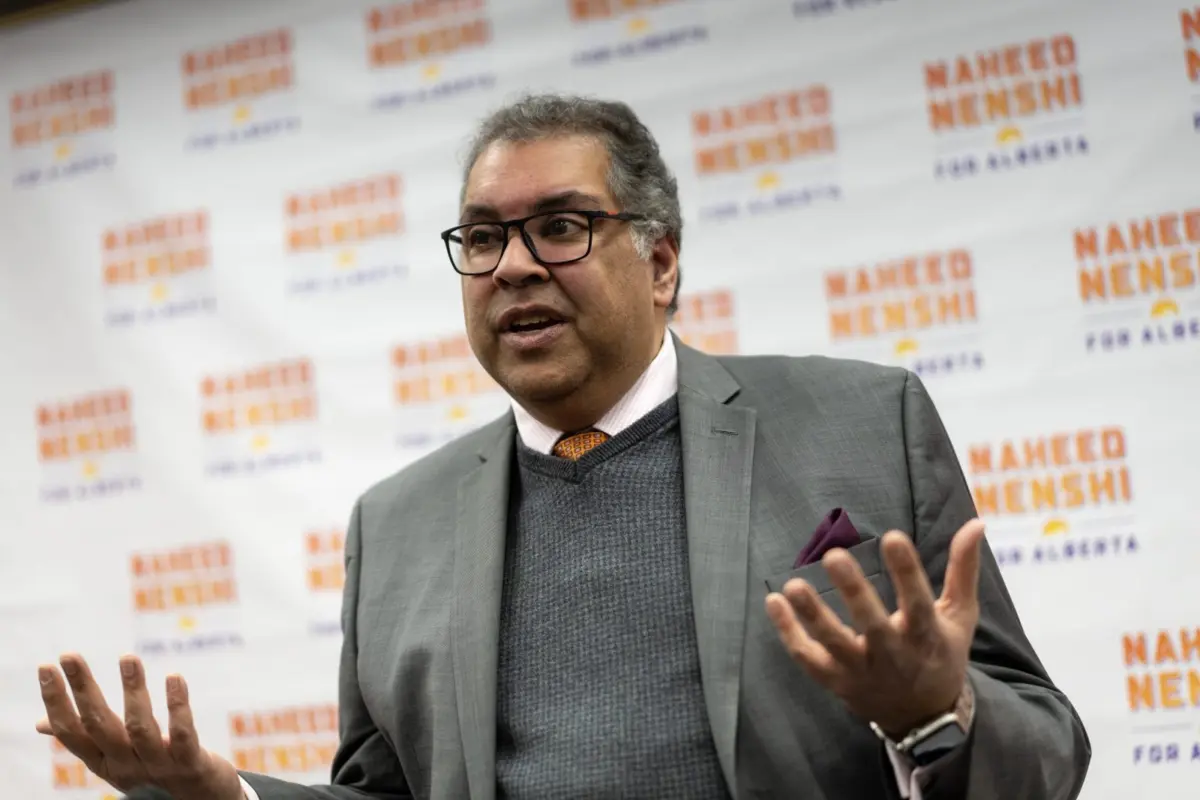
Official Opposition NDP Leader Naheed Nenshi spoke out forcefully against the forthcoming recommendations after receiving an advance briefing on the document. Nenshi accused the government and the boundary panel of attempting to gerrymander key voting districts in southern Alberta, pointing specifically to proposed changes affecting the major urban centers of Calgary and Lethbridge. Gerrymandering refers to the deliberate practice of redrawing electoral district boundaries not to reflect natural geographic features or population growth patterns, but rather to strategically group or fragment specific populations of voters to give an unfair structural advantage to a particular political party.
Nenshi raised concerns over the structural design of the suggested constituency maps, noting that two members serving on the legislative committee responsible for reviewing the report acknowledged that the proposed ridings draw a sharp, rigid dividing line between rural and urban voters. Under this proposed configuration, critics argue that the distinct political preferences of urban residents could be diluted by merging them with surrounding rural regions.
The political implications of redrawing these boundaries are substantial given Alberta’s current electoral geography. In recent provincial elections, the ruling United Conservative Party has demonstrated dominant support across rural regions and smaller municipalities throughout the province. Conversely, the NDP has established a firm stronghold in Edmonton. As a result, Calgary and surrounding southern Alberta communities have emerged as the primary political battleground where provincial elections are won or lost.
Nenshi argued that if the proposed boundary revisions pass the legislature in their current form, the concentration of NDP-leaning voters in key urban ridings would be effectively diluted, tilting the competitive advantage decisively toward the UCP. The Opposition leader declared that if the provincial government moves forward with adopting the redrawn map, the NDP will challenge the new boundaries in court on constitutional grounds. The Canadian Constitution guarantees citizens the right to effective representation, a legal principle that governs how electoral boundaries must balance population parity with community interest and geographic fairness.
Beyond the specific riding boundaries, Nenshi also leveled serious allegations regarding the independence of the panel responsible for drafting the new electoral map. The Opposition leader asserted that the panel appeared to have acted under guidance and instructions from the provincial government, compromising the non-partisan independence expected of electoral boundary reviews.
Premier Danielle Smith vigorously rejected Nenshi’s allegations, mounting a strong defense of the boundary panel and its leadership. Smith accused the Opposition leader of unfairly questioning the integrity of respected judicial figures, pointing out that the panel responsible for redrawing the boundaries was chaired by former judge Brian O’Ferrall. The Premier denied any suggestion that her government had pulled strings behind the scenes or manipulated the boundary review process to secure a political advantage in the upcoming election. Responding to Nenshi’s criticisms, Smith dismissed the Opposition’s concerns, telling Nenshi to stop complaining and start actively campaigning instead.
The current boundary review panel was convened following a stalemate in the province’s boundary review process. Previous efforts to update the map ran into obstacles when an earlier bipartisan boundary commission became deeply divided over its final recommendations, despite having conducted months of extensive public consultations across the province. That impasse led to the creation of the current panel and the subsequent drafting of the controversial report now heading to the legislature floor.

As political tension built over the weekend, the NDP maintained its aggressive critique of the government’s handling of the process. In a formal statement released on Friday, Nenshi reiterated his party’s stance, charging that the UCP caucus has spent months trying to undermine the democratic rights of Albertans by pushing through election maps engineered to deliver a legislative victory for the ruling party regardless of voter intent.
Nenshi highlighted the chief electoral officer’s letter as validation of the Opposition’s warnings. He argued that Elections Alberta has now explicitly confirmed it lacks the necessary time to implement what he described as a rigged map before the scheduled fixed election date. Nenshi noted that this fixed date had already been pushed back by Premier Smith’s government, extending the current mandate by six months.
The fixed election date controversy dates back to 2024, when Smith’s government introduced legislation altering the timing of Alberta’s provincial elections. Under the statutory change, the province’s recurring four-year election window was shifted from May to October, establishing October 18, 2027, as the official date for the next vote. The government defended the calendar adjustment as a practical measure aimed at avoiding election campaigns during the peak spring and summer seasons, when Alberta frequently faces major natural disasters such as severe wildfires and flooding. However, political opponents have continually criticized the move as an artificial extension of the government’s time in office.
In response to the Chief Electoral Officer’s urgent letter to Speaker McIver and MLAs, the office of Alberta’s Minister of Justice confirmed on Saturday that it is actively reviewing McClure’s recommendations and operational warnings. A spokesperson for the justice minister indicated that the government will provide a formal response and further detailed comments once its comprehensive review of the letter’s contents is complete.
With the boundary report scheduled to be officially tabled on Monday, the legislature faces an immediate dilemma. Members must weigh the imperative of resolving heated boundary disputes against the practical, non-partisan warnings issued by Elections Alberta. As the chief electoral officer made clear, maintaining the integrity of the provincial voting process will depend on whether lawmakers decide to proceed under the established riding boundaries or take the extraordinary step of altering the election schedule to accommodate the administrative realities of a redrawn political map.