
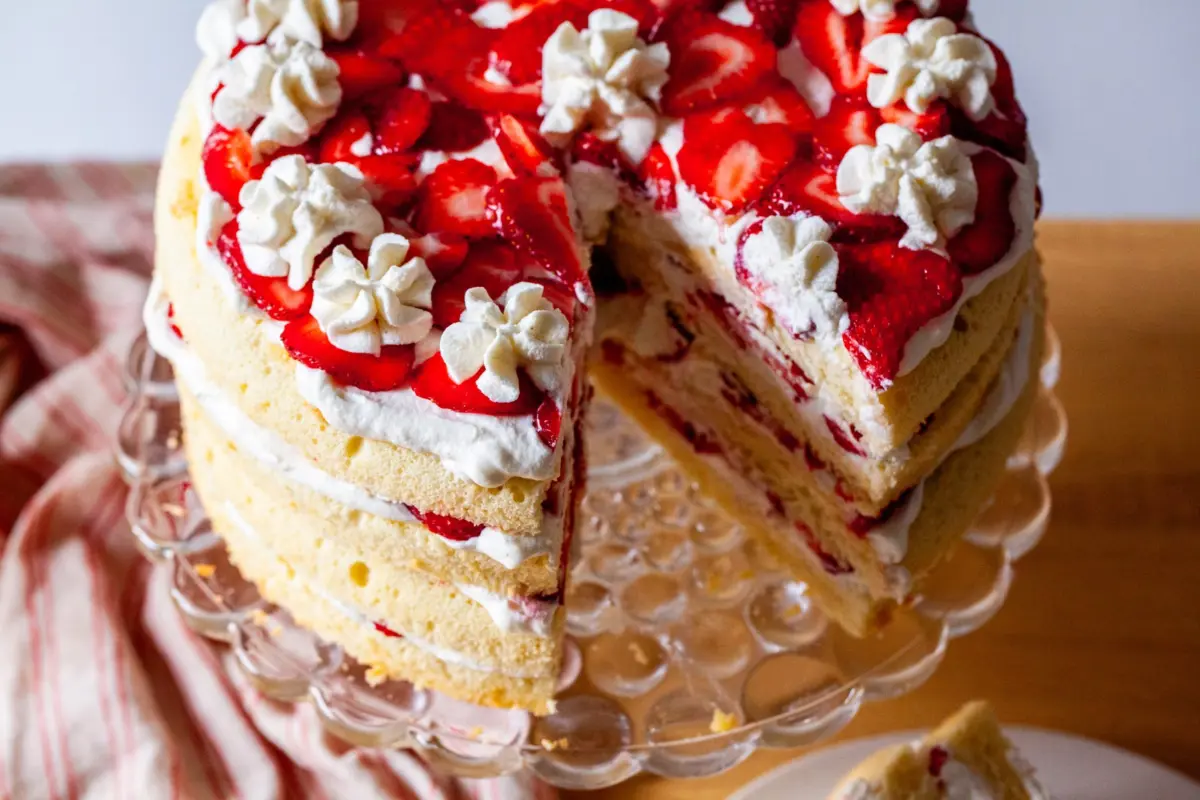
Nearly two decades after first introducing her readers to a towering, featherweight dessert, popular food writer and recipe developer Deb Perelman has unveiled a thoroughly updated, streamlined version of her classic strawberry chiffon shortcake. The original recipe, published in 2007 when her website was still in its infancy, was born out of a rooftop birthday barbecue where Perelman brought the airy confection assuming guests would not complain about a dessert featuring layers of whipped cream and fresh strawberries, regardless of how inexpertly it had been constructed.
Back then, while Perelman could certainly appreciate the final product, she was far from a dedicated superfan of chiffon cakes. Traditionally, the style of cake carried a reputation for being somewhat stiff, lean, and notoriously fussy to execute. The baking process historically demanded rigorous sifting, specialized ingredients like cake flour rather than standard all-purpose flour, superfine sugar instead of regular granulated varieties, an uneven ratio of egg whites to egg yolks, cream of tartar, and a minimum of three distinct mixing bowls just to prepare the structural layers. Furthermore, chiffon cakes are infamous for a frustrating tendency to dip in the center as they cool, presenting a formidable challenge even for experienced home bakers.

Nineteen years after that initial summer debut, the recipe resurfaced inside Perelman’s editorial queue under the heading of items needing a fresh look. Recognizing an opportunity for improvement, Perelman set out to strip away the unnecessary rigidity of the traditional technique. Her goal was to engineer a chiffon cake recipe tailored for real-life modern baking without sacrificing the ethereal qualities that define the dessert.
Along the way, as she describes it, she experienced a late-in-life conversion, falling deeply in love with the mechanics and results of chiffon cakes. Admitting to her friends that she had officially entered her "chiffon cake era," she was met with affectionate amusement. Yet, her newfound appreciation is grounded in practical culinary science. Beyond being light as air and remarkably well-suited for warm-weather celebrations, chiffon cake layers possess an extraordinary shelf life, retaining a texture and freshness on day six that rivals the exact moment they were pulled from the oven.

The revamped recipe recently underwent a rigorous real-world test during Perelman’s birthday celebration. Baking a supersized, multi-layered version of the cake, she briefly stepped away from the party to walk her mother to her car. Upon returning to the main room, she discovered that nearly the entire confection had vanished, leaving behind only a single solitary slice and a scattering of untouched plates. In a momentary panic, she questioned whether the cake was still being portioned elsewhere, only to learn that guests had frantically devoured the dessert straight from the serving platters the moment they were set down, completely bypassing the formalities of plates and patience. Partygoers described the creation as a weightless, melt-in-your-mouth experience, with one guest jokingly lamenting that she needed the recipe doubled next time simply because she was unable to secure a third helping.
Strawberry Chiffon Shortcake, Perfected
The perfected iteration serves as a simplified, highly dependable update to the 2007 original, functioning as a reliable go-to layer cake for any occasion featuring summer fruits alongside whipped cream, custard, or similar components. For large gatherings, bakers can easily double the specifications to construct a towering four-layer sheet cake.

The process begins by preheating the oven to 325 degrees Fahrenheit. Bakers are instructed to lightly coat the bottom of two nine-inch round cake pans with nonstick spray before lining each with a fitted circle of parchment paper, noting that the oil merely serves to anchor the paper and should not be applied to the sides of the pans. Additionally, two cooling racks should be lightly coated with nonstick spray in preparation for the cooling phase.
The foundation of the cake batter is prepared in a large bowl by whisking together egg yolks, lemon zest, and one cup of granulated sugar. Although the mixture initially appears stiff and dry, persistent whisking for approximately one minute transforms the batter, causing it to loosen, lighten to a pale yellow, and achieve a thick, frosting-like consistency. Oil, water, and vanilla extract are subsequently whisked into the mixture. The dry ingredients—consisting of cake flour, salt, and baking powder—are then incorporated in alternating stages, yielding a notably thick batter.

In a separate large bowl, an electric mixer is employed to whip egg whites until they achieve a thick consistency capable of holding firm peaks. The remaining quarter-cup of sugar is added gradually while continuing to beat the mixture. Once the egg whites are exceptionally thick and hold peaks that slightly flop over when the beaters are removed, a small amount of lemon juice is beaten in to finalize the meringue.
To integrate the components without sacrificing the air trapped within the whipped whites, a quarter of the egg meringue is whisked directly into the yolk mixture to loosen the heavy base. The remaining egg whites are then gently folded in across two separate additions, requiring a delicate touch to avoid deflating the batter. The mixture is evenly divided between the two prepared pans and baked for twenty to twenty-five minutes until a toothpick inserted into the center emerges clean.

To combat the traditional tendency of chiffon cakes to shrink or dip, an immediate physical intervention is required the moment the pans emerge from the oven. Each layer is dropped deliberately onto the kitchen counter from a height of a few inches. Following this shock, the cake layers are inverted and left to cool completely upside down in their pans, supported by the pre-greased cooling racks.
The assembly process centers on a whipped cream component crafted using heavy cream, powdered sugar, and vanilla, beaten until soft peaks form. Sour cream or crème fraîche is then incorporated, resulting in a stable, creamy mixture that holds its shape without becoming grainy. Once the cake layers have cooled completely and been safely extracted from their pans using a knife to loosen the edges, a long serrated knife is used to slice each layer horizontally into two thinner sections.

The construction of the dessert proceeds on a serving platter or cake stand, alternating individual cake layers with slightly heaped cups of whipped cream and precise portions of sliced fresh strawberries. This layering sequence is repeated three times, leaving a small reserve of whipped cream that can be transferred to a piping bag fitted with a star tip for decorative final touches.
Because of its delicate and wobbly nature, the finished cake is best served in generous wedges rather than rigid slices, a characteristic that Perelman notes is part of the dessert’s inherent charm. Furthermore, the components offer remarkable flexibility for advance preparation. The baked cake layers can be wrapped and stored at room temperature for five to six days without noticeable staling, while the freezer accommodates longer storage timelines. Even when fully assembled with cream and fruit, the cake maintains its structural integrity and quality in the refrigerator for nearly a week, though in practice, as Perelman’s recent birthday party demonstrated, surviving that long is rarely an issue.