
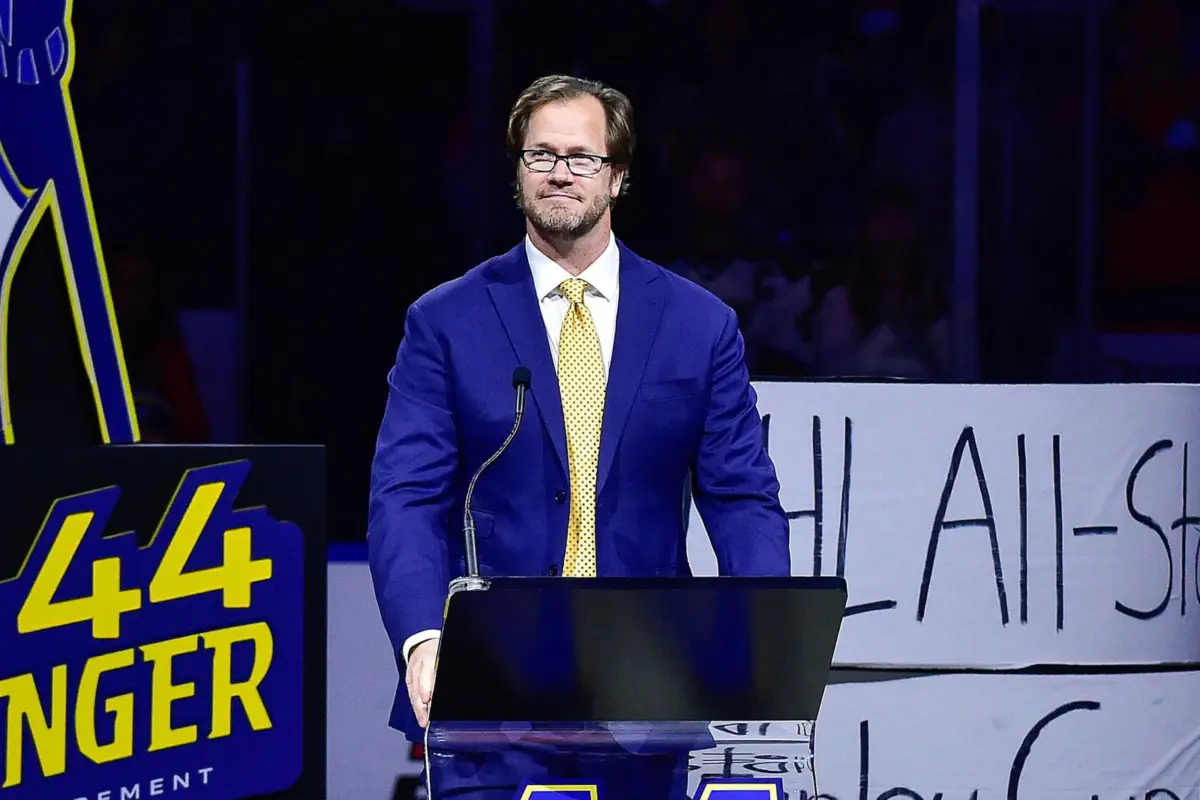
In the long and storied history of the Hart Memorial Trophy, which is awarded annually to the National Hockey League’s most valuable regular-season player, a distinct and discouraging pattern has emerged. And if you happen to be a defenseman skating in the world’s top hockey league, that pattern is far from favorable.
It has now been more than a quarter of a century since a blueliner was last honored with the prestigious individual award. Hockey Hall of Famer Chris Pronger, who stands as the final defenseman to capture the hardware back in the year 2000, has unique insight and definitive theories as to why even the most elite defensive stalwarts consistently come up short when ballots are cast.
Appearing on a recent episode of The Big Show with Michael Traikos of The Hockey News, Pronger broke down the inherent systemic and perceptual challenges that blueliners face in the MVP race. According to the former star defenseman, the position simply lacks the traditional offensive flash that captivates voters season after season.
"It’s not as sexy to be a defenseman," Pronger told Traikos. "You’re never going to have 50 goals, 60 goals, you’re never going to get 140-150 points. Maybe, but if you’re getting 140-150, then someone’s getting 200-250 points. There’s always the barometer of who you’re up against. And in some cases, you’re going up against someone on your team. If you’re able to do that, then someone on your team is having a career year as well."
For the dedicated members of the Professional Hockey Writers Association who hold the responsibility of voting on the Hart Trophy, there is a historically clear tendency to cast ballots for players who routinely fill the scoresheet with eye-popping goal totals and soaring assist tallies. Because defensemen are fundamentally tasked with preventing goals rather than merely accumulating them, their immense contributions to team success often get overshadowed by high-flying forwards.
Since Pronger famously took home the Hart Trophy as a member of the St. Louis Blues during the 1999-2000 campaign—anchored by a career-high 62 points during the NHL’s famously defense-oriented "Dead Puck Era"—no defenseman has even managed to break through as a finalist for the award.
While modern blueliners have occasionally crept into the top tier of voting, they have continuously fallen just short of finalist status or meaningful consideration at the very top of the ballots. In the 2007-08 season, legendary Detroit Red Wings icon Nicklas Lidstrom finished fourth in Hart balloting following another masterclass campaign. Nearly a decade later, during the 2016-17 season, star defenseman Brent Burns finished fourth in Hart voting as a member of the San Jose Sharks after a dominant offensive and defensive year.
More recently, the standard-bearers of the modern blue line have posted video-game-like offensive numbers without cracking the top five in MVP voting. Colorado Avalanche superstar Cale Makar, who put together a sensational 30-goal, 92-point campaign during the 2024-25 season, ultimately finished sixth in the voting. Meanwhile, a staggering 101-point campaign from Erik Karlsson during the 2022-23 season was only good enough to place him 15th in voting, a placement that perhaps was hindered by observers looking closely at his minus-26 plus-minus rating.
Beyond raw statistics and traditional scoring bias, Pronger pointed out to Traikos that Hart Trophy voting can frequently be influenced by human nature, personal relationships, and media dynamics that have very little to do with what actually happens on the ice.

"The media, sometimes they like you and sometimes they don’t," Pronger said. "Sometimes they have an affinity for a certain type of player. Sometimes it’s somebody’s turn, which I’ve heard a number of times. And sometimes the vote gets split or they don’t see you enough."
Offering a window into his own historic win, Pronger explained how unique circumstances and a specific voter’s philosophy aligned in his favor a quarter-century ago, noting that the race could easily have swung another way if not for missed time by a legendary forward.
"The year I won, it was a little bit of an anomaly in the sense that [Jaromir] Jagr would have probably won had he not been injured… The Pittsburgh writer who voted for me had Jagr in the second spot because he missed 19 games. So he didn’t play a full year," Pronger recalled. "I played 82 games and I think he played 63 games… So the writer was like, ‘You missed almost a quarter of the season, so how can I vote that you’re the MVP of the league when you missed a quarter?’ There’s always a number of factors, and in a lot of players’ cases, it’s who they’re up against."
If there was ever a historical window for this long-standing trend to finally shift and for another defenseman to capture the league’s ultimate individual regular-season honor, Pronger believes it would require a confluence of rare events.
"It will take an anomaly and an off-year maybe for forwards in their scoring, and a defenseman to have an all-world year," Pronger said.
Reflecting on his own milestone season, Pronger emphasized that individual hardware rarely happens in a vacuum; it requires a collective powerhouse effort from the entire organization to draw maximum attention to a player’s contributions.
That 1999-2000 campaign was undeniably the statistical pinnacle of Pronger’s illustrious career, even if he views it through a pragmatic lens regarding his overall style of play.
"That obviously was the best year of my career from a statistical standpoint. Maybe not the best that I’ve played. But from a statistical standpoint, it certainly was," Pronger noted.
"Having the type of year that we had as a team too, winning the Presidents’ Trophy, there was a lot of things that checked the box. Craig Conroy was up for the Selke that year. Our goalies won the Jennings. We had three or four guys who were up for awards, so we had an incredible regular season, which played a lot into it."