
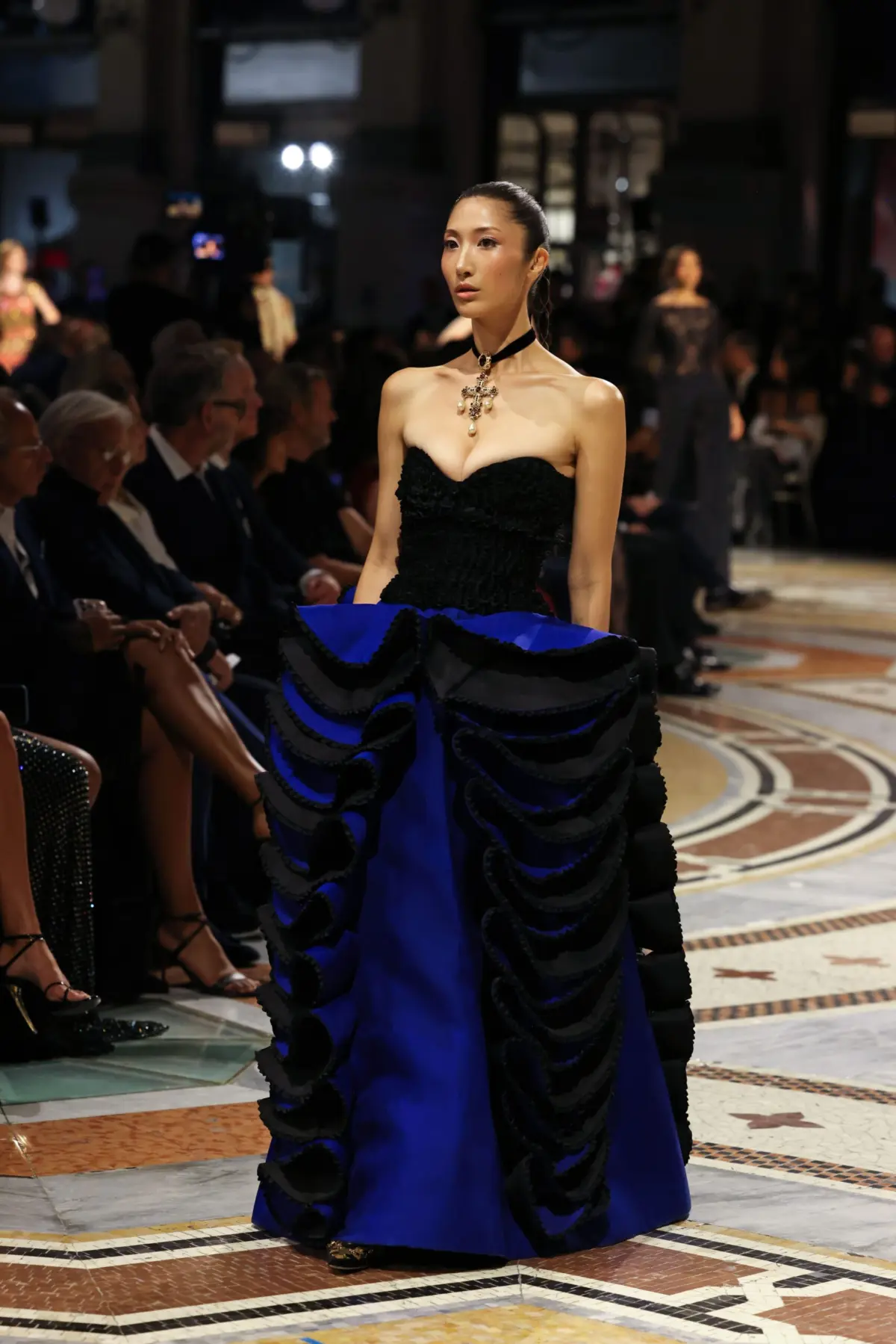
This evening, amid the historic grandeur of Vogue World: Milano, singer and style star Ejae captured the attention of the fashion world by walking the runway in a breathtaking archival Roberto Capucci gown. The striking blue-and-black tiered masterpiece served as a prime, living example of the visionary Italian couturier’s legendary craftsmanship, bridging the gap between historical artistry and modern-day performance on one of the industry’s most watched stages.
The appearance marked a high point in the evening’s narrative, honoring a designer whose contributions to Italian fashion helped define an entire century of high-end design. Born in Rome in 1930, Roberto Capucci originally trained as a sculptor before turning his meticulous eye toward fashion. Demonstrating a prodigious and rare talent, he opened his very first clothing atelier before he had even reached the age of 20. In the turbulent and transformative aftermath of World War II, Capucci quickly rose to prominence. Alongside contemporaries such as Valentino Garavani and Emilio Pucci, he became one of the leading fashion designers of his era, together ushering in an opulent, globally influential golden age of Italian design that put Rome and Milan firmly on the international style map.
Known as a passionate and colorful artisan, Capucci transcended the standard boundaries of tailoring by treating garments as three-dimensional works of art. His distinctive work can be immediately recognized through his exuberant color play, dramatic contrasts, and often deeply architectural silhouettes that defied gravity and conventional sewing techniques. Capucci’s creations were not merely worn; they were treasured as museum-worthy artifacts. Highlighting the extreme devotion his pieces inspired among collectors, legendary fashion journalist Joan Juliet Buck reported in Vogue in 1989 that Italian model Mirella Petteni famously stored each of her two prized Capucci dresses in their own dedicated closets within her Venetian home, ensuring the delicate, voluminous structures remained entirely uncompromised.
Ejae’s dramatic runway moment placed the singer directly at the heart of the show’s thematic narrative, as she participated in the event’s striking opening chapter, titled Act I: The Artisanal Revolution. Every single garment featured within this foundational section was carefully curated to represent the ornate embroidery, rich textures, and breathtaking intricacies of handmade Italian artistry from centuries past.
Providing deep insight into the vision behind the segment, Vogue World: Milan creative director Juan Costa spoke with Vogue prior to the evening’s festivities to explain the historical and conceptual weight of the opening chapter. "The first act is the artisanal revolution, which has to do with everything that comes before electricity and before industrialization," Costa told Vogue. Elaborating on the atmosphere the creative team sought to evoke, he added, "It was the time of kings, queens, and popes, and through that, we’re seeing fashion that’s handcrafted."
The archival Capucci gown worn by Ejae embodied this pre-industrial ethos of painstaking human labor and artistic devotion. To elevate the historical grandeur of the look even further, the ensemble was carefully paired with a striking Dolce & Gabbana choker featuring an intricate gold and pearl dangling cross. The thoughtful combination of Capucci’s monumental architectural silhouette and the opulent religious-inspired ornamentation of the Dolce & Gabbana accessory resulted in an aesthetic that was undeniably, magnificently fit for royalty, bringing the rich heritage of Italian craftsmanship vividly back to life for a contemporary global audience.