
CALGARY — One morning in May, the political reality of a shifting nation hit John Pentland not through an analytical briefing or a formal policy paper, but across the breakfast table. Pentland, a minister at Hillhurst United Church in Calgary, opened his morning newspaper and read about a growing movement of Albertans working to divide his country.
Something inside of him felt like it cracked open. He started to weep, an overwhelming physical reaction that caught him entirely off guard.
“I couldn’t stop, I couldn’t breathe,” he recalled months later. In the immediate panic of the moment, he dialed a friend and confessed, “I think I’m losing my mind.”
Pentland has spent his life believing in Canada, acknowledging its flaws while cherishing it as a nation gifted with diversity and historically welcoming to asylum seekers, refugees, and immigrants. But recently, that foundational belief has been deeply shaken. He has watched right-wing ideologies, heavily charged with anti-immigrant sentiment, take root across his home province. The shift leaves him simultaneously angry and deeply embarrassed for the country he loves so dearly.
“I’ve never felt our worship and our sermons matter more than they do right now,” Pentland said in mid-September, sitting in a crowded coffee shop in Calgary’s Kensington neighbourhood, just a few blocks from his church. “Right now, it feels very important that we’re speaking what I call good religion. Jesus has been usurped by the right wing. It’s not biblical. It’s not following Matthew 25: ‘I was hungry and you fed me, thirsty and you gave me drink. I was a stranger and you welcomed me.’”
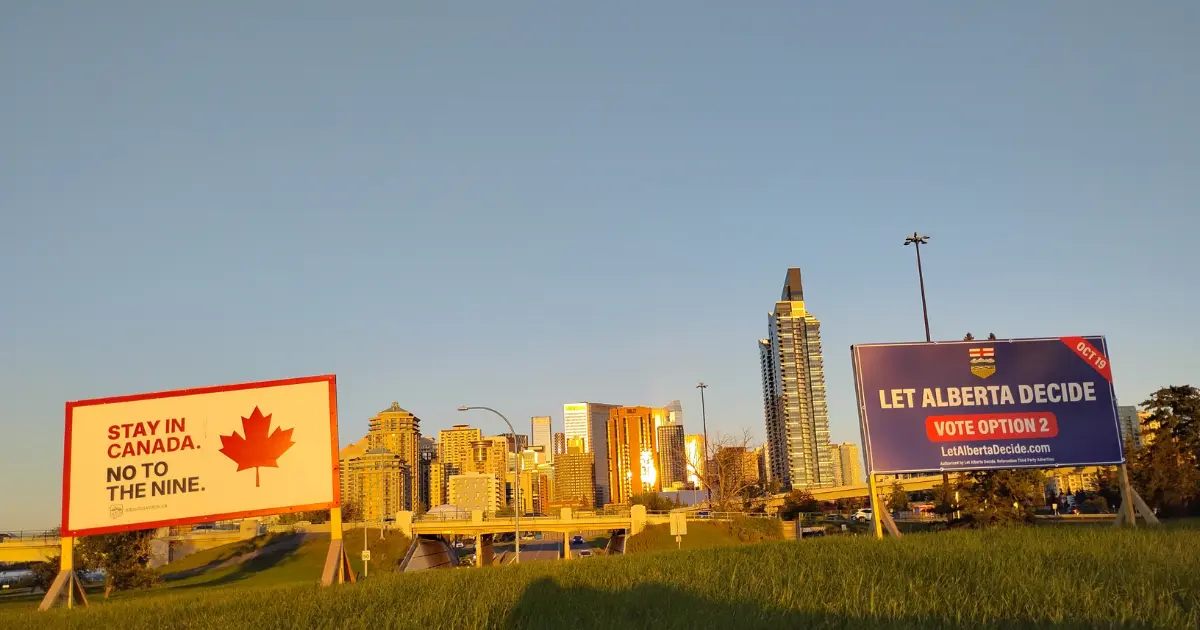
On October 19, Albertans are scheduled to go to the polls in a consequential referendum that has largely been framed in public discourse as a definitive vote on the province’s independence. Yet, beneath the broader conversation about separation lies a complex ballot featuring a total of 10 distinct questions—five of which focus squarely on immigration.
These specific immigration-related questions ask voters whether the Alberta government should assume greater control over immigration for the explicit purpose of decreasing newcomer numbers to more sustainable levels. Other questions propose withholding health care, education, and social services from individuals who are not Alberta citizens or permanent residents; requiring newcomers to live in the province for a full year before receiving provincially funded social support programs; charging non-permanent residents user fees for health care and education; and mandating proof of citizenship to vote.
For many community leaders and faith advocates, these proposals represent a disturbing turning point in provincial politics.
“Are these questions proposing solutions or are they presenting scapegoats?” asks Chris Mah Poy, who works for the United Church of Canada’s Alberta region. Since June, Mah Poy has been traveling across the province to hold workshops in local churches, helping people navigate the complex referendum questions and prepare for election day.
For Mah Poy, the current political rhetoric carries a profound generational weight. When his great-grandparents arrived in Canada in the early 1900s, they were subjected to the Chinese head tax, a race-based levy explicitly designed to restrict Chinese immigration following the completion of the Canadian Pacific Railway. His grandfather was born in Alberta but was not legally recognized as a Canadian citizen until 1947, enduring years of paying taxes without the fundamental right to vote.
“When I read the referendum questions on immigration, I see that once again a group of people, valued for their labour, who pay taxes and are our neighbours, risk being second-class citizens,” Mah Poy says. “Once again the forces of division, xenophobia and racism are being weaponized to distract and deflect from failures of government policy.”
Public debates in the province frequently point to immigration as the primary driver behind acute housing shortages and a strained health-care system. However, policy experts note that these systemic crises existed long before Canada temporarily increased immigration levels to accommodate international students and refugees fleeing conflicts in Syria, Ukraine, and Gaza. In fact, as recently as 2024, Alberta Premier Danielle Smith wrote a formal letter to Ottawa asking for the province’s federal immigration allotment to be doubled to bring in more evacuees from Ukraine. In the past two years, the federal government has sharply cut immigration levels, resulting in Canada recording its lowest rate of population growth since the Second World War.
Despite these figures, the social climate on the ground is shifting palpably.
“The division has already started,” says Adanech Sahilie, executive director of the Immigrant Outreach Society in Calgary, a non-profit organization that provides critical support to Ethiopian and Eritrean families. “We can feel it, we can see it.”
Sahilie notes that she has experienced more personal instances of racism in the past 10 months than in all the preceding 15 years she has lived in Calgary. Strangers have yelled at her from passing cars, hurled racial slurs, and told her to go back where she came from.
“It’s really unbelievable. Canada is supposed to be a great country. It’s widely known Canada is very welcoming,” she says.
The families Sahilie works with live in daily fear that they will lose access to essential health care and see their children expelled from public schools if the referendum’s restrictive proposals are enacted.
“Some of them are crying,” she says. “Already life is really uncertain for them. When you flee your home country, you leave everything behind and you know you aren’t going back. This is just another layer of stress. Honestly, it’s even hard for me to sit with them.”
Across town, a different perspective on the province’s future is actively taking shape. Two days after having coffee with Pentland, a reporter met Rory St. John on a street corner not far from the Chinook light rail station. St. John was handing out Ziploc bags containing granola bars and Gatorade. Next to him stood a folding table stacked with tracts warning of the civilizational threats allegedly posed by medical assistance in dying, Islam, and transgenderism.
A young man with a trim beard and a warm handshake, St. John serves as a pastoral assistant at Fairview Baptist Church. Earlier this year, his church hosted a public lecture titled “A Christian Perspective on Alberta Independence,” during which pastor Tim Stephens compared Canada to a cow being fed by hardworking Alberta farmers and milked dry by distant bureaucrats in Ottawa.
During the lecture, Stephens argued that the call for independence represented the “groaning of a people to live in a Christian society with Christian principles,” outlining four bedrock biblical values that he connected to Alberta separatism: liberty, justice, vocation, and belonging. He explained that biblical liberty is rooted in personal responsibility, individual rights, property rights, limited government, and local governance. Furthermore, he asserted that true biblical justice is not a socialist or Marxist framework that redistributes wealth, but a system where individuals retain what they earn.
When asked how these interpretations align with Jesus’s frequent biblical commands for the wealthy to sell their possessions and give to the poor, or the parable of labourers receiving equal wages despite working different hours, Stephens maintained those teachings referred strictly to voluntary acts of charity, which he fully supports.
While St. John was not stationed on the street corner to debate separatism—stating his primary mission is to share the gospel so people might be saved—he offered clear views on the upcoming referendum. He expressed a strong belief that his resource-rich province would thrive financially if Albertans no longer contributed to federal equalization payments and were liberated from federal regulations on oil and gas. More urgently, he maintained that Alberta has historically been more culturally Christian and conservative than the rest of the country.
“Having Alberta as a separate nation would give us more freedom to talk about things like MAID and abortion and transgenderism and build a more Christian-influenced society,” he said, despite polling data, such as a 2022 Ipsos survey, indicating that Albertans on average support a woman’s right to access abortion services at rates slightly higher than the national average.
While acknowledging that scripture urges believers to welcome strangers and foreigners, St. John argued that federal immigration policies under former prime minister Justin Trudeau created excessive incentives for newcomers. Citing biblical scripture that warns those who do not work should not eat, he added, “I don’t think Christianity necessitates free handouts to everybody.”
When it was pointed out that he was distributing free food and drinks on the street corner to individuals who may not be currently working, St. John chuckled.
“Well, we want to be kind to them and get them on the right track, and most of all share the gospel with them. There’s a gospel tract in there. That’s our main mission.”
As the vote approaches, progressive and faith-based coalitions are mobilizing to counter the separatist push. On a warm Wednesday evening in September, approximately 200 people crowded into the wooden pews of Scarboro United Church. The gathering brought together members from Unitarian, Lutheran, Anglican, and United churches, alongside representatives from local synagogues, non-profit organizations, unions, and immigration support groups, all united by a common goal to defeat the separatist agenda.
Darren Weaselchild, a member of the Siksika Nation Blackfoot Confederacy, addressed the assembly to remind attendees that First Nations treaty relationships are established directly with the Crown, not the provincial government of Alberta.
“Treaty 7 represents a promise to work together, a promise to live together, a promise to build a future together,” he told the room, noting that an Alberta court has already ruled that provincial separation would directly violate established treaty rights.
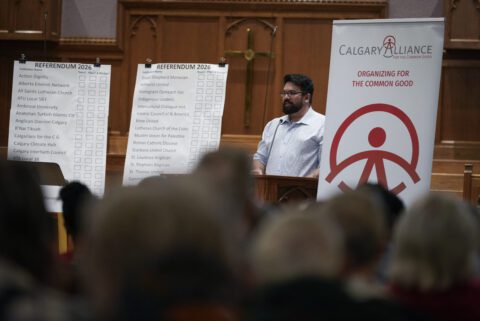
Ryan Andersen, lead organizer with the Calgary Alliance for the Common Good—a progressive coalition of faith groups, unions, and non-profits—stepped up to the pulpit to outline the critical electoral math facing opponents of the referendum.
“So far we’ve been focusing on educating about the issues. It’s time to switch to educating people about voting,” Andersen said. “It’s expected that about 80 percent of separatists will vote. In a typical referendum about 30 percent of people vote. So, if 80 percent of separatists vote and 30 percent of the rest of us vote, guess who wins? The separatists.”
Andersen urged everyone in attendance to form teams, claim their local turf, and build concrete plans to mobilize voters to the polls, emphasizing that the logistical effort required is demanding and difficult to undertake alone.
A vibrant hubbub quickly filled the sanctuary as small groups put their heads together in the pews. Representatives from various organizations eventually took turns stepping up to a central microphone to report the number of voters they calculated they could successfully drive to the polls.
Two ministers diligently tallied the figures on large flip charts at the front of the room. Finally, Erin Klassen, a minister at Scarboro United Church, made the announcement: participants had collectively pledged to mobilize between 16,000 and 20,000 voters to the ballot booths. The room erupted in jubilation.
Leaving the church into the cool autumn night after the meeting, Chris Mah Poy reflected on the evening’s energy and the hard work ahead before the final push toward referendum day.
“Often we say we hope for an outcome,” he said. “Hope is not a strategy. We’re moving people from passive hope to: ‘We have a plan.’”