
CALGARY — One morning in May, John Pentland opened his morning newspaper in Calgary and read about a concerted political movement within his home province attempting to sever ties with the rest of Canada. For Pentland, a minister at Hillhurst United Church, the news struck with a visceral, physical impact. Something inside him felt like it had cracked open, and he began to weep uncontrollably.
“I couldn’t stop, I couldn’t breathe,” Pentland recalled months later, describing a moment of acute despair that led him to call a close friend and whisper his fears: “I think I’m losing my mind.”
Pentland has spent his life believing in Canada, viewing it as a fundamentally generous nation—flawed, certainly, but defined by diversity and a historic willingness to welcome asylum seekers, refugees, and immigrants. Yet that foundational belief has been deeply shaken in recent years as right-wing ideologies, frequently charged with explicit anti-immigrant sentiment, have taken firm root in Alberta. For a minister whose vocation is rooted in community and inclusion, the shift has sparked a potent mix of anger and sorrow for the country he loves.
“I’ve never felt our worship and our sermons matter more than they do right now,” Pentland said during a September interview in a crowded coffee shop in Calgary’s Kensington neighbourhood, just a few blocks from his church. “Right now, it feels very important that we’re speaking what I call good religion. Jesus has been usurped by the right wing. It’s not biblical. It’s not following Matthew 25: ‘I was hungry and you fed me, thirsty and you gave me drink. I was a stranger and you welcomed me.’”
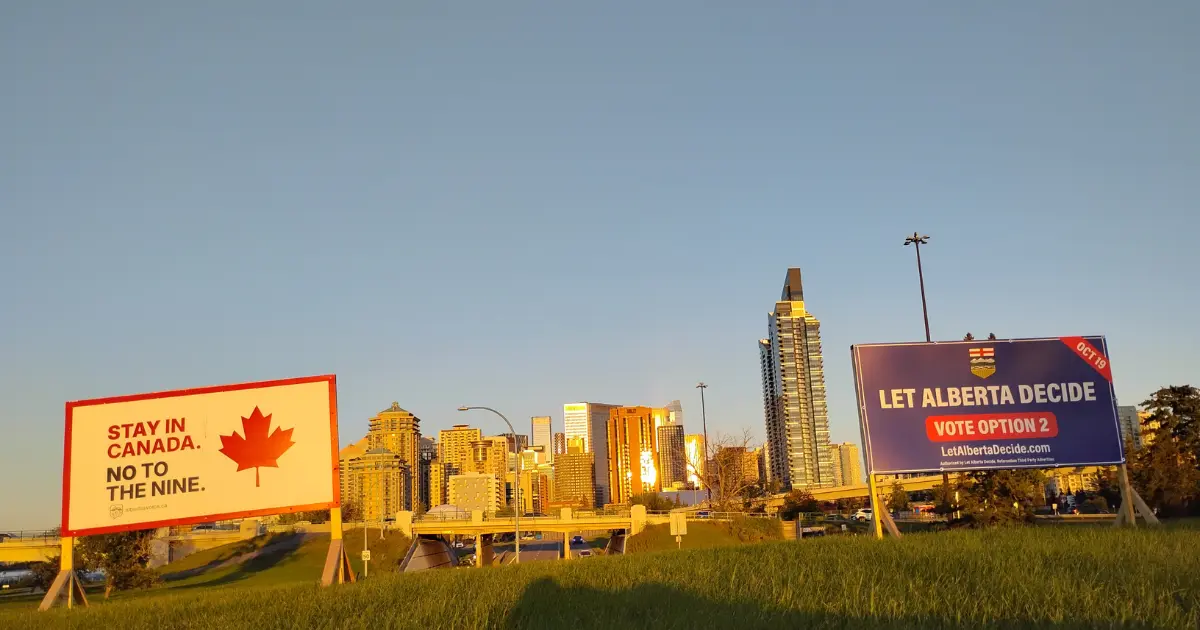
The flashpoint for this growing anxiety arrives on October 19, when Albertans head to the polls for a high-stakes referendum. While the public debate has largely been framed around the concept of provincial independence, the actual ballot presents voters with a complex array of 10 distinct questions. Five of those inquiries focus directly on immigration, proposing that the Alberta government assume tighter control over newcomers “for the purposes of decreasing immigration to more sustainable levels.”
Further questions ask whether health care, education, and other vital social services should be withheld entirely from individuals who lack Alberta citizenship or permanent residency; whether newcomers should be required to reside in the province for a full year before qualifying for provincially funded social supports; whether non-permanent residents should face mandatory user fees for basic health care and education; and whether citizens should be forced to present explicit proof of citizenship simply to cast a ballot.
To community advocates and religious leaders, the wording of the ballot items represents a dangerous shift in political rhetoric. “Are these questions proposing solutions or are they presenting scapegoats?” asked Chris Mah Poy, who works for the United Church of Canada’s Alberta region.
Since June, Mah Poy has traversed the region, hosting educational workshops inside local churches to help parishioners decode the complex referendum questions and prepare for election day. His perspective is deeply informed by family history. When Mah Poy’s great-grandparents arrived in Canada in the early 20th century, they were forced to pay the Chinese head tax—a notorious race-based levy designed to restrict Asian immigration following the completion of the Canadian Pacific Railway. His own grandfather, though born in Alberta, was legally denied recognition as a Canadian citizen until 1947, paying taxes for decades without the fundamental right to vote.
“When I read the referendum questions on immigration, I see that once again a group of people, valued for their labour, who pay taxes and are our neighbours, risk being second-class citizens,” Mah Poy said. “Once again the forces of division, xenophobia and racism are being weaponized to distract and deflect from failures of government policy.”
Public debates in the province have frequently pinned the blame for persistent housing shortages and an overburdened health-care system on high immigration numbers. However, economic and social analysts note that these systemic crises predated recent federal efforts to bring in foreign students and refugees fleeing conflicts in Syria, Ukraine, and Gaza. In fact, as recently as 2024, Alberta Premier Danielle Smith wrote a formal letter to Ottawa requesting that the province’s federal immigration allotment be doubled specifically to accommodate more evacuees from Ukraine. Meanwhile, federal policy shifts over the past two years have already sharply reduced immigration levels, leading to the lowest rate of population growth recorded in Canada since the Second World War.
Despite these realities, marginalized communities report that the political rhetoric is already reshaping daily life. “The division has already started,” said Adanech Sahilie, executive director of the Immigrant Outreach Society in Calgary, a non-profit organization providing critical support to Ethiopian and Eritrean families. “We can feel it, we can see it.”
Sahilie noted that she has encountered more overt personal racism in the past ten months than during the previous fifteen years she has lived in Calgary. She described unsettling incidents of motorists yelling racial slurs from passing vehicles and telling her to return to her country of origin.
“It’s really unbelievable. Canada is supposed to be a great country. It’s widely known Canada is very welcoming,” she said.
The climate of hostility has sown deep anxiety among the families Sahilie serves. Many live in active fear that a successful “Yes” vote on the referendum proposals could strip them of health care access or lead to their children being barred from public schools.
“Some of them are crying,” she said. “Already life is really uncertain for them. When you flee your home country, you leave everything behind and you know you aren’t going back. This is just another layer of stress. Honestly, it’s even hard for me to sit with them.”
Contrasting visions of faith and society are central to the debate. Two days after meeting with Pentland, a reporter spoke with Rory St. John on a street corner near the Chinook light rail station. St. John, a pastoral assistant at Fairview Baptist Church, was handing out Ziploc bags filled with granola bars and Gatorade. Beside him stood a folding table stacked with tracts warning of the perceived civilizational threats posed by medical assistance in dying, Islam, and transgenderism.
A young man with a trim beard and a welcoming demeanor, St. John’s primary focus on the street corner was spiritual rather than political. “Our main mission” is sharing the gospel of Jesus so that people might be saved, he explained. Yet he readily shared his enthusiastic support for the referendum and the broader separatist movement.
Earlier in the year, Fairview Baptist Church hosted a public lecture entitled “A Christian Perspective on Alberta Independence.” During the event, pastor Tim Stephens compared Canada to a cow that is fed by Alberta farmers only to be milked dry by bureaucrats in Ottawa. Stephens argued that the push for independence reflected the “groaning of a people to live in a Christian society with Christian principles,” outlining four bedrock biblical values—liberty, justice, vocation, and belonging—as justifications for separatism. In Stephens’ view, true biblical liberty is rooted in personal responsibility, property rights, and limited government, while biblical justice rejects socialist wealth redistribution in favor of individuals keeping what they earn.
St. John echoed these sentiments, expressing his belief that an independent Alberta would be economically better off without federal equalization payments and oil and gas restrictions. More importantly, he argued that a separate nation would give conservative Christians greater legislative freedom to address social issues such as abortion, medical assistance in dying, and transgender rights, ultimately building a more overtly Christian-influenced society. Opinion polling, such as a 2022 Ipsos survey, suggests that Albertans, on average, support a woman’s right to access abortion services at rates slightly higher than the national average, complicating the narrative of uniform social conservatism in the region.
When asked about biblical injunctions to welcome the stranger, St. John argued that federal immigration policies under former prime minister Justin Trudeau had created unsustainable incentives. Citing the Apostle Paul’s maxim that those who do not work should not eat, he added, “I don’t think Christianity necessitates free handouts to everybody.”
Reminded that he was currently distributing free food on a street corner to individuals who were not working, St. John chuckled. “Well, we want to be kind to them and get them on the right track, and most of all share the gospel with them. There’s a gospel tract in there.”
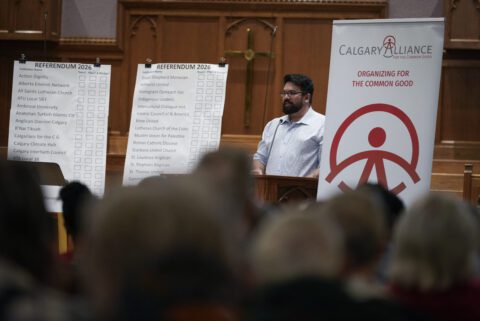
As the vote approaches, progressive religious and civic organizations are mobilizing to counter the separatist momentum. On a warm Wednesday evening in September, roughly 200 people packed the wooden pews of Scarboro United Church in Calgary. The gathering brought together a diverse coalition of Unitarians, Lutherans, Anglicans, United Church members, synagogue representatives, labor unions, and immigration advocacy groups, all united by a shared goal to defeat the referendum proposals.
Darren Weaselchild, a member of the Siksika Nation Blackfoot Confederacy, opened the meeting by reminding the audience that First Nations treaty relationships are legally established with the Crown, not the provincial government. “Treaty 7 represents a promise to work together, a promise to live together, a promise to build a future together,” he said. An Alberta court has previously affirmed that unilateral provincial separation would violate existing Indigenous treaty rights.
Ryan Andersen, lead organizer with the Calgary Alliance for the Common Good—a formidable coalition of progressive faith groups, unions, and non-profits—took to the pulpit to frame the tactical reality of the campaign.
“So far we’ve been focusing on educating about the issues. It’s time to switch to educating people about voting,” Andersen told the crowd, noting that historical turnout models suggested approximately 80 percent of separatists intended to cast a ballot, compared to a typical 30 percent turnout among general voters. “If 80 percent of separatists vote and 30 percent of the rest of us vote, guess who wins? The separatists.”
Urging attendees to form teams and construct concrete logistical plans, Andersen acknowledged the difficulty of the task. A lively hum filled the sanctuary as participants clustered in the pews to map out grassroots mobilization strategies. Toward the end of the evening, representatives announced their calculated tallies to two ministers keeping score on flip charts.
Finally, Erin Klassen, a minister at Scarboro United Church, stepped to the microphone with the results. Through coordinated local efforts, the assembly had pledged to mobilize between 16,000 and 20,000 voters to the polls. The announcement was met with jubilation from the pews.
Stepping out into the cool autumn night after the meeting, Chris Mah Poy reflected on the evening’s energy.
“Often we say we hope for an outcome,” he observed. “Hope is not a strategy. We’re moving people from passive hope to: ‘We have a plan.’”