
For years, the Canadian real estate industry relied on an informal patchwork of office conversations, Facebook groups, and WhatsApp chats to share information about properties that were quietly coming soon to the market. While consumer-facing property search technology advanced by leaps and bounds, the behind-the-scenes communication methods used by agents remained largely unchanged.
Now, a growing real estate technology platform is looking to drag that informal pre-marketing out of private chat threads and into the mainstream.
Ottawa-based Derek Hooper, a third-generation real estate agent who saw firsthand the inefficiencies of traditional agent networking, has spent the last few years developing a better way. Hooper is the founder of FirstList, a real estate technology company designed to take pre-marketing beyond individual brokerage offices and private agent networks. The system allows upcoming properties to appear on major real estate websites before they are officially listed for sale on local boards, standardizing a process that has long relied on word-of-mouth.
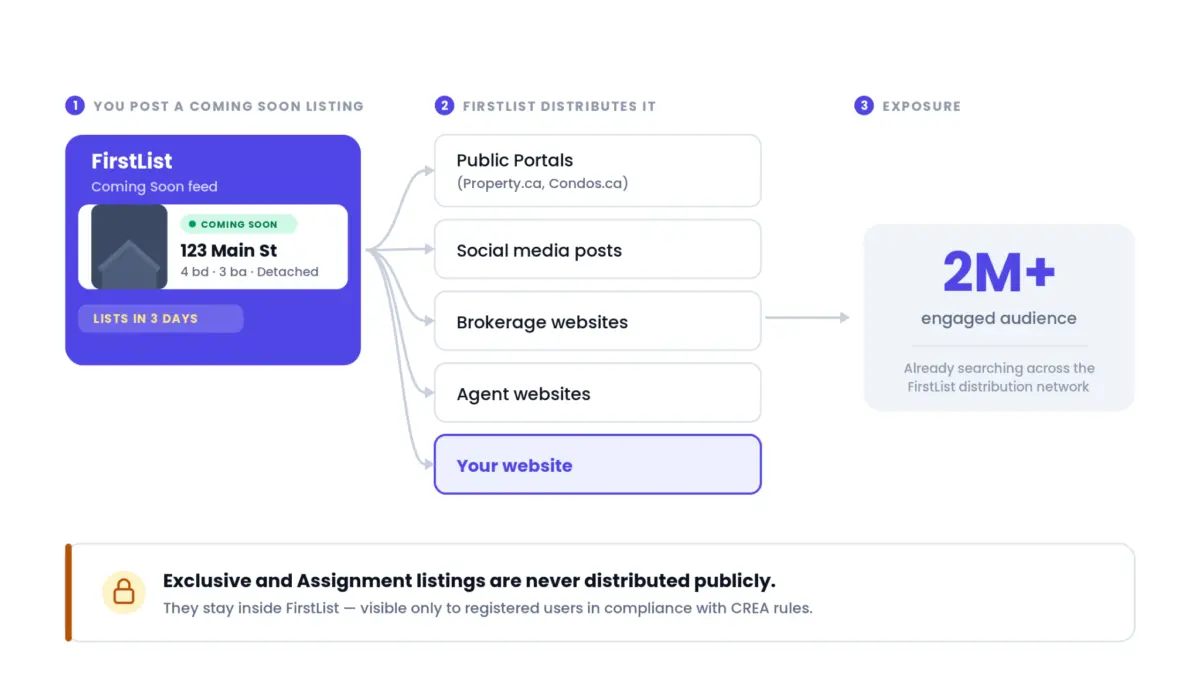
FirstList was acquired last November by myAbode, a real estate technology company that owns prominent consumer-facing brands such as Property.ca and Condos.ca. Following the acquisition, FirstList launched a dedicated "coming soon" distribution network. This infrastructure allows agents from any brokerage to advertise qualifying upcoming properties through participating websites, giving properties a chance to build early momentum and attract prospective buyer interest ahead of their official market launch.
Under the current setup, the service enables agents to publicly market coming soon listings for up to three days before their official MLS launch. This short window gives sellers a head start on generating exposure while remaining strictly aligned with contemporary industry regulations.
How the Network Works
The operational mechanics of the FirstList distribution network are designed to balance broad public exposure with lead generation for the listing agent. Agents and brokerages can seamlessly display the network’s upcoming listings by embedding a custom feed directly onto their own professional websites.
When prospective buyers land on these feeds, they can browse detailed neighbourhood information and general property specifications without being forced to create an account or register. However, platform rules dictate that users must register to view specific property addresses and exact asking prices. Once a user completes this registration step, their information becomes a potential sales lead for the individual agent whose website is hosting the feed.
Despite the wide distribution, accountability remains central to the platform’s design. Hooper emphasizes that the original listing brokerage always remains clearly identified wherever its properties appear across the network, ensuring proper attribution and brand recognition for the firms bringing the inventory to market.
From Office Conversations to a National Network
The inspiration for FirstList came directly from the daily frustrations Hooper encountered while working as an active real estate agent. In the normal course of business, agents frequently begin working with home sellers months before a property is physically ready to be listed publicly on the open market. Some homeowners require extended periods to complete necessary home repairs, undertake professional staging, or handle personal and family circumstances that complicate the timing of an imminent sale.
During that pre-listing window, agents often want to test the waters or share preliminary information about upcoming properties with trusted colleagues, without prematurely launching a full-scale public marketing campaign.
"Some were doing it by standing up at their office meeting talking about what they had coming down the pipe," Hooper recalls of the old ways of doing business. "Others were putting it in WhatsApp and Facebook groups."
Observing this disjointed ecosystem, Hooper noticed a stark contrast. Despite massive technological advances in how everyday consumers search for residential real estate online, there had been very little comparable progress in how real estate professionals communicated and shared upcoming opportunities with one another.
That realization led Hooper to partner with Andrew Paliga, a former Shopify product leader, to establish FirstList in 2023. The platform was engineered from the ground up to facilitate seamless collaboration among agents while granting brokerages strict control over who could access and view their sensitive pre-market inventory.
The company’s acquisition by myAbode in November provided a vital catalyst to expand that foundational model on a much larger scale. Hooper came to recognize that building the business was just as much about creating a cohesive two-sided marketplace as it was about writing software code—connecting active agents with incoming properties and finding innovative ways to distribute those listings more widely to the buying public.
The trend of pre-marketing has also captured significant attention south of the border. In the United States, major players like Compass—particularly through Chief Executive Officer Robert Reffkin—have heavily championed the use of private and exclusive listings. Hooper notes that the growing prominence of pre-marketing in the U.S. market helped shine a crucial spotlight on the latent demand for similar structured services within the Canadian residential real estate landscape.
With thousands of active agents already utilizing FirstList across Ontario, the company quickly recognized a prime opportunity to build upon its existing internal network. By extending the distribution of coming soon listings to public-facing property websites, FirstList aimed to bridge the gap between private agent collaboration and public consumer search.
Navigating Canada’s Listing Rules
This expansion comes at a time when Canadian real estate agents are operating under strict new guidelines, notably the Canadian Real Estate Association’s Realtor Co-operation Policy. Introduced in January 2024 and subsequently amended, the policy drew a sharp regulatory line between private exclusive listings and properties that are publicly marketed to consumers.
Under the policy rules, any property that is publicly marketed must be officially submitted to the local multiple listing service within a strict board-mandated deadline, which cannot exceed three days.
Hooper acknowledges that the introduction of the policy was a necessary response that successfully addressed legitimate industry concerns regarding how certain agents were handling coming soon inventory.
"There was a lot of inconsistency in the market with how coming soon and off-markets are being handled," Hooper says. He recalls instances in the past where certain properties were advertised as coming soon for weeks on end without ever officially appearing on the multiple listing service, sometimes leaving sellers unaware of or confused by the marketing strategies their representatives were deploying.
Nevertheless, Hooper believes those problematic practices represented a relatively small fraction of the broader real estate industry, while the vast majority of agents were simply searching for honest, compliant ways to better serve their clients’ unique timelines.
To ensure strict compliance, FirstList says it has embedded CREA’s regulatory requirements directly into the underlying code of its technology platform. The system is architected to allow agents to share sensitive listings privately within restricted circles, or alternatively, to distribute eligible coming soon properties publicly within the permitted window.
Crucially, the company clarifies that true exclusive listings and property assignments remain strictly confined within its restricted, private network and are never included in the public-facing distribution feeds.
"We took all of the rules in the policy and we built them into the sharing logic of our platform," Hooper says.
Building Beyond Ontario
FirstList soft-launched its ambitious distribution network in Ottawa on October 13 and is actively scaling its footprint into the competitive Greater Toronto Area.
According to the company, more than 10,000 agents are already utilizing the platform across the province. This growing user base includes professionals from several prominent, well-established brokerages, such as REVEL Realty and Harvey Kalles Real Estate.
The company operates on a straightforward subscription business model, charging individual agents a flat fee of $49 per month, while offering scaled discount plans tailored for larger brokerages based on their total agent count. Participating brokerages receive their own customized internal listing-sharing networks for private office collaboration, while individual agents maintain the flexibility to distribute eligible listings through the wider public network.
Looking ahead, Hooper states that the company has clear ambitions to expand nationally. He positions FirstList’s specialized technology as an infrastructure solution that individual brokerages would find difficult or cost-prohibitive to build on their own.
"We really felt like we’re in this unique position that most brokerages won’t be able to build what we’ve built in terms of the cross-brokerage sharing capabilities," Hooper says.