
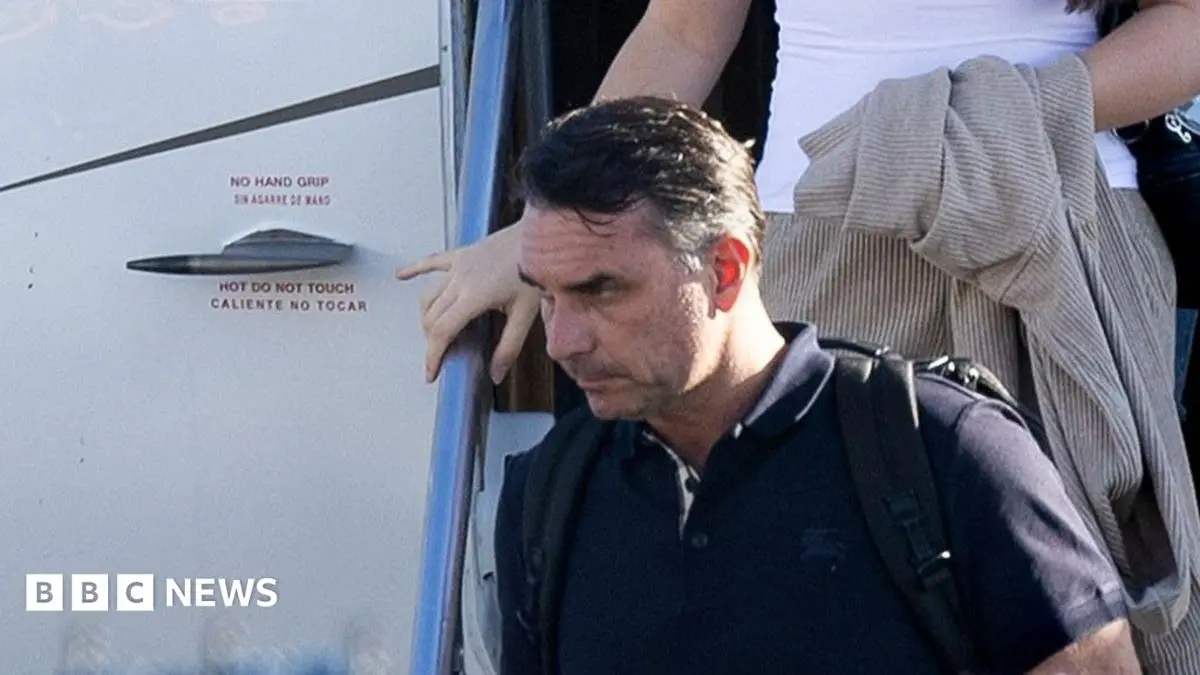
Brazilian Senator Flávio Bolsonaro has arrived in Miami following his loss in Sunday’s presidential election, breaking days of intense national speculation surrounding his location and triggering sharp political reactions in both Brasília and Washington. Speaking in his first public statement since leaving Brazil, the senator insisted that his sudden departure was not an act of flight, but rather a strategic decision taken in response to what he characterized as a hostile political environment.
In a formal statement distributed through the right-wing Brazilian influencer Paulo Figueiredo, the senator sought to defend his departure from the country, declaring that he never intended to abandon his homeland. "I did not flee Brazil; I left for the sake of Brazil," he stated, arguing that his relocation was necessary to ensure the safety of his family and to continue his political mission from abroad.
Flávio Bolsonaro framed his movement as a necessary retreat from what he described as an increasingly oppressive judicial and political framework back home. "It was never my intention to leave my homeland, but I know exactly where this is heading," he said in the statement. He went on to assert: "I departed from a regime of exception so that I could become the leader my people deserve."
Throughout his statement, the senator portrayed himself as the primary target of political persecution and a systemic power grab, calling himself a victim of a coup d’état. He also revived unsubstantiated allegations regarding the integrity of the vote that defeated him, claiming that widespread "electoral fraud" had taken place during the presidential contest. Flávio Bolsonaro alleged that these irregularities produced what he characterized as a "mathematical impossibility" in the final tally.
The senator expressed explicit gratitude to foreign allies who facilitated or supported his movement, singling out the leadership of both the United States and Argentina, as well as the American public. In his message, he thanked those "who share the same values as the good people of my own country."
Confirmation of Flávio Bolsonaro’s entry into the United States came directly from Washington. Speaking to reporters on Wednesday, US President Donald Trump publicly addressed the senator’s arrival, confirming that American authorities had facilitated his entry. "We gave him a pass to come into the country," Trump told reporters.
When questioned about the specific claims of election fraud contained within Flávio Bolsonaro’s letter, Trump declined to validate or examine the details of the allegations, opting instead to offer a broader commentary on the political situation. "I won’t get involved. It was a very strange election, that’s for sure," Trump said. The US president expressed sympathy for the Brazilian senator and his relatives, adding that he believed Bolsonaro "and his family were treated very unfairly."
The news of the senator’s departure drew immediate criticism from newly reelected President Luiz Inácio Lula da Silva. Delivering a blunt assessment of his opponent’s actions, Lula dismissed the claims of political persecution and questioned the motives behind the rapid exit. "Those who have nothing to hide have nothing to fear," Lula remarked, reflecting the view among government supporters that the senator’s movement was aimed at evading legal accountability.
The official election results marked a dramatic shift in momentum between the two voting rounds. Flávio Bolsonaro had initially secured a victory in the first round of the presidential election. However, President Lula mounted a successful comeback in the runoff, ultimately winning the second round by a margin of more than four million votes. Political analysts attributed Lula’s victory to significantly higher voter turnout in key areas and a strong performance among late-deciding, previously uncommitted voters.
The final results of the election carried institutional authority, having been officially confirmed and certified by the president of Brazil’s top electoral court. In a notable twist of political history, the electoral chief who validated Lula’s victory had originally been appointed to his judicial post by Flávio’s father, former president Jair Bolsonaro.
The arrival of Flávio Bolsonaro at Miami-Opa Locka Executive Airport brought an end to several days of profound uncertainty and conflicting reports across South America regarding his whereabouts. Rumors regarding the senator’s departure first began circulating following a report published by an Argentine news website, which alleged that he had secretly crossed the land border separating Brazil and Argentina before boarding a private aircraft destined for North America.
The initial reports prompted immediate action by Brazilian law enforcement agencies, who treated the possibility of an unauthorized departure with high urgency. Early on Tuesday, Brazilian police conducted targeted checks at key border posts along the national frontier. At that stage, officials found no physical or documentary evidence indicating that Flávio Bolsonaro had crossed any official border station, while authorities in Argentina similarly reported that they had no record of his entry into their territory.
For a brief period, observers speculated that the senator was merely maintaining an uncharacteristically low profile while coming to terms with his unexpected defeat against his left-wing rival in Sunday’s runoff vote. However, legal complications quickly escalated when Flávio Bolsonaro failed to comply with an official order to surrender his passports within a strict 24-hour deadline.
In response to his failure to hand over his travel documents within the mandated timeframe, Brazilian authorities formally canceled his passports and dispatched law enforcement personnel to heighten checks and monitoring at border checkpoints across the country. The sense of crisis deepened when Flávio Bolsonaro’s own legal team publicly admitted that they did not know where their client was, fueling widespread belief that he had successfully left the national territory.
Clarification regarding his escape route finally emerged late Tuesday when Argentine migration authorities posted an official message on social media. The post confirmed that Flávio Bolsonaro, accompanied by his wife and two daughters, had indeed entered Argentina by crossing the land border during the night hours, local time.
Subsequent flight tracking data, verified by the BBC, outlined the exact multi-leg itinerary used by the family to reach North America. The tracking records indicated that the Bolsonaros boarded a private jet at the airport in Puerto Iguazú, Argentina, taking off at 12:18 local time (03:18 GMT) on Wednesday. The aircraft flew north across South America, making a brief stop in Guayaquil, Ecuador, for refueling and operational checks.
Following the stopover in Ecuador, the private jet resumed its journey toward Florida, ultimately touching down at Miami-Opa Locka Executive Airport. The family was pictured disembarking from the aircraft just before 09:30 local time (13:30 GMT).
A crowd of photographers and news crews, who had gathered at the airport anticipating his arrival to resolve the days-long mystery, swarmed the senator as he emerged from the facility. Flávio Bolsonaro’s security detail and accompanying team attempted to block news cameras by surrounding him with open umbrellas as they maneuvered him toward a waiting vehicle.
Flávio Bolsonaro’s departure to the United States continues a distinct pattern established by key figures within his family during times of intense political and legal pressure in Brazil. His father, former president Jair Bolsonaro, notably departed Brazil for Florida in December 2022, just days before his presidency officially ended and before his successor, Lula, was inaugurated.
Jair Bolsonaro was still residing in the United States on January 8, 2023, when thousands of his supporters stormed Brazil’s key government institutions, including the Congress, the presidential palace, and the Supreme Court. The former president later referenced his presence in the United States as part of his legal defense during his subsequent trial for attempting a coup d’état. Despite his arguments, the trial ultimately resulted in Jair Bolsonaro’s conviction and a 27-year prison sentence.
Similarly, Flávio’s brother, Eduardo Bolsonaro, has been residing in Texas after taking a formal leave of absence from his seat in the Brazilian Congress. While stationed in the United States, Eduardo actively lobbied American politicians and officials in an attempt to build international pressure regarding his father’s legal proceedings in Brasília. Those lobbying efforts contributed to significant diplomatic tension, culminating in the United States applying punitive tariffs on Brazilian goods and imposing sanctions on key Brazilian government officials.
Eduardo Bolsonaro’s international actions eventually faced severe domestic consequences. Earlier this year, Brazil’s highest court tried and convicted Eduardo in absentia for his efforts to interfere with the judicial proceedings surrounding the coup trial.
It remains unclear what Flávio Bolsonaro’s ultimate plans are regarding his residence in the United States, or how long he intends to remain in Florida. His departure comes at a critical juncture regarding his legal standing in Brazil, where he faces mounting judicial challenges before the Supreme Federal Court.
The senator is currently the subject of two separate, active investigations pending before Brazil’s highest judicial tribunal. One inquiry centers on alleged financial irregularities involving the transfer of nearly $70 million (approximately £53 million) from the private financial institution Banco Master toward the production of Dark Horse, a biographical feature film about his father, Jair Bolsonaro.
The second Supreme Federal Court investigation focuses on broader allegations of money laundering. Flávio Bolsonaro has consistently denied all wrongdoing in connection with both matters, maintaining that the inquiries are politically motivated attempts to undermine his family’s movement.
His exposure to potential prosecution is tied closely to the calendar. Flávio Bolsonaro is scheduled to officially lose his parliamentary immunity on January 31, when his eight-year term in the Brazilian Senate comes to a formal end, stripping him of the constitutional protections that currently govern his legal proceedings.