
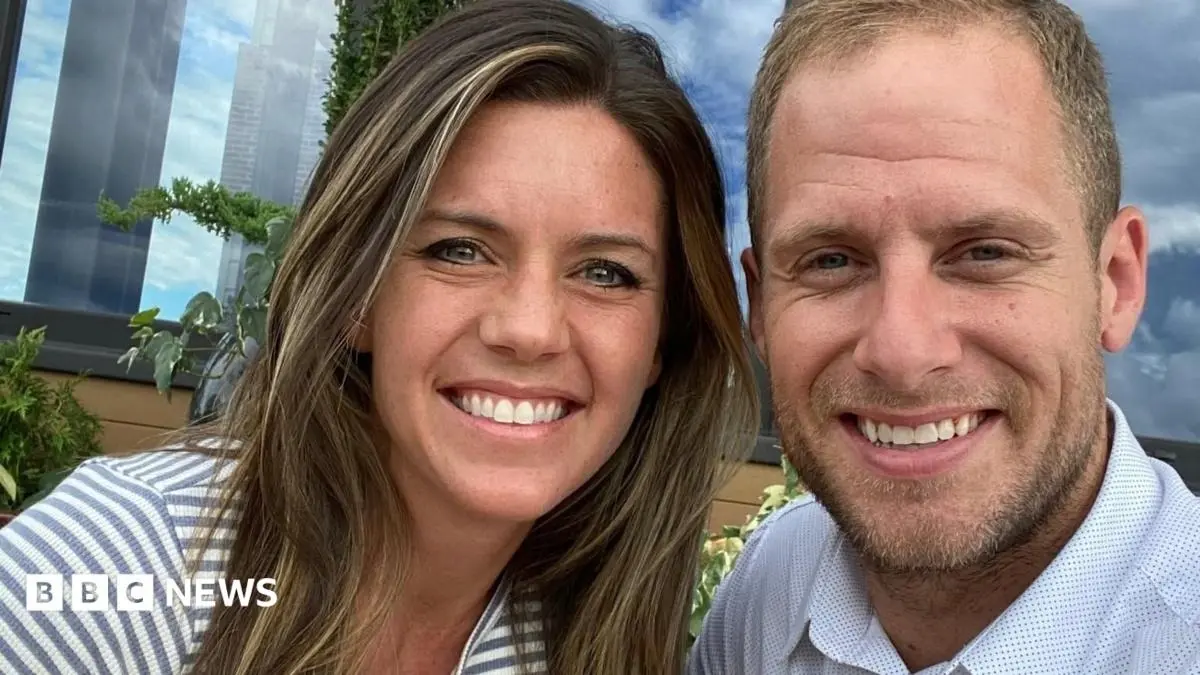
A former Ohio music pastor who once performed on national television as a contestant on the talent competition American Idol has been convicted of murdering his wife inside
their family home.
Caleb Flynn, 40, was found guilty of fatally shooting 37-year-old Ashley Flynn twice in the back of the head while she slept in their bed at their residence in Tipp City, a suburb located near Dayton, Ohio. The killing occurred in the early morning hours of February 16. Following the shooting, Flynn attempted to conceal his actions by staging a cover-up and claiming to law enforcement that an unknown intruder had broken into the house and executed his wife.
The verdict was returned after a jury deliberated for less than three hours, concluding an eight-day trial that featured extensive forensic testimony, thousands of private text messages, and a viral courtroom moment involving an artificial intelligence-generated song. As the guilty verdicts were read aloud in the courtroom, Flynn wept openly, sniffling and wiping tears from his eyes as he learned his fate.
In addition to the primary murder charge, Flynn was convicted on eight other counts brought against him by prosecutors, including aggravated murder and tampering with evidence. Following the comprehensive guilty verdict across all nine counts, Flynn now faces a mandatory sentence of life in prison without the possibility of parole.
The trial offered a detailed look into the final hours of Ashley Flynn’s life and the events leading up to her death on February 16. According to evidence presented in court, Ashley was shot twice at point-blank range in the back of the head while sleeping. When emergency responders and local police arrived at the family’s Tipp City home in response to a 911 call, Flynn provided officers with a narrative attempting to distance himself from the violence.
Prosecuting attorney Paul Watkins detailed during closing arguments how Flynn initially told responding officers that he was in his daughters’ bedroom when he heard the sound of gunfire echoed through the residence. Flynn claimed that after hearing the shots, he went to investigate, discovered his wife dead in their bedroom, and noticed that the side door to the garage was sitting open, suggesting an outside intruder had entered the premises.
However, investigators quickly uncovered fatal inconsistencies in Flynn’s claims. Prosecuting attorney Watkins pointed out to the jury that during subsequent interviews with law enforcement officers and forensic investigators, Flynn contradicted his original story by stating that he had not actually been to the garage area at all. This major discrepancy became a focal point for the prosecution, who used police body camera footage recorded at the scene to highlight the shifts in Flynn’s account.
Throughout the eight days of proceedings, prosecutors argued that Flynn acted out of a combination of deep-seated resentment toward his wife and intense fear over the life-altering consequences of a potential divorce. Watkins leaned heavily into the defendant’s personal life, framing the murder as a calculated move to escape his marriage without sacrificing his personal and financial stability.
The prosecution asserted that Flynn was deeply terrified of losing custody of his daughters in the event of a divorce. Furthermore, a marital breakdown threatened his livelihood, as Flynn was employed by his wife’s family business in addition to his position as a music pastor at his local church. Prosecutors argued that Flynn recognized a divorce would simultaneously cost him his family, his primary employment with Ashley’s family, and his standing and salary at the church, driving him to choose murder as an exit strategy.
Central to the state’s motive argument was evidence showing Flynn’s ongoing extramarital affair with 24-year-old Alleigha Botner. The two had met while Botner was working as an intern at the church where Flynn served as music pastor. Botner took the witness stand during the trial, testifying over the course of two days about their nearly 18-month romantic relationship.
During her testimony, the prosecution introduced a massive archive of digital communication between Flynn and Botner, revealing that the pair had exchanged roughly 100,000 text messages during their secret relationship. Several of these text messages were read aloud in open court to demonstrate Flynn’s extreme hostility toward his wife.
In one particularly damning message sent to Botner in August 2025, Flynn explicitly wrote about his desire to harm his wife, stating: "I was up until 4am last night crying, literally thinking of ways to kill her and not go to jail."
In another text message read to the jury, Flynn expressed his absolute disdain for his wife, bluntly stating: "I just want her dead and gone."
While testifying from the stand, Botner addressed her current feelings toward the defendant, telling the courtroom that she now harbors intense hatred for Flynn "because I believe that he murdered his wife."
The digital trail extended beyond text messages into creative media. During Botner’s time on the stand, prosecutors introduced an artificial intelligence-generated song that Flynn had written and dedicated to her. The court listened as Botner explained the lyrics of the AI-generated track line by line, while prosecutors argued the piece stood as further proof of his obsessive relationship with his mistress and his desire to build a new life away from his wife.
The moment the song was played in the courtroom attracted widespread attention after video footage showing the jury’s visible reactions—which included what appeared to be subtle laughter among panel members—was shared online and went viral.
In addition to the emotional and written evidence, prosecutors presented technical forensic data gathered by state investigators. Joseph Wilhelm, a special agent with the Ohio Bureau of Criminal Investigations (BCI), took the stand as an expert witness to detail the digital extraction performed on Flynn’s electronic devices.
Special Agent Wilhelm presented data captured from Flynn’s iPhone and Apple Watch around the estimated time of the murder, analyzing movement and device usage. Wilhelm testified that a thorough digital audit revealed that multiple mobile applications had been intentionally uninstalled from Flynn’s phone shortly before his wife’s death. Among the deleted software were the social media platform Instagram and the specific AI music-generating application used to create the song for Botner. Wilhelm noted under oath that the deleted music application directly "related to his relationship with Alleigha Botner."
The prosecution also linked Flynn to the missing murder weapon through physical evidence at the scene. Investigators testified that Flynn owned a handgun that he routinely stored inside the center console of his pickup truck. When law enforcement officers searched the vehicle on the morning of the crime, they found the truck’s center console sitting open, and the firearm was nowhere to be found. The gun has remained missing since the day of the murder, forming the basis for the tampering with evidence charge.
In contrast to the extensive parade of witnesses called by the state, Flynn’s defense team opted for a minimalist strategy. Defense attorney Patrick Mulligan called no witnesses to testify on Flynn’s behalf, choosing instead to rest the defense’s case purely on cross-examination and argument.
During closing arguments, Mulligan forcefully questioned the strength of the state’s circumstantial case, maintaining that prosecutors had failed to provide direct physical proof linking Flynn to the actual shooting. Mulligan argued that the state was attempting to turn unrelated marital indiscretions into a conviction for murder.
"Connecting a couple of meaningless dots doesn’t solve the case," Mulligan told the jury, insisting that the fundamental issue before the court was not whether Flynn was an unfaithful or flawed husband. He argued that evidence of an extramarital affair did not equate to proof of a violent murder.
Mulligan also attacked the prosecution’s charge regarding the missing weapon, pushing back against the idea that the open truck console proved Flynn had disposed of his own gun to hide evidence of a crime. "They can’t find the gun, therefore they blame it on him?" Mulligan questioned, arguing that the absence of the weapon left a major gap in the state’s burden of proof.
Despite the defense’s arguments, the jury swiftly rejected Flynn’s claims of innocence, taking under three hours to deliberate before returning unanimous guilty verdicts across all nine counts.
The conviction brings a tragic end to the life of Ashley Flynn, a 37-year-old mother who worked as a dedicated schoolteacher and volleyball coach in the local community, and whose family operated a local business.
For Caleb Flynn, the verdict marks a total downfall from his previous public life as a television performer and religious leader. More than a decade before the murder, Flynn gained brief national visibility in 2013 when he auditioned for the 12th season of American Idol. During his televised audition, he performed in front of a celebrity judging panel that included musicians Mariah Carey, Nicki Minaj, and Randy Jackson.
Flynn earned a "golden ticket" during his audition, granting him advancement to the show’s Hollywood week rounds, though he ultimately failed to reach the main live competition. In promotional video footage filmed for the television program, Flynn spoke about his passion for singing and credited his wife with encouraging his musical ambitions.
"Music is all I know, it’s what I live to do and I love to sing, so that’s why I auditioned," Flynn said in the broadcast clip from 2013, adding with a smile: "Maybe my wife kinda nudged me a little, too."
Following his brief stint on reality television, Flynn built his life around his involvement in local ministry, eventually taking on the role of music pastor at his church in Ohio—the same institution where he would later meet the intern with whom he carried out the affair that preceded his wife’s murder.
Following the reading of the jury’s verdict, Flynn was remanded into custody. He is scheduled to officially receive his sentence on October 5, where he faces a formal judgment of life in prison without the possibility of parole.