
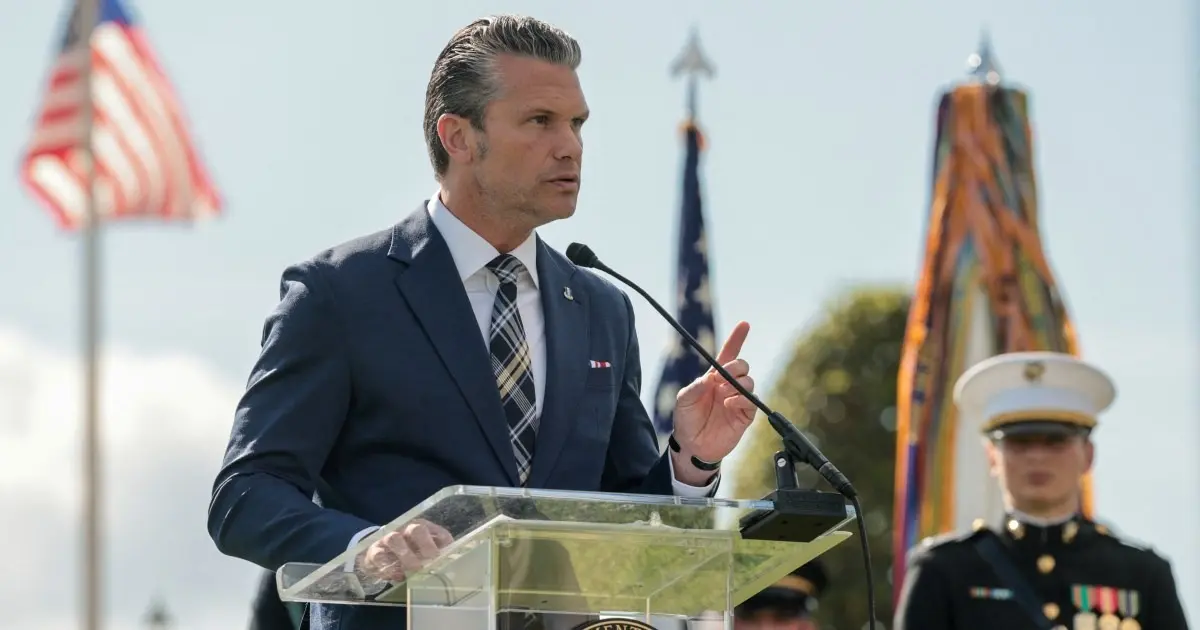
United States Secretary of Defense Pete Hegseth is preparing to order a dramatic reduction in the top ranks of the American armed forces, directing a 20 percent cut to positions reserved for generals and admirals across all military branches. The sweeping administrative policy change, confirmed by a Pentagon official speaking to Al Jazeera, will directly reshape senior command structures across the Army, Navy, Air Force, and Marine Corps. Hegseth is scheduled to formally unveil the directive during a visit to Marine Corps Base Quantico in Virginia, where he will deliver his "State of the Force" address before an audience composed primarily of junior officers and enlisted personnel.
The upcoming directive expands significantly upon earlier administrative efforts to trim top-level military leadership. According to details reported by The Associated Press, which cited Pentagon officials, Hegseth will instruct all military service branches to double a previously issued 10 percent reduction order that targeted the military’s baseline of roughly 800 flag and general officer positions. By expanding the mandate to a total 20 percent decrease across the enterprise, the Department of Defense has set a firm deadline for the military services to fully complete the organizational downsizing by January 1, 2027.
Reporting from Fox News confirmed that the reaching impact of the new reduction policy could affect any officer holding the rank of one-star general or above, as well as officers holding equivalent ranks within the Navy, such as rear admirals (lower half). The wide scope of the order ensures that both current high-ranking commanders and rising flag officers facing future promotion boards will feel the immediate structural effects of the administration’s capped officer quotas.
The downscaling of senior leadership positions is anticipated to create profound ripples throughout the military’s career progression pipelines and organizational hierarchy. Reporting from The Washington Post emphasized that the planned cuts could adversely affect the careers of hundreds of current and rising military leaders. This widespread structural impact follows a highly turbulent period marked by scores of high-level firings, denied promotions, and unexpected departures across the services, leaving senior officer corps across the Armed Forces facing an unprecedented level of instability and churn.
This 20 percent reduction represents the latest and most comprehensive structural phase of an ongoing effort by US President Donald Trump and Defense Secretary Hegseth to overhaul the Pentagon’s senior military command. Since taking office in January 2025, the administration has systematically removed or forced into retirement more than two dozen high-ranking military leaders. The frequency and high-profile nature of these dismissals have sent persistent shockwaves through the Department of Defense, signaling a decisive break from traditional military personnel management and historical standards of leadership continuity.
Among the most significant personnel actions taken during this period was the abrupt firing of the Army’s top uniformed officer, General Randy George, whom Hegseth removed from his post in April. The administration’s broad sweeping leadership dismissals have also notably impacted top female command officers within the Armed Forces. During the same period, the Pentagon removed the only two women serving as four-star officers in the United States military, alongside the dismissals of several other senior female officers holding prominent flag-rank assignments.
The leadership churn within the defense establishment has extended beyond uniformed military flag officers to include high-ranking civilian leaders inside the Pentagon. The Department of Defense has experienced major departures through retirements and resignations, including that of Army Secretary Dan Driscoll, who resigned his position after repeated and documented clashes with Hegseth over defense policies, administrative priorities, and command governance.
Defense Secretary Hegseth has publicly defended the force reduction, framing the elimination of general and admiral positions as an essential administrative reform required to streamline an overly complex defense bureaucracy. When the Defense Secretary initially introduced measures to trim the top ranks of the military services, he argued that the strategy was designed to eliminate redundant force structures in order to optimize command channels and streamline operational leadership across all branches.
Hegseth further codified this policy stance in an official memorandum released to the military enterprise in May 2025. In that document, the Defense Secretary detailed his core rationale, stating that his primary objective was to free the armed forces from "unnecessary bureaucratic layers" that he argued were hindering organizational efficiency, slowing decision-making, and adding unnecessary administrative weight to the defense department’s high-level command structures.
The planned downsizing of general and admiral positions aligns with a broader policy and cultural shift spearheaded by Hegseth since assuming leadership at the Pentagon. At approximately this time last year, the Defense Secretary formally declared an end to what he characterized as "woke" culture within the ranks of the armed services. Alongside that announcement, Hegseth instituted new operational directives for service members, which included the implementation of updated physical fitness standards framed around "gender-neutral" or "male-level" physical requirements across operational ranks.
The impending policy announcement has drawn swift criticism and concern from lawmakers on Capitol Hill. Senator Jack Reed of Rhode Island, the ranking Democrat on the Senate Armed Services Committee, issued a strong statement expressing deep concern over the Defense Secretary’s planned 20 percent cut. Reed emphasized that any effort to eliminate senior military leadership positions must be executed in close consultation with Congress, warning that the administration’s plan to unilaterally reduce flag officer posts "should alarm every American."
In his formal statement, Senator Reed pointed to persistent communication breakdowns between the Pentagon and legislative oversight committees regarding military personnel decisions. "Congress has been clear with the Secretary that he must consult this body and explain his reasoning for senior officer removals and promotion holds. To date, we have not received satisfactory answers," Reed stated, criticizing the administration’s lack of formal justification for its ongoing purge and structural standard changes.
Senator Reed also raised immediate operational concerns, warning that reducing experienced senior commanders could destabilize ongoing military commitments worldwide. "Our military is conducting major operations around the world, and the force is already under strain," Reed added, stressing that stripping senior leadership positions during a period of complex global security challenges places additional risk on an already heavily taxed armed force.
Despite legislative pushback, the executive branch retains specific structural mechanisms to enforce the reductions without needing immediate congressional approval or statutory amendments. While the maximum authorized number of general and flag officer positions is established by federal law, the executive branch can effectively enforce reduced staffing levels simply by withholding officer nominations. By choosing not to submit replacement nominees to the Senate for confirmation, the administration can allow positions to sit vacant, using attrition and unsubmitted promotion slates to achieve its targeted 20 percent reduction by the January 1, 2027 deadline.
As Defense Secretary Hegseth prepares to deliver his "State of the Force" address at Marine Corps Base Quantico, the planned 20 percent cut signals a fundamental restructuring of the leadership matrix governing the United States military. Combined with ongoing policy changes and high-level personnel changes, the directive marks a decisive transformation in how the Department of Defense manages its highest levels of military command.