
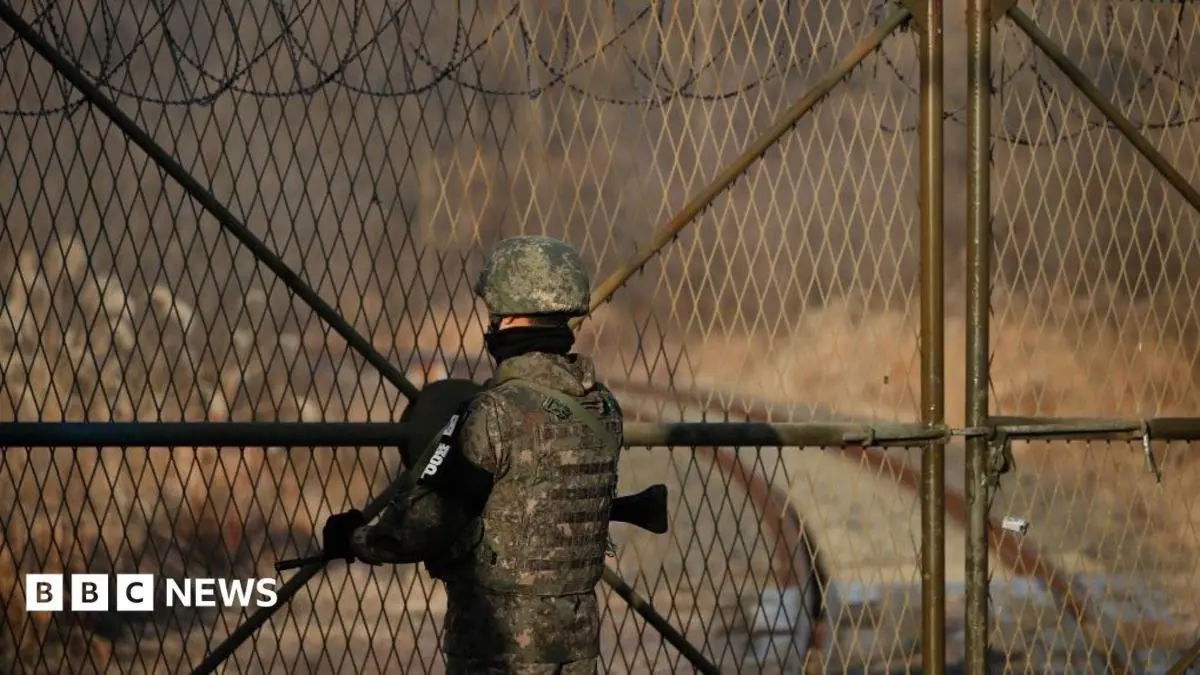
South Korea’s military has issued a firm demand for an official apology from North Korea following a series of landmine explosions along their shared border that left three South Korean personnel injured earlier this month. The incident, which occurred on September 21 within the Demilitarised Zone (DMZ) that separates the two nations, has reignited intense diplomatic and military friction across the Korean Peninsula. South Korean defense officials stated that the blasts took place on the South Korean side of the buffer zone and concluded that the landmines were "highly likely" planted by North Korean forces as part of ongoing efforts to reinforce border barriers. In response, Seoul vowed to take corresponding measures against Pyongyang, framing the event as a severe breach of the long-standing military agreement that has maintained a fragile truce between the two Koreas for decades.
North Korea was swift to reject the allegations, issuing a scathing denial through its state media apparatus and accusing South Korea of manufacturing the entire episode to destabilize the region. Pyongyang dismissed Seoul’s findings as completely "groundless" and described the South Korean military’s public assertions as a political and military "farce" deliberately constructed to heighten confrontational rhetoric across the division line.
The regime’s official response was spearheaded by Kim Yo Jong, the influential sister of North Korean leader Kim Jong Un and a prominent official in Pyongyang’s governing hierarchy. In a fiercely worded statement published by state media outlets on Wednesday, Kim accused South Korea of "cooking up" the claims regarding the landmine explosions in order to create a false pretext for "political and military provocation." She strongly rejected any assertion that North Korean troops had infiltrated across the border to lay mines, characterizing the allegations as a deliberate attempt by South Korea to manipulate public perception and blame North Korea for the rising heat along the border.
According to Kim Yo Jong, South Korea’s official stance constitutes "a deliberate and planned strained assertion to shift the responsibility for escalating tension" back onto Pyongyang. Directing a sharp warning toward military and political leaders in Seoul, Kim cautioned that South Korea must be "prepared for paying price for the farce of their own making." Her comments highlight Pyongyang’s total unwillingness to accept accountability for the incident, while signaling a readiness to respond aggressively if South Korea pursues retaliatory or punitive measures along the border line.
Despite Pyongyang’s vehement denials, South Korean military officials maintained that their investigative findings point directly to North Korean involvement. South Korea asserts that the landmines involved in the September 21 detonations were laid by North Korean troops as part of a wider, deliberate initiative by Pyongyang to fortify its border defenses and physically harden the frontier. In an official statement delivered on Wednesday, South Korean authorities formally called upon North Korea to apologize for the explosions and demanded an immediate and complete halt to all ongoing border fortification activities along the perimeter of the buffer zone.
The seriousness with which South Korea is treating the incident was further highlighted by South Korean Defence Minister Kang Shin-chul, who addressed the situation directly on Tuesday. Kang stated unequivocally that the landmine explosions on the South Korean side of the buffer zone represented a "clear" violation of the 1953 armistice agreement. The armistice, signed over seven decades ago, brought an end to active military combat in the Korean War and established the foundational framework that continues to govern military conduct and border interactions along the divided peninsula.
The 1953 armistice resulted in the creation of the Demilitarised Zone—a 4-kilometer-wide (2.5-mile) strip of land that spans the width of the Korean Peninsula and serves as a physical buffer between the opposing armed forces. Embedded within the center of the DMZ is the Military Demarcation Line, which marks the exact land border separating North and South Korea. Designed to reduce the risk of direct military confrontation and keep the two armies apart, the DMZ remains one of the most heavily fortified and closely monitored borders on Earth. Despite its designation as a demilitarized buffer zone, the area has been the setting for recurring military clashes, hostile encounters, and deadly landmine explosions in the decades since active hostilities were halted.
The current crisis bears a striking resemblance to a major border incident that occurred in 2015, which severely damaged inter-Korean relations at the time. In that event, two South Korean soldiers were maimed and permanently injured by hidden landmine explosions while conducting a routine security patrol inside the DMZ. Following an extensive military investigation, South Korea concluded that the landmines had been covertly planted by North Korean soldiers who had slipped across the demarcation line to position the explosives near a South Korean guard post. Pyongyang firmly denied responsibility for that incident as well, leading to a dangerous military standoff along the border.
Kim Yo Jong explicitly referenced the 2015 landmine crisis in her statement on Wednesday, attempting to draw a direct line between that past event and the present situation. She claimed that South Korea had previously used the 2015 incident as a "pretext" to justify escalating military readiness and hostile rhetoric against North Korea. According to Kim, South Korean authorities are now relying on the exact same strategy, using the September 21 landmine detonations to construct a false narrative aimed at scapegoating Pyongyang and inflaming tensions across the Korean Peninsula once again.
However, security analysts point out that the broader geopolitical environment surrounding the current incident is considerably more volatile than it was during the 2015 crisis. Relations between Seoul and Pyongyang have deteriorated steadily and drastically over the intervening years, stripping away critical diplomatic safeguards and heightening the risk that localized incidents could trigger wider military confrontation. The lack of constructive engagement has left the border region in a state of continuous high alert, where minor encounters carry disproportionate security risks.
Providing expert context on the rising risks along the border, Christopher Green, a senior consultant with Crisis Group, told the BBC that Pyongyang’s actions in the DMZ reflect a deliberate policy shift aimed at permanent separation. Green explained that "The North Koreans have been wilfully attempting to harden the border [and] eliminate inter-Korean relations." According to Green, North Korea’s efforts to physically fortify the border align directly with a broader, systemic drive to sever remaining ties with South Korea and reframe inter-Korean relations in purely hostile terms.
Green emphasized that a key factor distinguishing the current standoff from previous border crises is the complete breakdown of direct communication between the two capitals. He noted that the two Koreas no longer maintain the "same low-level communication" channels that were available to military and political officials during similar flare-ups in 2015. In past disputes, these lower-level communication links provided a vital safety valve, allowing both sides to manage tensions, clarify intentions, and prevent misunderstandings from spiraling out of control.
In the absence of those operational communication lines, Green warned that the buffer zone has become an increasingly precarious flashpoint where accidental conflict could easily erupt. "Accidental escalation on the Korean Peninsula is always just a few steps away, and it’s fewer steps now than it was in 2015," Green cautioned. His evaluation reflects widespread concern among international security experts that isolated events—such as landmine detonations or physical border enhancements—could rapidly provoke escalating military responses from either side without the benefit of formal de-escalation mechanisms.
In response to the incident, the United Nations Command (UNC)—the multinational military body tasked with overseeing the enforcement of the 1953 armistice—has taken direct action to investigate the circumstances surrounding the explosions. Working in close coordination with the South Korean military, the UNC conducted comprehensive on-site investigations at the location of the September 21 blasts inside the DMZ. Following its preliminary assessment, the UNC confirmed that it would address the reported armistice violation through formal, established Armistice mechanisms designed to process border disputes and mitigate conflict risks.
Reaffirming its commitment