
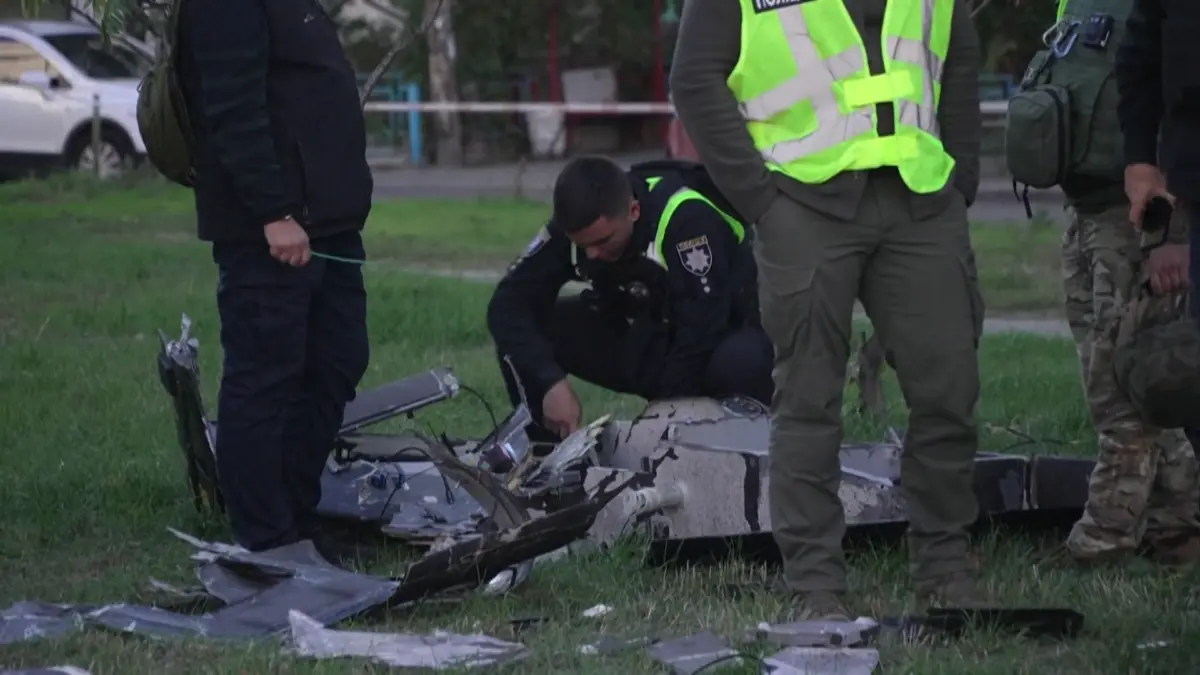
A residential courtyard in Kyiv became the site of a high-risk emergency clearance operation after a Russian attack drone crashed directly into a children’s playground in broad daylight without detonating its explosive payload. The incident, which unfolded in a densely populated neighborhood, caused immediate alarm among local residents before specialist bomb disposal teams arrived on the scene, successfully neutralizing the threat and removing the hazardous debris without injury or structural damage.
The sight of a military airframe resting amid colorful play equipment and shared residential grounds provided a stark visual reminder of the persistent dangers facing civilian areas across the Ukrainian capital. The drone descended into the enclosed courtyard during daylight hours, a time when outdoor spaces are typically used by local families, children, and elderly residents. Despite the velocity of the impact and the presence of an intact warhead, the device failed to detonate on contact, preventing what could have been a catastrophic explosion in the heart of a residential community.
Upon discovering the downed aircraft in the middle of the courtyard, local authorities were alerted immediately. Emergency services and specialized explosive ordnance disposal (EOD) units rushed to the scene to establish a secure safety perimeter around the perimeter of the playground. Police and civil defense officers cordoned off access to the courtyard, instructing nearby residents to remain indoors, stay away from windows, and clear the surrounding balconies while technicians assessed the condition of the unexploded aerial vehicle.
The containment and neutralization of downed attack drones in urban environments present complex challenges for bomb clearance specialists. Modern uncrewed aerial vehicles utilized in long-range strikes are typically equipped with heavy explosive warheads designed to detonate on impact through mechanical or electronic fusing systems. When such a weapon strikes the ground or a physical structure without exploding, it enters an extraordinarily volatile state. Internal triggering mechanisms, battery circuits, or damaged fuses can remain armed or become unstable, making any physical disturbance or attempt to move the airframe extremely dangerous.
Bomb disposal experts clad in protective gear meticulously examined the wreckage in the playground to determine the integrity of the explosive payload and its fusing apparatus. After systematically rendering the warhead safe and ensuring that secondary detonators or fuel reserves posed no immediate threat of ignition, the team carefully packed the remains of the drone into specialized containment equipment. The debris was then safely transported away from the residential district for detailed forensic examination and controlled destruction at a secure testing facility outside the capital.
The successful removal of the weapon brought profound relief to the residents of the surrounding apartment buildings, who had watched the delicate disposal operation unfold from behind safety lines. The knowledge that a live combat drone had landed directly in a space set aside for children’s recreation without exploding was viewed locally as a extraordinarily fortunate outcome. In an enclosed courtyard bounded by concrete multi-story residential blocks, the detonation of a full-scale drone warhead would have generated a devastating blast wave, shattering windows across multiple floors and showering the playground with flying glass, high-velocity shrapnel, and structural fragments.
The incident highlights the complex threat profile created by aerial warfare over major urban centers. Long-range attack drones deployed in the region are frequently targeted by multi-layered air defense systems, electronic warfare countermeasures, and mobile air-defense units operating in and around the capital. While these defensive measures successfully prevent many incoming munitions from reaching their intended targets, damaged drones, intercepted airframes, or weapons suffering from mechanical failure can still fall anywhere along their flight trajectory. When these descending airframes carry intact warheads into high-density residential areas, they transform quiet domestic neighborhoods into sudden hazard zones.
The timing of the crash added to the tension surrounding the event. While many long-range aerial strikes occur under the cover of night, daylight incidents significantly increase the likelihood of direct civilian exposure. Broad daylight operations mean that citizens are actively moving through public spaces, commuting, working, or spending time outdoors. The sudden appearance of an airborne threat over a residential neighborhood leaves little time for structural shelter, making the failure of the drone’s warhead to detonate all the more critical in preventing loss of life.
Municipal authorities and civil defense agencies in Kyiv have maintained rigorous public safety guidelines regarding the discovery of military debris and unexploded ordnance. Through public announcements, digital warning networks, and municipal bulletins, citizens are regularly reminded of the protocols to follow when encountering suspected drone fragments or fallen missiles. The primary rule emphasized by emergency services is total non-approach. Civilians are strictly instructed never to touch, move, or examine fallen airframes, as unexploded warheads, residual aviation fuel, and active electronics can detonate unexpectedly even hours after an impact.
The role of Ukraine’s State Emergency Service (SESU) and specialized police explosive units has expanded significantly as a result of frequent aerial activity over urban centers. These specialized teams remain on perpetual stand-by across the capital, equipped with specialized vehicles, remote handling gear, and armored containment transport designed to safely handle unexploded munitions in delicate civilian settings. Their ability to rapidly deploy, secure a site, and neutralize explosive threats in high-density housing areas has become a crucial element of the city’s overall civil resilience framework.
Beyond the physical danger, the landing of a combat drone in a children’s playground underscores the ongoing psychological burden borne by residents of urban centers during wartime. Courtyards and playgrounds serve as essential communal spaces within modern city life, offering places for recreation, rest, and neighborhood interaction. The intrusion of war materiel into these everyday domestic environments disrupts the routine of daily life and reinforces the pervasive sense of vulnerability shared by city dwellers, even in areas located far from active ground combat.
Despite the emotional impact of the event, the calm and methodical response of both the local residents and the emergency personnel prevented panic on the ground. Neighbors alerted one another to stay clear of the courtyard, complied fully with police cordons, and allowed emergency crews to carry out their delicate work without interruption. This level of public awareness and discipline has proved essential in minimizing casualties during similar urban clearance operations throughout the city.
Following the safe clearance of the playground and the removal of all structural fragments, emergency teams conducted a thorough sweep of the immediate ground and surrounding greenery to confirm that no secondary hazards or unexploded components remained hidden in the area. Once the site was declared entirely safe by explosive ordnance personnel, the security cordons were lifted, allowing residents to return to their normal routines and restoring access to the courtyard.
The incident ended without injury, leaving the neighborhood intact and relieved, while reinforcing the necessity of constant vigilance and rapid civil defense capabilities in safeguarding urban communities against unexploded aerial threats.