
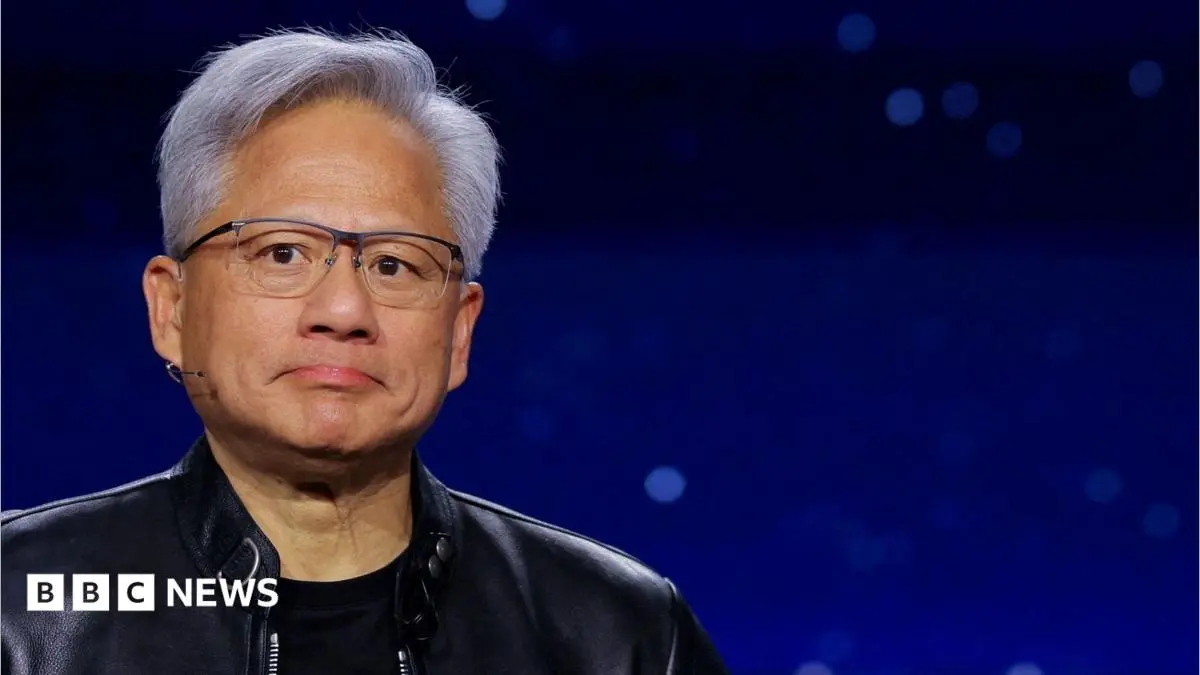
Former Nvidia Chief Executive Officer Jensen Huang has been summoned to testify before a United States Senate committee next month following his abrupt resignation from the technology giant amid allegations surrounding an extramarital affair with a woman suspected of being an operative for Chinese intelligence. The dramatic fallout from the scandal has sent shockwaves across Silicon Valley, wiped hundreds of billions of dollars off the company’s market capitalization, and triggered intense scrutiny from congressional leaders and national security officials in Washington.
Huang’s sudden resignation on Thursday brought a startling end to his decades-long tenure leading one of the world’s most valuable and influential semiconductor companies. The leadership crisis deepened following revelations of alleged extramarital relationships, including one involving a high-level Nvidia executive. As details of the personal and national security allegations spread, Nvidia suffered an unprecedented financial blow, losing approximately $550 billion (£415 billion) in stock market value over just five trading days.
The fallout has quickly escalated into a major political and national security matter on Capitol Hill. Senator Tim Scott, a South Carolina Republican who serves on the Senate Banking Committee, dispatched official letters on Thursday to both Huang and United States Commerce Secretary Howard Lutnick, requesting that both key figures appear before the panel in December. The committee’s inquiry centers on whether sensitive American technology or national security assets were exposed during Huang’s interactions with the individual suspected of links to foreign intelligence.
Addressing the situation publicly on the social media platform X, Senator Scott emphasized the gravity of the allegations facing the former tech chief and federal regulators. "Recent reports raise serious concerns about our national security and the protection of sensitive US technology," Scott wrote, adding that "the American people deserve answers."
Scott formally requested that Huang appear voluntarily before the Senate Banking Committee on December 3 to answer questions regarding the matter. However, the senator issued a stern warning alongside the invitation, noting that the committee is prepared to issue a formal subpoena to compel Huang’s testimony if he does not agree to appear willingly.
At the same time, pressure on Huang is mounting from the House of Representatives. A trio of key House panels—the Permanent Select Committee on Intelligence, the Committee on Foreign Affairs, and the Select Committee on the Strategic Competition Between the United States and the Chinese Communist Party—jointly issued a letter to the former chief executive. The three committees have summoned Huang to participate in a private, closed-door interview scheduled for December 1 as lawmakers seek to assess the full scope of any potential security vulnerabilities.
The congressional inquiry also directly implicates Commerce Secretary Howard Lutnick, whose executive department is charged with administering foreign trade regulations and restricting the export of sensitive technology to foreign adversaries. Lutnick has faced intense government scrutiny regarding the oversight and export controls applied to Nvidia’s highly advanced artificial intelligence microchips sent to China. He has been summoned to appear before the Senate Banking Committee in December as lawmakers investigate whether regulatory enforcement failed to prevent risks associated with critical semiconductor technologies.
Prior to his sudden departure on Thursday, Huang was widely expected by corporate observers to maintain his position despite the initial public disclosure of an extramarital affair. Even after Nvidia announced that its board had launched an internal investigation to determine whether the chief executive had been "the target of a foreign intelligence effort," industry insiders believed he might weather the public storm.
Within Nvidia’s internal ranks, employee reactions shifted dramatically as the scope of the scandal expanded. A current staff member told the BBC that rank-and-file workers initially brushed off early media reports regarding Huang’s personal infidelity, treating the matter as a private personal issue. However, the internal dynamic altered completely when separate revelations emerged detailing an alleged affair between Huang and a fellow Nvidia executive. The employee noted that it was only after the internal executive affair became public that workers across the company began to express widespread shock, remarking that staff started to feel "this is crazy."
In the wake of the growing public and internal crisis, Nvidia management imposed strict communication protocols across its global workforce. Another employee confirmed to the BBC that staff members were explicitly instructed by management not to speak with members of the news media or offer any public commentary regarding the ongoing situation.
The workplace shock comes at a time when many Nvidia employees have accumulated immense personal wealth. Thanks to lucrative equity-based compensation structures, countless staff members earned millions of dollars by cashing out company shares as Nvidia’s stock price surged exponentially in recent years.
Addressing the potential exposure of proprietary designs, Nvidia publicly maintained that it has "no reason to believe that either national security or Nvidia secrets were compromised" during the events in question. Nevertheless, the company pledged that its ongoing independent inquiry would comprehensively evaluate all available information to ensure complete integrity.
The market consequences of the scandal have been severe. Nvidia’s $550 billion loss in market capitalization over five days marks the most significant five-day stock price drop in the company’s 27-year history as a publicly traded firm.
This dramatic fall stands in stark contrast to Nvidia’s remarkable trajectory over the past five years, during which its market value soared by more than 470%. The stock had reached an all-time peak just weeks before the scandal broke, but it has since tumbled by 31% amid the high-level executive turmoil and broader economic uncertainty across the technology sector.
The abrupt conclusion to Huang’s leadership marks a dramatic turn for a figure who was central to the rise of modern artificial intelligence. As co-founder and chief spokesperson for Nvidia, Huang positioned the enterprise at the absolute center of the global AI boom, convincing the broader tech industry to rely heavily on Nvidia’s specialized hardware.
Nvidia originally built its business around designing high-performance graphics processing units for computer gaming. However, over the past four years, as artificial intelligence evolved rapidly from experimental projects into advanced chatbots and large language models, tech companies worldwide suddenly required immense volumes of specialized silicon chips capable of executing complex data processing tasks. Nvidia’s advanced hardware became the gold standard for training and deploying these massive AI models, catapulting the company into the upper echelons of the global corporate market.
In the wake of Huang’s departure, Nvidia’s board of directors has begun searching for a permanent replacement to fill the chief executive position. Chief Financial Officer Colette Kress was officially appointed as interim CEO on Thursday, taking immediate control of company operations as the firm seeks to reassure investors and stabilize its corporate standing.
Beyond the corporate and national security dimensions, the scandal has carried deep personal consequences for Huang, who has been married to his wife, Lori Huang, for 40 years. The situation is further complicated by the fact that both of the couple’s adult children serve as executives within Nvidia.
Across the San Francisco Bay Area—a region densely populated by tech workers, corporate executives, and industry leaders—Huang’s fall from grace has become a dominant point of discussion. Multiple tech insiders confirmed to the BBC that the shocking turn of events surrounding one of Silicon Valley’s most recognizable leaders has completely captivated the local business community.
As the dates for congressional appearances draw closer, public and government attention remains fixed on whether Huang will comply voluntarily with the request to appear before the Senate Banking Committee on December 3 or force lawmakers to issue a subpoena. Combined with the closed-door House interviews scheduled for December 1, the coming month will prove critical in determining the full extent of the national security, political, and corporate fallout from the scandal.