
NCAA hockey is rapidly evolving into a younger man’s game. Even the traditional powerhouse programs that have long relied on the maturity, physical development, and poise of 23- and 24-year-old veterans are now accelerating their timelines, placing immense pressure and responsibility squarely on the shoulders of incoming rookies. Across the collegiate landscape, these high-end newcomers are no longer viewed merely as developmental projects; they are expected to step onto the ice immediately and dictate the fortunes of their respective programs.
This shifting paradigm has been amplified exponentially since the NCAA granted former Canadian Hockey League (CHL) players eligibility to compete in college hockey. The adjustment has fundamentally altered the top tier of the North American development pyramid, shifting the spotlight onto elite freshmen who arrive on campus with high-level professional aspirations already firmly in sight.
The immediate impact of this talent influx was vividly illustrated at the NHL Draft, where 19 of the 32 players selected in the first round were either active college players or had already made firm commitments to play collegiate hockey at a later date. Many of those elite prospects are already settled into their campus dormitories, hitting the gym, and preparing to make their official debuts when the college hockey regular season drops the puck on the first weekend of October.
With expectations soaring across the country, the pressing question for scouts, coaches, and fans alike is which freshmen are most capable of carving out monumental roles for their teams and asserting themselves on the national stage right from the opening weekend. A select group of standout rookies stands ready to answer that call and potentially define the entire collegiate season.
Landon DuPont, Defenseman, Michigan
As the presumptive No. 1 overall pick in the 2027 NHL Draft, defenseman Landon DuPont arrives in Ann Arbor amid an extraordinary wave of hype and anticipation. DuPont makes the jump to the collegiate ranks after putting together a dazzling campaign with the Everett Silvertips of the Western Hockey League, where, as a 16-year-old blueliner, he racked up an astonishing 18 goals and 73 points in 63 games.
While the general consensus within hockey circles is that DuPont possesses generational superstar talent, history reminds observers that not every 17-year-old phenom hits the collegiate ground running without encountering growing pains. Last season, North Dakota’s Keaton Verhoeff carried immense No. 1 pick buzz into his freshman year before ultimately being selected ninth overall, a reminder that it is exceptionally difficult to play the demanding position of a top-tier defenseman in the fiercely competitive environment of college hockey. Similarly, Gavin McKenna went first overall in his respective draft tracking but did not enjoy the exact same historic level of dominance displayed by Macklin Celebrini during his legendary freshman stint in college hockey.
Fortunately for the Michigan Wolverines, the program returns nearly all of its core contributors from last season. This organizational depth means the team is positioned to succeed regardless of where DuPont slots on the developmental spectrum. Whether he emulates the very strong freshman-year production of a Cale Makar or mirrors Makar’s transcendent sophomore campaign—widely regarded as the single greatest season by a defenseman in college hockey history—Michigan will be formidable. If DuPont leans closer to the latter trajectory, the Wolverines might boast enough high-end talent to drop only two or three games all year, at most.
Daxon Rudolph, Defenseman, Denver
Over the past several seasons, the University of Denver has consistently boasted one or two of the absolute finest defensive corps in the nation, churning out elite NHL prospects like Eric Pohlkamp, Zeev Buium, Sean Behrens, and Mike Benning. This season, the defending national champions are reloading with an extraordinary influx of youth on the blueliner front, welcoming four rookie defensemen who heard their names called early in the NHL Draft.

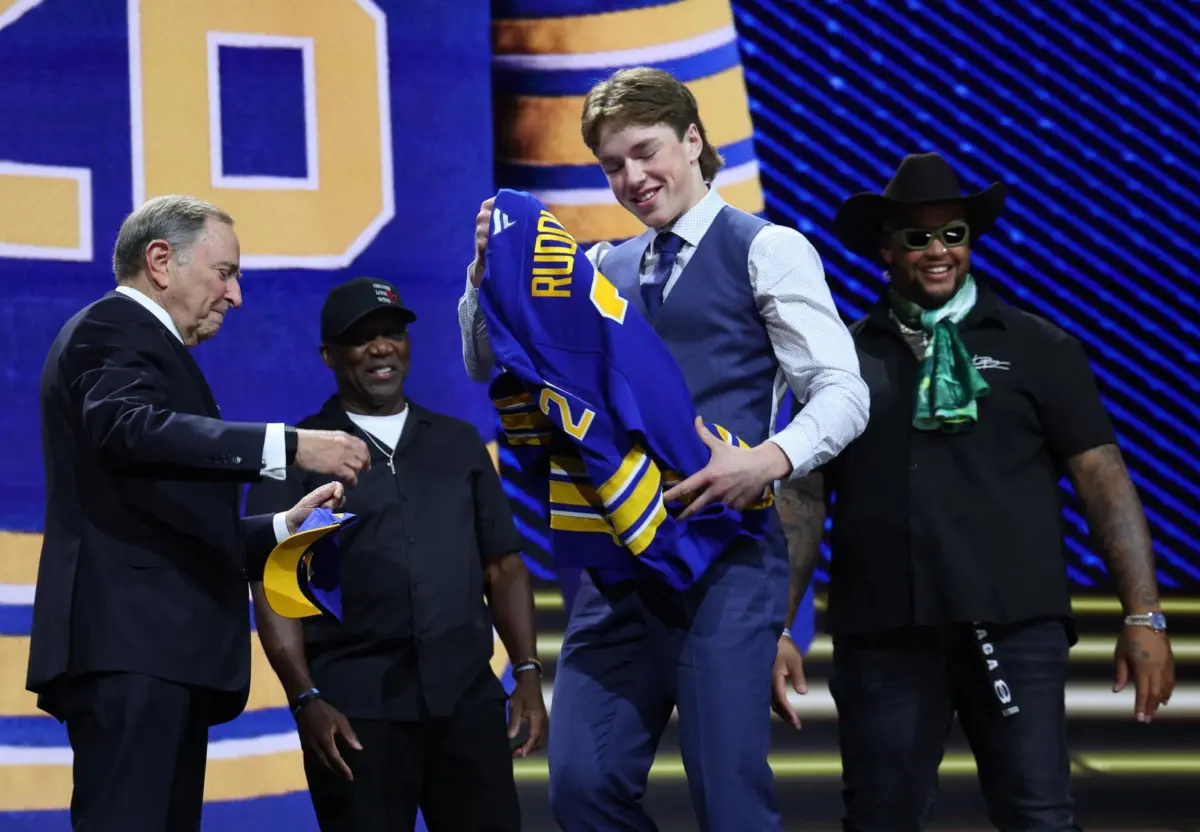
The group features 2026 first-round selections Daxon Rudolph, who went fourth overall to the Buffalo Sabres, and Ryan Lin, selected 21st overall by the San Jose Sharks. They are joined by high-end second-round picks Blake Fiddler, drafted 36th overall by the Seattle Kraken, and Ben MacBeath, who went 64th overall to the New York Rangers. While Rudolph’s inclusion here is a natural nod to his status as a fourth-overall selection, any of his fellow incoming rookie defensemen could realistically command this spotlight.
Remarkably, this quartet is stepping into the dressing room of a reigning national champion that experienced far less roster turnover than typical powerhouse programs. The Pioneers return over a dozen players from their championship run, including reliable goaltender Johnny Hicks, who seized the starting job midway through last season and rattled off a stellar 16-0-1 record down the stretch. Denver’s proven player-development system consistently puts its athletes in a position to succeed, ensuring that while DuPont will command a lion’s share of the media headlines among freshman rearguards, there is an equally strong probability that one of Denver’s rookie blueliners ultimately enjoys the most successful debut campaign in the country.
Caleb Malhotra, Center, Boston University
The Boston University Terriers endured a surprisingly difficult campaign last season, stumbling through a year defined by several distinct challenges. Among the most glaring issues was a notable lack of depth down the middle at the center position. However, with the arrival of high-profile center Caleb Malhotra and fellow top first-round talent Tynan Lawrence—who joined the Terriers midway through the previous campaign and is now poised for an expanded role—that structural weakness should be thoroughly addressed.
Boston University simply did not possess a forward of Malhotra’s specific profile last year, a deficiency that became painfully apparent during the late stages of tightly contested games. Tasked with heavy minutes and difficult matchups in the rugged Hockey East conference, Malhotra will have a massive plate of responsibilities as a freshman. Yet, if he can translate his dynamic play from the back half of his WHL career directly into the NCAA, he promises to become a persistent headache for opposing coaches and defensive pairings.
Joshua Ravensbergen, Goaltender, Michigan State
The Michigan State Spartans enter the new season boasting a staggering influx of elite talent, headlined by four players selected in the first round of the NHL Draft alongside three other drafted prospects. This wave of incoming star power includes defensemen Chase Reid, drafted seventh overall by Seattle, and Tommy Bleyl, taken 31st overall by the Nashville Predators, as well as towering winger Ethan Belchetz, selected 15th overall by the Utah Mammoth, and center Jack Hextall, who went 30th overall to the Calgary Flames.
These blue-chip talents are complemented by a pair of 2025 first-round picks in goaltender Joshua Ravensbergen, selected 30th overall by San Jose, and center Mason West, drafted 29th overall by the Chicago Blackhawks, forming the backbone of a robust nine-man freshman class. Strikingly, only two members of this incoming class are undrafted, and every drafted player except one was selected in the first round.
First-year goaltenders are traditionally a volatile commodity in college hockey. For every standout freshman who delivers an elite campaign akin to Jack Ivankovic or Johnny Hicks, there are numerous others who experience middling or difficult developmental curves. While the Spartans benefited immensely from recent stability in the crease, Ravensbergen now faces a tremendous platform to prove his high-end pedigree.
The silver lining for Michigan State is that the roster features multiple skilled forwards capable of stepping forward to help replace the offensive production lost by the departure of major scorers like Porter Martone and Charlie Stramel. While a hockey team can rotate and replace skaters across various lines, the crease belongs to only one goaltender on any given night. The historical pedigree and elite talent are undeniably present in East Lansing, and even if this massive freshman class delivers only a fraction of the production provided by last year’s departed veterans, the Spartans’ established system should keep them firmly in the national conversation.