
There has never been any genuine question that the NFC South is the weirdest division in professional football. It has long operated as the sport’s ultimate theater of chaos, occupied historically by four franchises that often seemed more intent on tripping over their own feet than executing a clean game plan against their rivals. It is a unique ecosystem of gridiron unpredictability—a place where the historic 28-3 Super Bowl collapse by the Atlanta Falcons can occur, where Cam Newton famously hesitates to dive on a loose fumble in the biggest game of his life, and where division crowns have routinely been handed out to teams hovering stubbornly around the .500 mark for four consecutive, agonizing years.
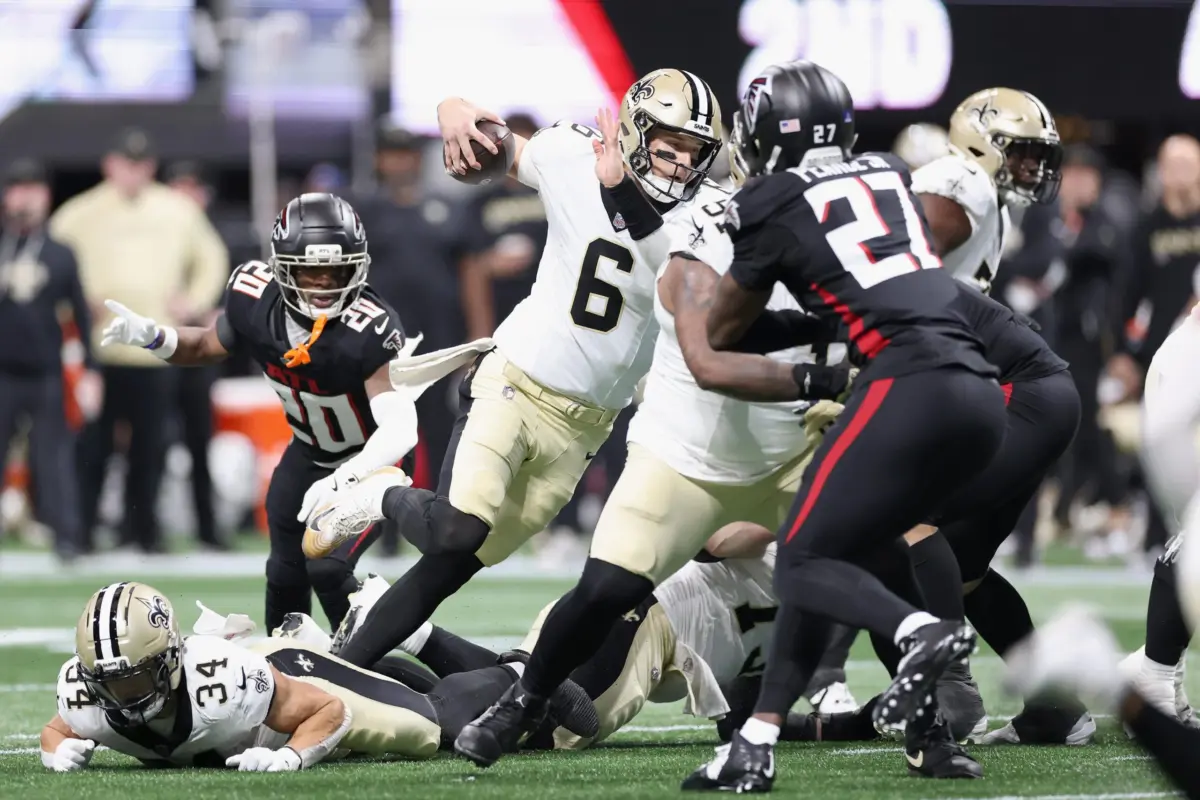
For the better part of the 2020s, the NFC South has simply been funny. The division has been bad, but more than that, it has been funny and bad at the exact same time. It became a weekly punchline for national analysts and fans alike, a loop of mediocrity that defied standard football logic. Now, however, it increasingly feels like that long-standing tide may finally be turning. The upcoming Monday Night Football matchup between the Falcons and the New Orleans Saints arrives as an oddly compelling clash, landing precisely at a moment when the NFC South is quietly producing some truly interesting, high-stakes football.
What makes this emerging new era of the division so genuinely fascinating is the resurgence of individual excellence across the board. For a long, grueling stretch, the NFC South was thoroughly marred by the unfortunate timing of all four franchises attempting to rebuild at more or less the exact same time. The Falcons were desperately trying to find their way forward in the murky post-Matt Ryan era, the Carolina Panthers were wandering the wilderness in search of an identity after the Cam Newton chapter closed, the Saints were grappling with life after the legendary Drew Brees retired, and the Tampa Bay Buccaneers were attempting to sustain momentum after their short, immensely successful championship window with Tom Brady slammed shut.
Those four iconic signal-callers defined the entire identity of the division for a generation, and the moment they departed, everything else fell remarkably flat. Three of the four teams failed entirely to find stable, long-term answers at the most important position in sports. The Buccaneers opted to stabilize the ship by bringing in Baker Mayfield, but on the whole, the broader division remained thoroughly ho-hum, characterized by sluggish offenses, conservative coaching philosophies, and a rotating cast of quarterbacks who struggled to move the needle.
Fast-forward to the current 2026 landscape, and everything suddenly feels profoundly different. The foundational pieces have shifted, and the talent pipeline has begun to flow once again. Bryce Young, after enduring a tumultuous and heavily scrutinized introduction to the professional ranks, has officially turned a massive corner. He is currently playing at an elite level, firmly cementing himself as a top-five quarterback in the National Football League. Meanwhile, Tyler Shough has emerged as a deeply fascinating player to watch under center as he continues his steady professional development, injecting a new wave of excitement into the NFC South quarterback room.
While the Atlanta Falcons might still find themselves momentarily trapped in what fans lovingly call quarterback hell, they possess elite talent elsewhere that alters the geometry of every game they play. They boast the undisputed best running back in the entire NFL in Bijan Robinson, whose dynamic elusiveness and vision create nightmares for opposing defensive coordinators. Alongside him, wide receiver Drake London is forcefully staking his claim as a core member of the league’s next generation of elite playmakers.
The Tampa Bay Buccaneers are temporarily standing outside of this immediate conversation, largely because the team is currently navigating a bit of an on-field mess. Yet, paradoxically, they are also positioned as the franchise best equipped to turn a corner at a moment’s notice, string together a dominant winning streak, and force themselves right back into the thick of the division picture before anyone realizes what is happening.
While the impending Monday night showdown between the Falcons and the Saints may lack broader national playoff ramifications at this exact micro-moment, it will have a profound, lasting effect on the divisional landscape. As the standings currently sit, the Panthers are holding a narrow lead at 2-2, while both Atlanta and New Orleans sit just behind them at 1-2. A victory under the bright lights of prime time will lock another team right atop the division standings, shifting the momentum of the entire autumn.
Furthermore, this remains the single best, most fiercely contested rivalry game in the division. Falcons and Saints fans possess a deep, generational hatred for one another, but unlike many of the past several years, there is now genuine pride and substance attached to the rivalry as well. Rather than simply fighting for local bragging rights and a temporary morale boost, the division’s actual future is now hanging in the balance. In a tighter, more competent race, there is suddenly very little room for error when dropping any head-to-head divisional matchup.
The remaining question for analysts, fans, and front offices alike is what the future ultimately holds for the NFC South. Can this unexpected surge genuinely serve as the starting point for the long-term competitive stability that the league has been desperate to see in America’s most chaotic corner? Much of that answer hinges directly on whether Young and Shough can sustain their impressive upward trajectories. At the same time, the Falcons must eventually identify and secure their definitive franchise answer at quarterback, and the Buccaneers must resolve once and for all whether Baker Mayfield is truly the long-term solution under center.
Either way, the NFC South has successfully shaken off its reputation as a weekly comedy of errors. It is compelling once again in a way that it simply hasn’t been in several years, proving that even the most chaotic divisions in professional sports can eventually find their footing when elite individual talent begins to rise.